Archive for the ‘Articles’ Category

Russell Brand Does Stand-Up for Transcendental Meditation

November 29, 2011

Medical Unit

By Susan Donaldson James

Nov 29, 2011 2:39pm

Russell Brand Does Stand-Up for Transcendental Meditation

Comic actor Russell Brand credits his sobriety with practicing Transcendental Meditation.

Russell Brand, who credits Transcendental Meditation for helping him stay off addictions to alcohol, drugs and sex, will do a stand-up comedy show tonight at the Palace of the Fine Arts in San Francisco to benefit the David Lynch Foundation.

Brand has said publicly that meditation had helped him find a “deeper state of happiness.”  Other celebrities — including Oprah and Ellen DeGeneres — are devotees of TM.

“What it felt like to me was the dissolution of the idea of myself,” he said at a press conference last year. “Like, I felt separateness evaporated, this tremendous sense of oneness. I’m quite a neurotic thinker, quite an adrenalized person. But after meditation, I felt this beautiful serenity and selfless connection. My tendency towards selfishness, I felt that exposed as a superficial and pointless perspective to have.”

Brand, who is best known for his films, “Get Him to the Greek” and “Arthur” –  and for being the husband of pop start Katy Perry – gave up alcohol nearly a decade ago. He has said,  ”I was really, really committed to that drug addiction.”

The David Lynch Foundation, the brainchild of the filmmaker of the same name, has been committed to helping those who suffer from trauma since 2005. The often dark and abstract director credits his creativity with 37 years of meditation.

Their meditation programs have helped those in the military, who are at higher risk for post-traumatic stress and in schools where students grow up in a climate of fear with bullying, violence and substance abuse. They also work with other at-risk populations like Native Americans and the homeless.

The Lynch foundation now teaches 150,000 students for free in 350 schools around the world; 15 of them are in the United States.

Click here for video of David Lynch discussing His First Meditation.

“It’s not a religion,” Lynch told ABC last year. “It’s not against any religion, it’s not mumbo-jumbo. It truly does transform life. Kids come to school and they meditate together for 15 minutes in the morning. And before they go home they meditate for 15 minutes. A lot of them come from, you know, bad situations, and so this gives them this thing you know, at the beginning and the end of the day, the rest of the time you just watch the violence stop. Watch relationships improve. Watch happiness in the hallways, in the classroom, watch creativity flow more and more, watch that heavy weight that we are living under gently lift away.”

Brand learned TM at the foundation headquarters in Fairfield, Iowa, during a time when he was making a  documentary on happiness with directors Oliver Stone and Albert Maysles.

David Lynch Foundation Executive Director Bob Roth asked Brand if he wanted to learn TM. “I have all the time in the world,” Brand responded, according to foundation spokesman Ken Chawkin. “He taught him and he loved it and came back a second time.”

Brand went to India, where he was married to Perry last year, to research the film. The comedian is a vegetarian and devotee of Buddhism and Hari Krishna. He also practices yoga.

Oprah also meditated with 500 other women at the “dome” in Iowa, according to Chawkin. ”Her companies are now instructed as part of their daily routine,” he said. “It’s awesome. She really got it.”

On Dec. 3, Brand will join actress Ellen DeGeneres and Def Jam’s Russell Simmons in Los Angeles for another benefit performance. The foundation will webcast from their website  a live global news conference on Dec. 2 on its gift of $1 million to teach veterans to meditate. The celebrity event will be replayed online Sunday, Dec 4.

Various studies funded by the David Lynch Foundation have shown that those under stress, particularly ethnic and racial minorities, can reduce their stress levels by 36 percent by practicing TM. Students in “quiet programs” that include meditation have also shown higher rates of achievement.

 ”It allows the thinking process to naturally settle down,” said Chawkin. “And just automatically and quietly you transcend beyond to the source of thought within. You are twice as deep as the deepest point of sleep, while awake inside.”

Brand has said that his stress was rooted in his celebrity. “I used to be poor, now I’m not,” he said last year at a conference with young people. “I didn’t used to be famous, now I am. And I thought that both of these significant transitions would bring a certain amount of satisfaction.

“They did a bit, initially as being famous gives you enormous access to– given there are some young people here– partners in physical nocturnal activities.”

SHOWS:

User Comments

Brand is FUNNY but when he talks about profound stuff like how TM helps him he is REALLY good. I wish I could be there tonight!

Posted by: quirkysquirrel | November 29, 2011 November 29, 2011, 3:15 pm

I’m really impressed with David Lynch’s work as well as Russell Brand speaking up and stepping up to help promote David’s foundation. TM has been a remarkably helpful and profound practice for me, in all areas of my life. Whether you are a vet, a student, a down and out artist to be or a person who could use more chill, more health, more creativity in your life – it’s a fantastic tool.

Posted by: Tlccabin | November 29, 2011 November 29, 2011, 6:42 pm

——–

The David Lynch Foundation will host two events: a live global news conference, webcast from the Beverly Hills Hotel in Los Angeles, Friday, December 2, 11 AM (PT), 2 PM (ET); and the Third Annual David Lynch Foundation Benefit Gala, Saturday, December 3, 5 PM (PT), 8 PM (ET) at the Los Angeles County Museum of Art, which will replay online Sunday, December 4, at 5 PM (PT), 8 PM (ET). Click here for more information: http://www.davidlynchfoundation.org/emailing/2011_11_29.html.

Also see: An Evening of Stand-Up With Russell Brand — a Benefit for the David Lynch Foundation Tuesday, November 29th at the Palace of Fine Arts in San Francisco | The SF Examiner: Russell Brand makes it to the Palace | The Times of India: Russell Brand to headline comedy show for charity | Examiner.com: Russell Brand makes San Francisco laugh for The David Lynch Foundation | What do Stephen Collins, Ellen DeGeneres, Russell Brand, Russell Simmons, David Lynch and Oprah have in common?

Maharishi University Sustainable Living Students Are Going Green In The Heartland—KTVO Report

November 23, 2011

Going green in the Heartland

Sustainable living students at Maharishi University in Fairfield are creating instruments that can be utilized for a “green”, environment-friendly lifestyle.

FAIRFIELD, IOWA — The future of sustainable energy may be right here in the Heartland.

At Maharishi University in Fairfield, about 90 students are enrolled as sustainable living majors. They create and use different types of equipment that contribute to a “green”, environmentally friendly lifestyle.

Lonnie Gamble is a professor in the program, which he sees as cutting edge.

“The program is really designed to give students the skills to help design, build and maintain sustainable communities,” Gamble said. “As such, it involves re-thinking every aspect of human endeavor in terms of sustainability. And a big part of that is energy, because energy is involved in everything that we do.”

The students work in groups to create and utilize their projects. Jimmy Leritz and his group took leftover vegetable oil from local restaurants and converted it to deisel fuel, that they use to fuel their school bus and the students’ own vehicles.

“This is so inspiring,” Leritz said. “To run an engine off of veggie oil, it really shows what we can do with the future of green energy.”

Robert Belding-Miller and his group built a wind tower as a source of energy.

“We’re trying to make this building entirely sustainable, so that’s a really good wind generator that will generate enough energy to power several classrooms here,” Belding-Miller said.

Yet another group project was the construction of an “information wall”, consisting of two differently colored light bulbs to alert the building’s visitors to the current status of energy supply.

“We have a yellow light for our solar system,” student Josh Wilson said. “As long as that light is on, we can use energy as much as we need to, to turn on our lights and to power our presentations. We’re excited that we have this system, because we’re able to show that even in an existing, old building, that there are things you can do to lower your energy usage.”

The focus on renewable energy is only just beginning, but the projects created by these students are the first steps toward a sustainable lifestyle.

“The work that these students are doing here at the sustainable living program is part of an effort that I think every human on the planet is going to be involved with,” Gamble said. “These guys are really on the leading edge of it. It’s very rewarding for me to work with young people in this way.”

3.2 News banner

HUFFPOST: David Lynch: Why I Meditate

November 22, 2011
David Lynch
Award-winning director, writer, producer

Why I Meditate

Posted: 11/22/11 08:23 AM ET

Dear HuffPost Friends,

I’ve been asked to write something about meditation today. A question was, “Why do I meditate?” I practice Transcendental Meditation as taught by Maharishi Mahesh Yogi. Before I started TM, I looked into many different kinds of meditation, and something about each of them said they weren’t for me. When I heard about Transcendental Meditation from my sister who had started, I liked what she told me in relation to all the other forms I had looked into. And as I’ve said, I’d heard a change in my sister’s voice. I heard more happiness and more self-assuredness. And I said, “I want this Transcendental Meditation.”

I guess people start meditation for many different reasons, but each person who starts will get the benefit they are looking for, and many other benefits as well. I became interested in meditation because I heard a phrase, “True happiness is not out there. True happiness lies within.” And this phrase had a ring of truth to me, but the phrase doesn’t tell you where the within is, nor how to get there.

One day it hit me that meditation would be the way to go within.

The beauty of Transcendental Meditation is that it gives effortless transcending. It is not a trying form of meditation, not concentration, nor contemplation. It is a unique form of meditation, a mental technique, an ancient form of meditation brought back by Maharishi for this time.

At the base of all matter and all mind there is an eternal field, which is beyond the field of relativity — it is non-relative, absolute. This field has many names. For quantum physicists it is called the Unified Field. It is also known as The Transcendent, Being, The Source, Totality, Ocean of Pure Bliss Consciousness, The Self. This field is that level of life, which has always been, it is, and will be forever.

When a human being truly transcends and experiences this deepest level of life, they’re able to infuse some of that consciousness and begin to expand whatever consciousness they had to begin with. All of us human beings have consciousness, but not every human being has the same amount. The potential for each of us is infinite consciousness, enlightenment, total fulfillment, infinite bliss, liberation.

Tied to consciousness are all-positive qualities, intelligence, creativity, happiness, love, energy, power and peace. With the regular practice of Transcendental Meditation, a person can transcend many times in each meditation and really see huge life-transforming benefits. Those all-positive qualities grow more and more each day. And the side effect is that negativity begins to receded. Stress, anxiety, tension, sorrow, depression, hate, anger and fear begin to lift and this is such a great sense of freedom for the human being. All the stressful things are still out there, all the negative things are still out there, but because the all-positive things are still growing, those negative things have less and less power to hurt us.

For me, I felt so much relief from this heavy weight of negativity lifting. And as I say, I felt the suffocating rubber clown suit of negativity dissolving, and it was such a feeling of bright freedom. I got more and more happiness in the doing of things, ideas seemed to flow more freely. I felt more energy for the work and I began to see other people as people I liked more and more. I felt healthier and more comfortable in my body. The whole world looked better.

There is an expression, “The world is as you are.” I think it means that it can be the same old world, but when we change — in a more positive way — that same old world looks better and better.

The David Lynch Foundation for Consciousness Based Education and World Peace was started to raise money to give the technique of Transcendental Meditation to any student who wanted it anywhere in the world. So far we have helped 250,000 students learn this technique and get the benefits. The foundation has also branched out to funding programs for prisoners, prison guards, children suffering from child prostitution, the homeless, Native Americans suffering from diabetes and alcoholism, veterans suffering with Post Traumatic Stress Disorder. And it’s always the same. No matter what the suffering is or how much stress or torment there is, when people get this technique they get happier. They start feeling better. They start seeing that suffering lift and they say they get their lives back and see a good future.

It’s a human being thing to transcend. Many people have transcended without a technique, but they don’t know how it happened. Transcendental Meditation is a technique that gives a person an opportunity to transcend — first time, every time.

There are so many programs in the world to help people. But unfortunately most of them are surface solutions, and surface solutions will never work. They’ll never address the deep torment, suffering, anger or hate inside the person. When a person can transcend and infuse those all-positive qualities from that beautiful field of pure consciousness within, it’s like cleaning the machine and infusing it with gold.

Einstein said you can’t solve a problem at the level of the problem, you have to solve it from beneath the problem. We can’t get deeper than the Unified Field — The Ocean of Consciousness, Being. This field is also known as the Kingdom of Heaven, which lies within. Think about it, how beautiful it is to sit quietly, close the eyes, start a technique and visit the Kingdom of Heaven each day.

Veterans suffering from Post Traumatic Stress Disorder, from what I’ve heard, are not getting the help that truly lets them have their lives back, which truly relieves their suffering in a real way. Now there have been testimonials from veterans who have gotten the technique of Transcendental Meditation, and it is beautiful to hear their stories of how this has saved their life and helped the lives of their friends and family.

Maharishi revived a great technique, which is a blessing to human beings. Take advantage of it, make hay while the sun shines.

Your friend,

David

Oprah meditates with ladies in MUM Golden Dome

November 19, 2011

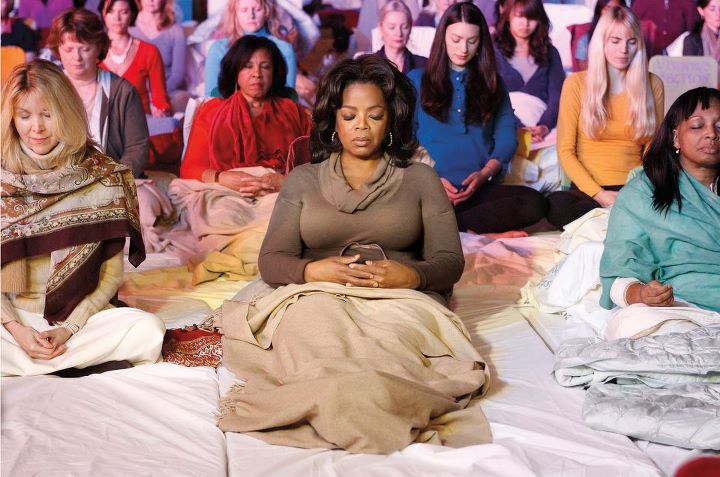
This photo, with text, was posted on Oprah Winfrey’s Facebook page. OWN also showed previews from her upcoming shows, including a few clips from her visit here. This episode is scheduled to air early in the year. Watch a sneak peek of Oprah’s Next Chapter. Read more: First Look: Oprah’s Next Chapter.

Now more clips available from Doctor Oz’s Dec 7 exclusive interview with Oprah. In this candid one-on-one interview, Oprah discusses her life after the Oprah show. She details her aspirations, challenges, how she knew it was time to make a change and found the courage to do it.

Part 3 at 1:00–1:15, shows clips of her visit with the Vedic Pandits, and Part 7 at 1:15–3:00, Oprah discusses rush hour in Fairfield, Iowa, TM Town, where everyone goes to the domes to meditate, how TM benefits her and all her employees who do TM twice a day at work, and the value of taking time for your Self in that way.

Oprah’s Next Chapter

Oprah Winfrey joins in evening meditation at The Golden Dome of Pure Knowledge in Fairfield, Iowa
Photo Credit: (c) 2012 Harpo, Inc./George Burns

Oprah in a small town in Iowa devoted to the practice of Transcendental Meditation. Oprah’s Next Chapter debuts January 1 at 9/8c exclusively on OWN. Find OWN on your tv here: www.oprah.com/findown

See related events/posts: Reports of Oprah’s visit to Fairfield, Iowa and Oprah says she and her staff meditate, enjoy a Quiet Time twice a day—Facebook Live interview. Here’s a report on the interview with Dr. Oz, reported in Miami Spirituality Examiner: Oprah Discusses Her Life After the Practice of Transcendental Meditation. And a recent post on the TM Blog Oprah Winfrey talks TM with Dr. Mehmet Oz. For more, see: Some Reports on Dr. Oz’s Interview with Oprah about TM and her Next Chapter. And this latest news: Oprah writes in O Mag about her visit to TM Town and meditating with ladies in their Golden Dome | OWN: Oprah Visits America’s Most Unusual Town, Sunday, March 25, 8 p.m. CT, 9-10 p.m. ET/PT.

Transcendental Meditation Effective Antidote to Record Stress Levels in School Students

November 16, 2011

Transcendental Meditation Effective Antidote
To Record Stress Levels in School Students

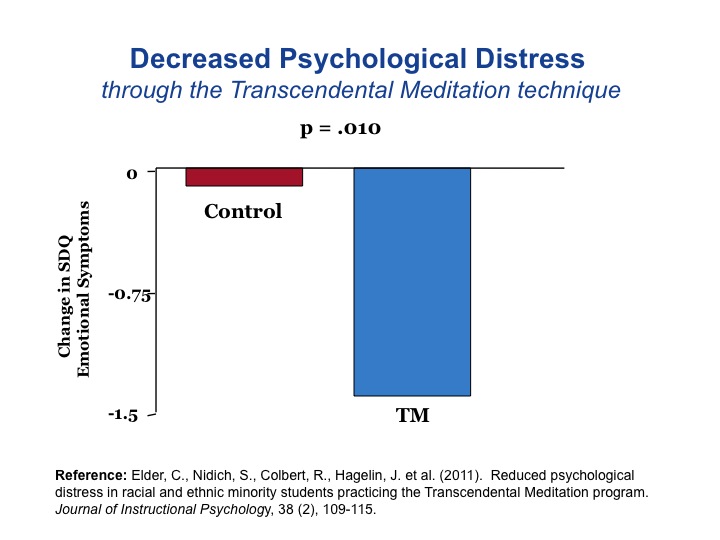
This graph shows a 36 percent reduction in psychological distress in 106 at-risk racial and ethnic minority students practicing the Transcendental Meditation technique compared to controls over a period of 4 months (p=.010). Significant decreases were also found in trait anxiety and depressive symptoms.

With record levels of student stress reported in a recent UCLA survey, can a simple stress-reducing meditation technique be a viable solution?

A new study published in the Journal of Instructional Psychology found the Transcendental Meditation (TM) technique significantly decreased psychological distress in public school students. The study, conducted with at-risk minority secondary school students, showed a 36 percent reduction in overall psychological distress. Significant decreases were also found in trait anxiety and depressive symptoms.

Rising Stress Levels Affect Emotional and Physical Health

The percentage of students in the UCLA survey reporting good or above-average high school emotional health dropped from 55.3 percent in 2009 to 51.9 percent in 2010. This marks the lowest level within the past 25 years.

Dr. Charles Elder, MD, lead author of the TM study, and investigator at Kaiser Permanente Center for Health Research, emphasized the important implications of the findings on reduced stress. “It is vital that we start addressing the high levels of emotional stress being reported by high school and college students. Decreased stress can have a positive impact on mental health, and can also reduce the risk for hypertension, obesity, and diabetes—major risk factors for heart disease,” explained Dr. Elder.

Educational research has also linked student stress to negative school behavior and poor academic performance.

Promising Findings for Education

“These new findings on reduced stress, along with the recent research on academic achievement gains, hold tremendous promise for public education,” said Sanford Nidich, EdD, principal investigator, and professor of education at Maharishi University of Management. “There is a growing body of evidence showing Transcendental Meditation to be an easy to implement, value-added educational program that promotes emotional health and increases academic achievement in at-risk students,” said Dr. Nidich.

A total of 106 secondary school students, 87% racial and ethnic minorities, took part in the study. Results showed that over a four-month period, students practicing Transcendental Meditation as part of their schools’ Quiet Time program exhibited significant reductions in psychological distress factors compared to controls.

According to James Dierke, 2008 National Association of Secondary School Principals—National Middle School Principal of the Year, “Stress is the number one enemy of public education, especially in inner-city schools. It creates tension, violence, and compromises the cognitive and psychological capacity of students to learn and grow. The TM/Quiet Time program is the most powerful, effective program I have come across in my 39 years as a public school educator for addressing this problem. It is nourishing children and providing them an immensely valuable tool for life. It is saving lives.”

The study was supported by the David Lynch Foundation.

Study Facts

  • This study evaluated change in psychological distress factors in students practicing the Transcendental Meditation program compared to non-meditating controls. A total of 106 students (68 meditating and 38 non-meditating students), took part in the study. The study included students from four public secondary schools.
  • Eighty-seven percent were racial and ethnic minority students, including 26% Hispanic, 25% African American, and 19% American Indian.
  • The Transcendental Meditation program was practiced in class twice a day as part of the schools’ Quiet Time program for four months prior to posttesting.
  • The Transcendental Meditation program was taught in the context of school-wide Quiet Time programs in which students voluntarily chose the Quiet Time program in which they wanted to participate.
  • Transcendental Meditation is a simple, natural, effortless technique that allows the mind to settle down and experience a silent yet awake state of awareness, a state of “restful alertness.” Practice of this stress-reduction program does not involve any change in beliefs, values, religion, or lifestyle.
  • Compared to eyes-closed rest, research has found that Transcendental Meditation practice is characterized by decreased activation or arousal of the autonomic nervous system, as reflected in decreased breath rate and lower sympathetic nervous system activity. The Transcendental Meditation program has been shown to increase electroencephalographic (EEG) brain integration and coherence, especially in the frontal area of the brain, responsible for higher-order processing.
  • Other published research on high school and college students has shown reduced psychological distress, improved positive coping ability, decreased blood pressure, reduced cardiovascular reactivity to stressful stimuli, reduced absenteeism, and decreased school suspensions.
  • Results of the current study indicated significant reductions in overall psychological distress (p=.010) and trait anxiety (p=.035) compared to controls. Within-in group differences in depressive symptoms were found for meditating students (p=.003).

Source: EurekAlert!

Reported on: Science Codex, sciencenewslinemedicine, PsychCentral: Meditation May Help Ease School Stress, Times of India: Beat stress with transcendental meditation (IANS), The Behavioral Medicine Report: Transcendental Meditation Significantly Decreased Psychological Distress In Public School Students, among others.

TM Blog: New research finds TM helps ease school stress, Ken Chawkin.

See related study: New research shows Transcendental Meditation improves standardized academic achievement.


Wild Geese by Mary Oliver, photo by Ken West

November 14, 2011

Wild Geese

You do not have to be good.
You do not have to walk on your knees
for a hundred miles through the desert repenting.
You only have to let the soft animal of your body
love what it loves.
Tell me about despair, yours, and I will tell you mine.
Meanwhile the world goes on.
Meanwhile the sun and the clear pebbles of the rain
are moving across the landscapes,
over the prairies and the deep trees,
the mountains and the rivers.
Meanwhile the wild geese, high in the clean blue air,
are heading home again.
Whoever you are, no matter how lonely,
the world offers itself to your imagination,
calls to you like the wild geese, harsh and exciting
over and over announcing your place
in the family of things.

—Mary Oliver

From Dream Work published by Atlantic Monthly Press
 

This photo of a family of Canadian Geese was taken by Ken West Iowa Landscape and Nature Photography. Ken West and his unique landscape photographs are featured on IPTV show Iowa Outdoors.

For more on Mary Oliver see The Journey by Mary Oliver, with links to other poems and an interview with Maria Shriver.

Listen to Mary Oliver read “Wild Geese” for The On Being Project. This poem is featured in Mary Oliver’s extraordinary conversation with Krista Tippett—one of the few in-depth interviews she gave in her lifetime: “I got saved by the beauty of the world.” She describes her creative process On Being: Listening to the World. 

Mary Oliver Reads Wild Geese (14:36) from A Thousand Mornings (1986) at the 92nd St Y, New York in 2012. 

A beautiful soundtrack was later added to her reciting this poem and posted on Instagram by coffee_with_keats.

Mary Oliver’s poem, Swan, asks us if we see, hear, and feel what she does, drawing rich references to the beautiful aspects of a swan, culminating in two powerful questions.

Mary Oliver’s poem, Mockingbirds, teaches us how to listen, and experience the wonders around us.

See this remembrance of Mary Oliver with links to more of her poems.

Ken West and his unique landscape photographs are featured on IPTV show Iowa Outdoors

November 14, 2011

The Iowan: Sizing Up Small Towns: Rethinking Success in Rural Iowa: Fairfield Thinks Inclusively

November 13, 2011


Home  /  Read  /  Nov/Dec 2011  /  Small-Town Success

Sizing Up Small Towns

Rethinking Success in Rural Iowa

Story by Carol Bodensteiner | Photography by Jason Fort, John Holtorf, Mark Tade

Attitude not Multitude

What does it take for rural Iowa to succeed?

That’s a question Iowans ask every decade when the U.S. Census delivers the message that the state’s rural population continues to shrink while urban areas expand. The 2010 Census was no exception, reporting that since 2000, 66 of the state’s 99 counties lost population.

Success recognized only by the rise or fall of population paints a bleak picture for rural Iowa. Experts who analyze the topic, however, say population numbers don’t tell the whole story.

And there isn’t just one story to tell about how communities thrive; there are many. Stories of leadership, vision, and strategic planning. Stories of collaboration and passionate volunteers. Stories of loyalty and advocacy and neighbors who roll up their sleeves and get the work done.

More studies will be conducted, more books will be written, and the debate will continue. Meanwhile, three small rural Iowa communities are thriving — creating success on their own terms.

(There are 9 pages to Success in Rural Iowa. Fairfield is in the last 3. Pages 1+3-6 are not included here. Click on the numbers to read them: 1+2+3+4+5+6+7+8+9)

Fairfield Thinks Inclusively

It’s midday on a Wednesday, and you may have to circle the town square twice to find a parking spot. Men in business suits and 20-somethings with computers crowd sidewalk tables outside restaurants and coffee shops. Yes, there’s the old Gimble’s jewelry store. Yes, there’s the familiar brick courthouse. But present also are the Ayurvedic cuisine, the aromatherapy, and the Jingui Golden Shield Qi Gong. Fairfield offers an unusual-for-Iowa blend of traditional and new cultures.

Maharishi University has put Fairfield on many people’s maps, but community-wide changes in the last decade have been a force for transformation in this southeast Iowa town of 9,464. Jefferson County’s county seat today boasts a diversified business economy that emphasizes entrepreneurship, the arts, and sustainability.

You can still drive from one edge to the other in about five minutes; however, Fairfield doesn’t feel rural. As in Elkader and Adams County, it’s attitude, not population numbers that drives success.

“We believe that all things are possible through a community working in harmony,” says Ed Malloy, who came to Fairfield from Long Island in 1980 and has been mayor since 2001. “We’re fortunate to have a diverse community. We value the resources of our diversity and welcome their participation.”

The new ideas generated by all the new immigrants— from across the United States and around the world — created challenges for traditional Fairfield. Malloy acknowledges that Fairfield was once viewed as a split community. “That image is 85 percent gone,”he says. Getting everyone to the table helped.

Fairfield, with less than 9,500 residents, doesn’t feel rural. Diversity, culture, and sustainability permeate the town, where Revelations Cafe (above) attracts a steady crowd for vegan pizza and organic espresso.

Broad community participation was what Malloy was after when he initiated a visioning process for the community shortly after he was elected. Malloy brought in the University of Northern Iowa Institute for Decision Making to assist.

“It was critical for us to have outside help,” he says. “An outsider can encourage diversity of opinion and find common ground.”

Planning started in 2002 and took 18 months. Malloy contends the planning process helped the community “grow, develop, mature, and gracefully integrate into a whole,” uniting a community once split.

“We have 80 different community organizations that said, ‘Yes, we understand,’ and, ‘Yes, we’ll take it on,’” he says. “Now all sides look at what will benefit all. The lines are much softer and the image of a split community is largely gone.”

Collaboration was critical to making the new Fairfield Arts & Convention Center (FACC) a reality. Fairfield groups had talked for years about the need for a permanent performance space. Community theater productions were staged in the fairgrounds livestock arena. The arts group had lost its studio space when the library moved.

“It was time to have a nice space everyone in the community could use,” says Suzan Kessel, a visual artist on the arts association board. So 10 years ago, Kessel joined with another longtime Fairfield resident, Sally Denney of the community theater, in leading a community-wide visioning process to turn talk into reality.

A board of 12 reached out to the chamber, hospital, schools, businesses, and the meditation community to get input. “We had a very well-balanced board from the beginning,” says Kessel, ensuring all voices were heard.

The process was not without conflict, however.

Possibility stems from harmony, says Mayor Ed Malloy (above, brokering fuel as President of Danaher Oil Company). He initiated a visioning process that brought together longtime residents like Suzan Kessel and Sally Denney with Fairfield newcomers like FACC executive director Rustin Lippincott. In another segment of old meets new, the 1960s-era Parsons College organ has been restored by Dan Glass and John Connet and installed in the 21st-century Fairfield Arts & Convention Center in 2009.

Some in the meditation community wanted the building to adhere strictly to Sthapatya Veda architectural principles. Many fiscally conservative, traditional Fairfield residents were concerned the town would be saddled with a white elephant few would use.

“The nucleus was patient,” says Denney. “We worked together because we had a common goal.”

Today’s FACC is more than either Kessel or Denney imagined, both in terms of space and the way that space represents the community.

The $10 million facility — built with the financial support of 1,100 individuals and companies — includes a 522-seat theater, an art gallery, office space, and meeting rooms that make the site attractive for private music and cultural events as well as for regional conventions.

Acts that take the Center’s stage range from local dance recitals to mixed martial arts, comedy, Way Off Broadway (Iowa’s only professional music theater company), and professional touring companies. Other parts of the facility are busy with class reunions, wedding receptions, and business meetings.

Fairfield is a diverse community, and the Center is where you really see the community mix,” says Denney. “This whole project has been a boon for Fairfield. Any conflicts have been far outweighed by the good. The Center brings us together.”

Staying focused on strategic priorities, says Malloy, positions Fairfield for opportunity. Rustin Lippincott, who moved from Nauvoo, Illinois, in 2007 and is now FACC executive director, applauds the mayor’s leadership.

“Ed has created an environment where everyone in Fairfield feels part of the mix for making Fairfield what it is.”

He pauses and decides on a sports analogy: “There are a lot of players in Fairfield, and not many are standing on the sidelines.”

Related article: Iowa Outdoors: Fairfield’s Abundance Ecovillage: Harmonious Living With Nature — Off The Grid

See KRUU FM’s Tanner & Moore Dream Green show featured in The Iowan Magazine Jan/Feb 2012 issue: The energy of two inquisitive minds fuels on-air conversations in Iowa, about Iowa: page 1 and page 2.

Maharishi University of Management‘s Sustainable Living Center is featured in the current March/April 2012 issue, under [potluck] titled Beyond LEED, on page 10. http://www.iowan.com.

To find out more about Fairfield and neighboring Maharishi Vedic City, visit http://discoverfairfield.org.

See NPR: Fairfield, Iowa: Where ‘Art Belongs To Everyone’

Post Traumatic Stress and How Transcendental Meditation Can Help [Infographic]

November 12, 2011

Post Traumatic Stress and How Transcendental Meditation Can Help [Infographic]

Over half a million of our Veterans from Iraq and Afghanistan are suffering from Post Traumatic Stress (PTS). It stopped me in my tracks when one of my patients said, “it can happen once in your life, but one hundred times in your mind.” The echoes linger on… This is a very serious dilemma not only for our nations veterans, but for countless individuals that have experienced any variety of serious trauma in their lives. The stress surrounding the attacks from 9-11-2001 are a great example of this type of trauma on a much grander scale.

Post Traumatic Stress and How Transcendental Meditation Can Help [Infographic] is an informative graphic portraying the seriousness of Post Traumatic Stress and how Transcendental Meditation can help folks to cope with this disorder. Click on this link to see the infographic: http://www.normanrosenthal.com/blog/2011/11/post-traumatic-stress-and-how-transcendental-meditation-can-help-infographic.

Brought to you by Norman Rosenthal MD.

Traumatic stress is a type of stress that exists on an entirely different level than that of the stress you and I encounter on a daily basis. Our bodies do not know how to process the impact that these scarring events have had on us, and in return the impression left on the brain is one that needs healing and recovery to restore its natural state of holistic functioning.

My desire is to help to provide individuals with the best tools available in treating and alleviating these serious mental and physiological patterns. With knowledge, guidance and practical tools we can start to reduce the painful flashbacks from our stress born incidents of the past. A little bit of specific help to restore hope, restore balance and restore the quality of life for the millions of people who are experiencing Post Traumatic Stress.

If you found this infographic informative please feel free to embed it on your website or share it on the social networks using the functionality seen below.

Wishing you Light and Transcendence,

Norman

———————————————————

Resources:
1) Learn more about Transcendental Meditation here.
2) Learn more about what the David Lynch Foundation is doing for our
Veterans at Operation Warrior Wellness.
3) Below is a relevant video titled: Mother of Iraq War Vet says Transcendental Meditation Saved Her Son’s Life

PTSD Infographic
Post-Traumatic-Stress-Disorder-PTSD-Transcendental-Meditation Brought to you by Norman Rosenthal MD.

Chandrika Tandon Benefit Concert in Iowa Helps Launch Global Peace Initiative

November 9, 2011

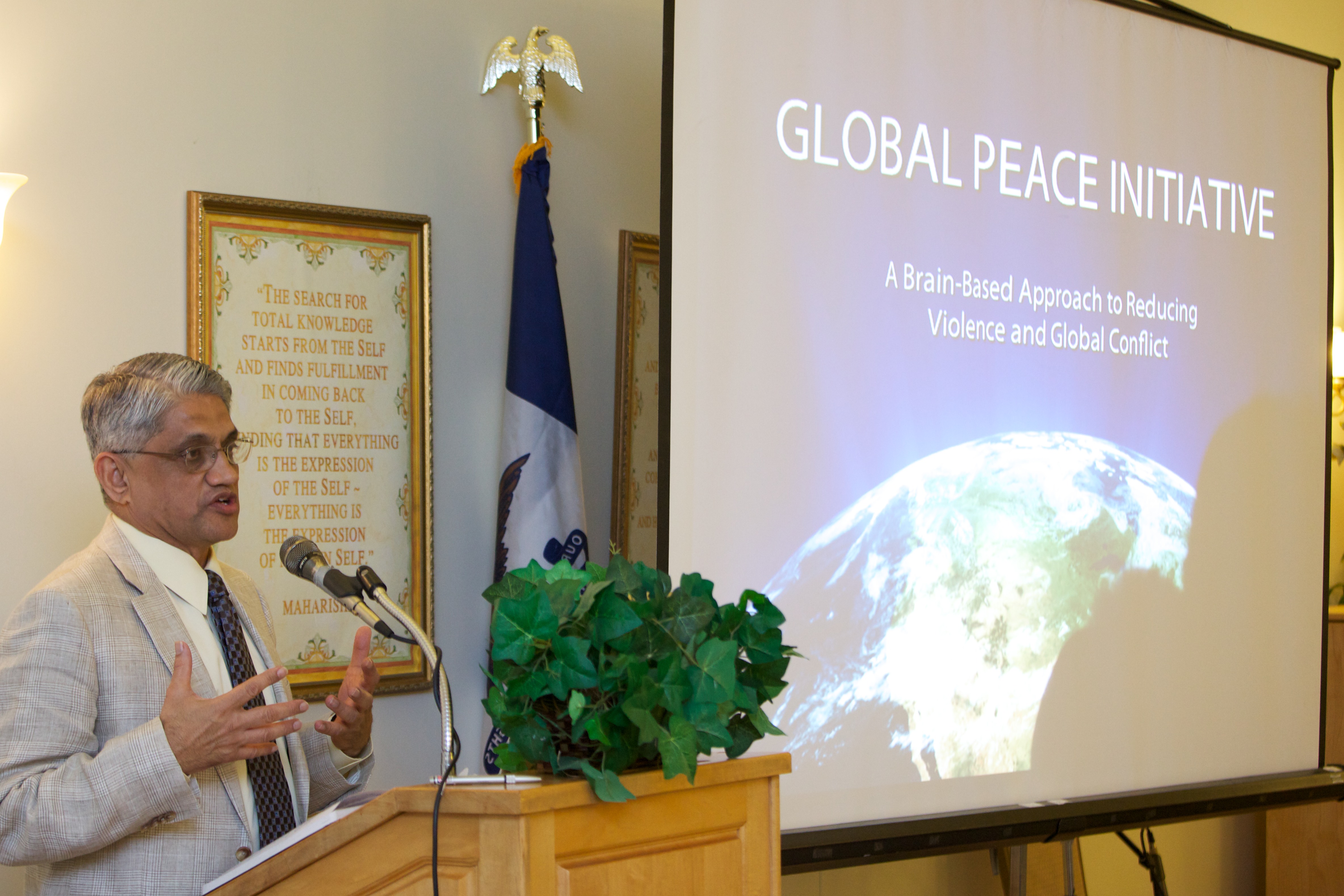
Chandrika Tandon Benefit Concert in Iowa Helps Launch Global Peace Initiative to Support 10,000 Maharishi Vedic Pandits

November 9, 2011: (MAHARISHI VEDIC CITY, IOWA) Leaders of the Global Peace Initiative hosted a Vedic Visitors Weekend, November 4 to 6, at Maharishi Vedic City in southeast Iowa, attracting Indo-Americans from cities as far away as Los Angeles and New York.

All the participants assembled for one purpose: to experience a weekend devoted to peace and all things Vedic: Vedic education, Vedic health, Vedic agriculture, and Vedic architecture.

The weekend culminated with Grammy-nominated world music artist, Chandrika Tandon, performing a stunning sold-out benefit concert at the Stephen Sondheim Theatre.

“The combination of different instruments and Chandrika’s voice revealed to me what World Music should be all about,” said Vinod Nayagar, a university student who attended the concert.

“All the sounds emerged from the same source, they resonated and built on each other’s vibrations at the subtlest, most blissful level of creation. The sounds were indistinguishable at transcendental moments—they created a harmony and unity from sound, which is the true purpose of music,” Mr. Nayagar said.

Ramani Ayer, retired CEO of the Hartford Financial Group and current Director of Development for the Global Peace Initiative, who served as a host of the weekend, said, “We invited Indo-Americans from around country to experience how powerful, valuable and relevant the practical application of ancient Vedic wisdom, as developed by Maharishi Mahesh Yogi, is to our daily lives and to the improvement of society.”

Leading Scientists Present Research on Meditation and World Peace

Fred Travis, Ph.D., Director of the Center for Brain, Consciousness, and Cognition at Maharishi University of Management in neighboring Fairfield, Iowa, is one of the world’s leading researchers on the brain, consciousness and meditation. His scientific presentation during the weekend on the effects of Transcendental Meditation on brain functioning was highlighted by slides and graphics illustrating the beneficial changes that occur as a result of regular TM practice.

From EEG signatures and connectivity maps, Dr. Travis showed how different meditation practices impact different parts of the brain. “Most meditations fall into two categories,” Dr. Travis said.

“First are ‘focused attention’ techniques, which require you to concentrate on an object, or a particular word or phrase. The second are ‘open monitoring’ techniques, which involve being mindful of your thoughts or breath without interfering with them. This approach attempts to still the mind and become an uninvolved witness to activity. But these attempts are on the surface level of the mind,” he said.

Dr. Travis then identified a third category—“automatic self-transcending”—a process that allows the mind to transcend its own activity. “This is the Transcendental Meditation technique, during which the mind transcends effortlessly, and arrives at the depth of consciousness, the source of the thinking mind, transcendental consciousness, or Samadhi,” Dr. Travis said.

Dr. Travis said that after several months of TM practice, the brain begins to demonstrate increased connectivity, even outside of meditation. “The brain functions more holistically, which accounts for the meditating student’s improved academic achievement. The student is able to absorb, integrate, and express knowledge more effectively,” Dr. Travis said.

Dr. G.V. Naidu, who traveled from St. Louis to attend the conference, said, “The scientific documentation of ‘The Neurophysiology of Enlightenment’ by Dr. Travis was impressive. And a subsequent presentation by physicist Dr. John Hagelin was a climax of the conference.”

World-Renowned Physicist Explains Global Peace Initiative

John Hagelin, Ph.D., a Harvard-trained, internationally renowned quantum physicist, provided the modern scientific understanding and corroborating scientific research documenting how groups of experts in the Transcendental Meditation and advanced TM-Sidhi program can neutralize violence and conflict and create world peace.

“Extensive research published in peer-reviewed scientific journals verifies that Transcendental Meditation dramatically reduces acute individual stress and its deleterious effects on brain and behavior far more effectively than other methods,” Dr. Hagelin said.

“But perhaps more interesting and important are the 23 published studies which show that relatively small numbers of people practicing the Transcendental Meditation and TM-Sidhi program together in a group can reduce crime, violence, and war throughout the entire population,” he said.

Citing studies conducted in the Middle East showing reductions in war death and violence by 70 percent, Dr. Hagelin said, “There is no approach to peace that has been so thoroughly tested and rigorously established. And now, since the arrival in America five years ago of the large group of Vedic Pandits, there has been a significant decrease in violent crime in America’s largest cities. We are mobilizing to add more numbers to the group, to create an even more positive effect in America.”

Thousands of Maharishi Vedic Pandits to Create Global Peace Effect through Yoga and Yagya

Ramani Ayer provided a vision of the goal of the Global Peace Initiative: To maintain permanent peace-keeping groups of 9000 Vedic Pandits in India and 1250 Vedic Pandits in the United States—the number established by research that is sufficient to create a concrete and demonstrative positive global effect.

“The Vedic Pandits’ daily practice of the TM and TM-Sidhi program establishes their consciousness in Yoga, the pure field of intelligence, at the basis of all creation. And their Vedic recitation from that deep and pure level creates a powerful influence of peace for humanity. This perfect combination of Yoga and Yagya will help create a much higher quality of life for the whole world’s population,” Mr. Ayer said.

The Global Peace Initiative is building an endowment fund to create and maintain these large groups of Vedic Pandits in perpetuity.

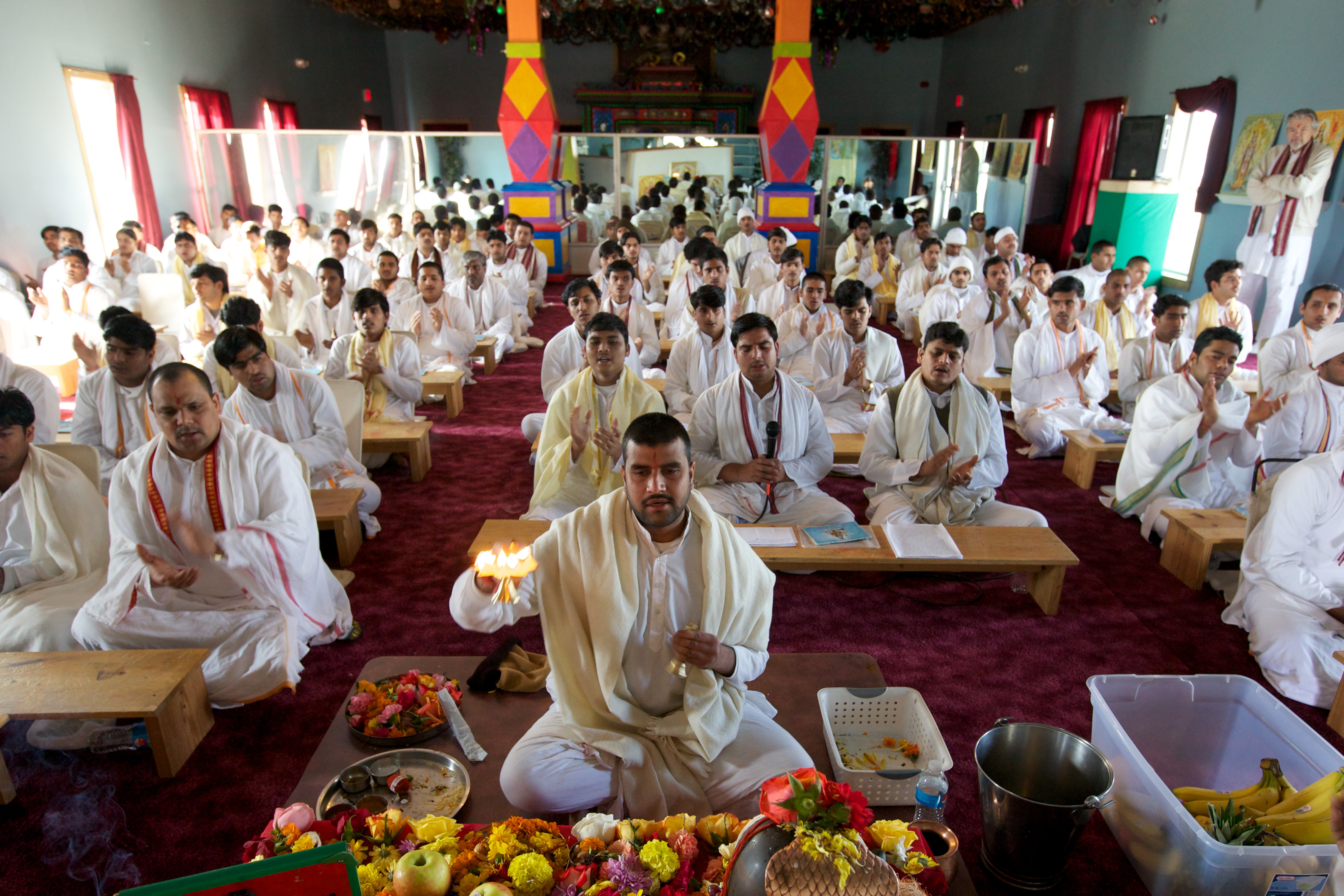
Maha Rudrabhishek with 121 Maharishi Vedic Pandits

Another sublime highlight of the weekend was the performance by 121 Maharishi Vedic Pandits of Rudrabhsihek.

“It’s an amazing sight to drive over the rolling hills of Iowa and see spread before you a campus where nearly 1000 Maharishi Vedic Pandits from India reside,” said Meenakshi Ghai, from Chicago’s western suburbs, who made the four-hour drive from Chicago with her daughter-in law to attend the weekend. “It was a non-stop wonderful experience packed into 36 hours.”

Mohan Pillai from Long Island, New York, who attended the conference with his family, said, “I cannot describe in words what is was like to hear such a powerful chanting of the Rudrabhishekam. The inner feeling was so good—it was beyond words. I could understand how such large groups of well-trained Vedic Pandits can create peace.”

G.V. Naidu expressed enthusiasm for the global initiative: “We were pleasantly surprised to see that Maharishi Vedic Vishwa Vidyalaya is training thousands of Vedic Pandits here in America as well as in India. These Vedic Pandits are propagating and sustaining ancient Vedic culture. At the same time, they are conducting fundamental research on the positive effects of meditation—far more than any other organization. I wish more people will participate in future seminars conducted by Maharishi University of Management,” Mr. Naidu said.

Mr. Ayer concluded: “As Indians who cherish the Vedic tradition in our hearts, we should feel very proud that this great knowledge has given us a practical means to create peace in the world.”

For more information, visit www.GlobalPeaceInitiative.org and www.VedicPandits.org.

Also see Global Peace Initiative: 13 Questions and Answers with Ramani Ayer, Chandrika Tandon Concert to Benefit 1000 Maharishi Vedic Pandits Launches Global Peace Initiative, and Lavina Melwani interviews Chandrika Tandon on her Grammy Award nomination.