Archive for the ‘Education’ Category

US Government National Health Center Highlights TM Study on Stressed College Students

May 14, 2010

Transcendental Meditation Helps Young Adults Cope With Stress

A recent study found that Transcendental Meditation (TM) helped college students decrease psychological distress and increase coping ability. For a group of students at high risk for developing hypertension, these changes also were associated with decreases in blood pressure. This could be good news for the many students experiencing academic, financial, and social pressures that can lead to psychological distress—especially in light of evidence that college-age people with even slightly elevated blood pressure are three times more likely to develop hypertension within 30 years.

Funded in part by NCCAM, researchers from Maharishi University of Management and American University studied 298 students from American University and other schools in the Washington, D.C., area. The researchers randomly assigned students to a TM group or a control (wait-list) group. They also created a high-risk subgroup, based on blood pressure readings, family history, and weight. The TM group received a seven-step course in TM techniques, with invitations to attend refresher meetings, and kept track of how often they practiced TM. At the beginning of the study and after 3 months, researchers tested all participants for blood pressure and psychological measures. The researchers noted that 30 percent of the participants dropped out before the end of the study.

Blood pressure decreased in the TM group and increased in the control group, but the differences were not significant overall (TM-control blood pressure differences were significant within the high-risk subgroup). However, compared with controls, the TM group had significant improvement in total psychological distress, anxiety, depression, anger/hostility, and coping ability. Changes in psychological distress and coping paralleled changes in blood pressure.

According to the researchers, these findings suggest that young adults at risk of developing hypertension may be able to reduce that risk by practicing TM. The researchers recommend that future studies of TM in college students evaluate long-term effects on blood pressure and psychological distress.

Reference

URL: http://nccam.nih.gov/research/results/spotlight/051410.htm

This page last modified May 13, 2010.

Twitter NCCAM

Transcendental Meditation Helps Young Adults Cope With Stress: http://go.usa.gov/ihN

Maharishi describes the nature of inner life: bondage and liberation, and gaining bliss consciousness through Transcendental Meditation

May 9, 2010

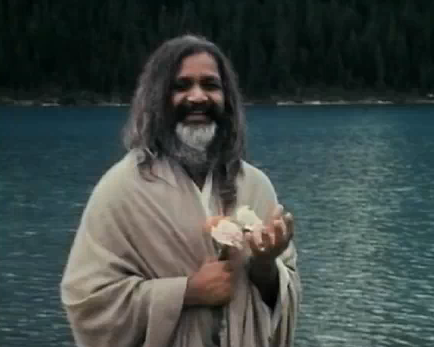
Maharishi at Lake Louise

The Canadian Broadcasting Corporation produced this beautiful documentary on Maharishi Mahesh Yogi, founder of the Transcendental Meditation technique, during his visit to Canada’s premier hotel Chateau Lake Louise,  June 10-14, 1968, the course location for Canadian meditators. I was very lucky to have been on that course and met Maharishi for the first time. All of the course participants lined up to present Maharishi with flowers for the CBC to film. It was used to open and close that documentary profile, which was made for the CBC program series called Telescope.

This CBC documentary remains one of the best films ever made on Maharishi. Filmed inside the hotel’s main lecture hall and outside with the backdrop of the majestic Canadian Rocky Mountains, it respectfully portrays Maharishi as a great spiritual teacher. They filmed him walking in front of the glacier lake, the image of which he used to describe the nature of inner life, bondage and liberation, and contacting and integrating bliss consciousness into daily life through the regular practice of Transcendental Meditation.

Posted here is an edited version of that documentary, minus the opening introduction, segues, and commercials, which was aired on Canadian national television during the Fall of 1968. Here is a partial transcription of that segment of the video. To view the whole video click on the title, Maharishi at Lake Louise. It can also be viewed on the Maharishi Channel on You Tube: Transcendental Meditation – Maharishi Mahesh Yogi at Lake Louise, Canada, 1968. Also, the Transcendental Meditation blog has a well-written comprehensive, historical, contextual description about this video by Bob Roth: Maharishi: A rare glimpse into the message of meditation from 40 years ago. It’s also embed here for you to enjoy.

The depth of the lake, and the ripples, and the beautiful reflection of the glacier, reminds me of the story of inner life. The mind is deep like a lake. The ripples on the surface represent the conscious mind, the activity of the mind on the surface. And the whole depth of the lake is silent. And that is the subconscious mind, which is not used by the wave. But if, the wave could deepen, and incorporate more silent levels of the water, the waves could become the waves of the ocean, the mighty waves.

This is what happens in Transcendental Meditation. The surface activity of the conscious mind deepens and incorporates within its fold the depth of the subconscious. And with practice, nothing remains subconscious. The whole subconscious becomes conscious, and a man starts using full potential of the mind.

And the reflection of the glacier on the water is like the impression of the objects that the mind perceives. And as long as the mind is not capable of maintaining its essential nature, which is bliss consciousness, so long the mind gets imprinted by the perceptions of the objects. And this is called the bondage of the mind. The mind loses bliss consciousness and gains the joy of the reflections of the world, the joy of the relative order, losing the bliss of the absolute eternal Being.

When the mind is not capable of maintaining its essential nature, bliss consciousness, and is overshadowed by the reflections of the object of perception, then only the object remains, and the subject, as if, becomes annihilated. This annihilation of the subjective nature within is a great loss. It’s a loss of eternal bliss at the cost of temporary joys. Such a life where the value of the matter dominates is called material life, and the spirit gets annihilated.

But, when through the practice of Transcendental Meditation, the mind goes deep within to the source of thought, transcends the thought, and gains bliss consciousness, and is capable of maintaining that even when it comes out into the worldly experience of objective nature, then it is called spiritual life—that the spirit is not capable of being overshadowed anymore by the objective experience. And this is spiritual life. This is life in eternal liberation. And without this, life is in bondage. A great loss. As if loss of a billion pounds, and gain of a million. Loss of eternal bliss consciousness and gain of a worldly fleeting joy.

The vision, the vision of the lake, brings about a great teaching of spiritual life. …

New Post: Watch the 1968 film of Maharishi at Lake Louise.

On September 30, 2014 I had posted how I learned #TMmeditation 47 years ago today. In there I share more information about the making of the CBC Telescope film, The Guru, of Maharishi at Lake Louise. Richard Day shared a story he had heard many years later about the director of the film who told Maharishi that he wanted to film him saying something that would encapsulate all his teachings. Maharishi said, “I’ll walk by the lake, you walk with me, and I’ll tell you everything about spiritual development.” He did it in one take!

EEG Demonstration of the Enlightened Brain

May 8, 2010

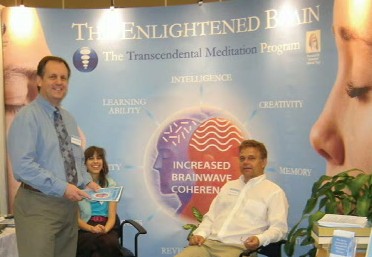
Michael Beresford, Sara Hea and Rich Van Shaik present the TM Program

Transcendental Meditation Brainwave Coherence Demo

Michael Beresford, brain researcher, businessman, and teacher of the Transcendental Meditation Program, demonstrates how TM increases EEG brainwave coherence and improves mental performance.

Maharishi School Students Win State Science Fairs Researching Jefferson County Farming Effects on Area Waterways

April 30, 2010

Maharishi School Students Research Jefferson County Farming Effects on Area Waterways, Win State Science Fairs

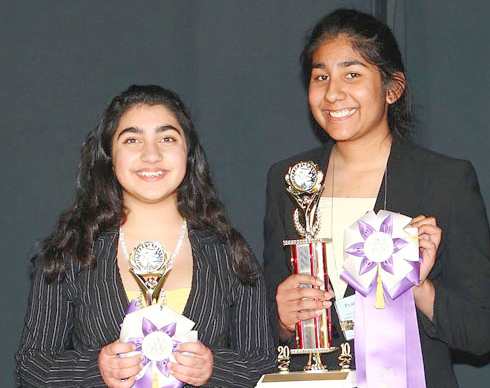
Maharishi School Students, Minna Mohammadi (l) and Pearl Sawhney (r), win at State Science Fair. Their research investigated Jefferson County Farming Effects on Area Waterways. – Photo clickphotographyonline.com

Pearl Sawhney and Minna Mohammadi, Maharishi School sophomores, swept the top prizes at the Eastern Iowa State Science Fair (EISEF) on March 21, as well as the State Science and Technology Fair of Iowa (SSTFI) on March 26th and 27th with their project entitled, “Farm Feeding Practices: Exploring Solutions for Environmental Sustainability.” They also won the most coveted prize – a free trip to participate at the INTEL International Science Fair in San Jose with their teacher and mentor, Dr. Mousumi Dey, on May 8th – May 14th.

They won the following categories: first place and $100 at the EISEF, special prize: Iowa Environment and Water Pollution Board, first place and $100 in the Seminar Team Project category, the Power Point Hope Award, first place and $75 in the Environmental Science Senior High category, first place and $1000 for Senior High team, grand prize overall and $1000 in the Senior High category, Iowa Angus Auxiliary Award.

Mohammadi and Sawhney were sponsored in part by Jefferson County Farmers and Neighbors Association. They received mentorship and testing materials from the USDA. Dr. Dennis Dey and Dr. Rajeev Sawhney provided additional mentorship.  The research team examined the relationship between animal feed and pollution in streams. The project impressed and intrigued judges, as it is an area not previously researched. They tested three different types of farms: confined animal feeding operations, conventional farms, and organic farms.

“Animal feed was tested for unbound phosphorous, important for bone growth, and phosphorous bound to phytates, which is indigestible and excreted by the animals,” explained Sawhney. “Manure is applied to fields as fertilizer. Pollution occurs when bound phosphorous enters local streams with run-off. We tested nearby streams, upstream and down, for bound phosphorous levels and biological oxygen demand. Biological oxygen demand is the level of oxygen needed to decompose dead organic matter. High levels of bound phosphorous increases the algae and phytoplankton populations. When the phytoplankton and algae die naturally, they use more oxygen to decompose than they did when living. This significantly lowers oxygen levels, creating an uninhabitable environment. The effects of the bound phosphorous are compounded when the streams enter the Mississippi River. This type of pollution has created a dead zone in the Gulf of Mexico that is the size of New Jersey.”

“We found that water running downstream organic farms had the lowest phosphorus content, and biological oxygen demand, and that water running downstream CAFOs had the highest phosphorus and biological oxygen demand. This indicates that organic farms, of the farms we tested, have the least negative effect on nearby water bodies,” explains Mohammadi. “We plan to continue our research and extend it to other counties.”

“The students performed multiple tests,” said Dr. Dey. “All the results were highly statistically significant. The girls collected water under extremely difficult conditions to minimize errors. Also, they took great care and every precaution to get the most accurate results. Such dedication and focus at such a young age is rare. They are continuing to collect more samples. If the area farmers could allow these two young researchers to collect water and soil samples from their land on a regular basis and organizations could help them with some more monetary support, we can have even more thorough results.”

When asked how the students chose their topic, Sawnhey said, “We wanted to find a local solution to a global problem.”

“We didn’t realize what we were getting into,” added Mohammadi. “It was difficult, cold, muddy work collecting samples!”

“We are extremely proud of the high level of scientific research that Minna and Pearl produced,” said Maharishi School Head, Dr. Richard Beall. “As much as their accomplishments, we’re also proud of the social significance of their topic. This research bears real consequence on public health.”

Maharishi University hopes to set the standard for “green” buildings

April 28, 2010

Maharishi University hopes to set the standard for “green” buildings

by Matt Kelley on April 26, 2010

in Education, Health & Medicine

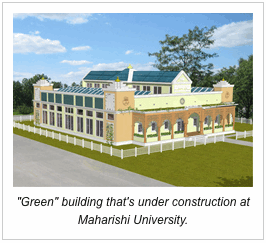
A new classroom and research building is under construction on a college campus in southeast Iowa that aims to set a new global standard for green buildings.

David Fisher, director of the Sustainable Living program at Maharishi University in Fairfield, says the building promises to be unlike any other structure on the planet.

“It will be off the grid completely with respect to electricity, heating, cooling, water and waste disposal,” Fisher says. “In addition, the building will be day lit throughout the building.”

Banks of solar panels will provide the electricity for the Sustainable Living Center, Fisher says, and solar energy is being used by workers during the construction phase, as well. During the warm months, he says the building will be kept cool using a geothermal system.

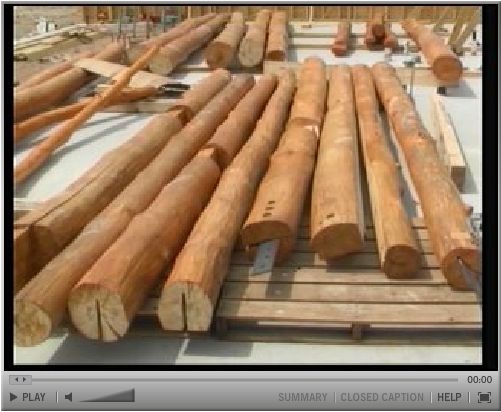
“The heating will be done with solar water heaters on the roof,” Fisher says. “We will have insulation provided in part by very local materials, that is compacted earth blocks which came from some earth right across the street that was being cleared out for a parking lot.” That dirt was compacted into 26,000 bricks that will make up the building’s insulation. The building’s skeleton will use whole tree post and beam techniques.

“Water will be all rainwater,” Fisher says. “It will be collected on the roof and stored in a cistern and, of course, for drinking purposes, it’ll all be filtered with (an ultraviolet) filter.” Fisher says the system for handling waste is also accounted for as a green effort. Fisher says, “We have a constructed wetland and we’re planning to use a system that’s similar to what they use in submarines and on space capsules, purifying the water with a system that puts very, very finely-divided bubbles through the water to keep it aerobic and to completely degrade all of the organic matter so as to purify the water.”

Fisher says the building is designed to meet the Living Building Challenge, the highest standard for sustainable design and green building in the world. It will also be the first to combine that standard with the standards of LEED Platinum certification, Building Biology and Maharishi Vedic Architecture.

The building will serve as the base for the university’s Sustainable Living major. It will have classrooms, a workshop, a meeting room, a greenhouse, a kitchen, a research lab, a recycling center and offices. Fisher says it’ll be a building that teaches. The one-point-seven million dollar project is expected to be complete late this year.

Sustainable Living Center is unique in USA

April 26, 2010

Sustainable Living Center is unique in United States

Front page, Friday, April 23, 2010; published online: 4/26/2010

As ancient walls continue to crumble the world over, a few new ones went up yesterday in Iowa’s hippest farmtown.

The Sustainable Living Center at the Maharishi University of Management in Fairfield was the scene of a modern-day barnraising. Walls were tilted and roof trusses placed during the Earth Day event.

The structure uses “whole tree” post and beam techniques.

“It will set a new standard for green building in America by being completely off the grid with respect to electricity, heating and cooling, water and waste,” MUM director of media relations Ken Chawkin said.

Innovative Design of North Carolina conceived the building to meet the Living Building Challenge, a standard for sustainable design introduced at the 2006 Greenbuild Conference in Denver, Colo. The SLC is the first to combine that standard with those of LEED platinum certification, Building Biology standards, and Maharishi Vedic architecture guidelines.

The Leadership in Energy and Environmental Design system was created by the U.S. Green Building Council and is an internationally recognized third-party certification. Vedic architecture is based on Hindu traditions emphasizing the use of natural materials such as wood, bricks, adobe, stucco and marble.

“There’s no other building like this going up in the nation, or in the world for that matter, that we know of,” said Mike Nicklas, SLC co-designer and president of Innovative Design.

The company has created over 4000 structures that use renewable energy solutions. Nicklas participated in the first Earth Day in 1970.

The SLC building is slated for university occupation this fall.

“It’s a building that teaches,” Chawkin said. The SLC will provide students with classrooms, workshop, meeting room, greenhouse, kitchen, research lab, recycling center and offices.

In addition to embodying sustainability, the SLC will allow students to interactively monitor performance and energy efficiency.

MUM Sustainable Living Department head David Fisher, who helped plan the building, said the SLC will be a living, evolving project.

“The building itself is an educational tool, not just a passive one like most classroom buildings,” Fisher said. “It will provide participatory education where students will be continually adding to or altering the building and grounds, as well as systematically checking its effectiveness.”

The SLC is designed to be completely off-grid. Construction uses all non-toxic materials from local sources, as defined by the Living Building Challenge requirements.

All energy will be provided from solar panels on the building and from an outside wind turbine. Rainwater catchment will be the complete source of the building’s water, with purification of drinking water via ultraviolet technology.

Wastewater will be treated on-site using a constructed wetland. Natural daylighting will illuminate the entire interior. Geothermal technology will assist with heating and cooling.

None of the planned systems in the building are new or experimental, according to construction manager Dal Loiselle, who said the SLC uses “state-of-the-shelf” technologies.

“This building proves that we can meet our environmental goals for our built environment with the materials, technologies, and green building protocols we already possess,” Loiselle said.

Sustainability is a major focus at MUM, which has long promoted techniques for living in harmony with nature. The school was founded in 1974 by the Maharishi Mahesh Yogi as an international center for teaching Transcendental Meditation.

MUM filed a climate action plan to be 100 percent carbon-neutral by 2020 as part of the American College and University Presidents Climate Commitment.

Fairfield Mayor Ed Malloy, named in 2009 by MSN.com as one of the nation’s 15 greenest mayors — alongside those of New York, Seattle and San Francisco — said the SLC holds promise for a sustainable future.

“Our city will benefit enormously by having this building on the campus of MUM as a demonstration of a new standard of design,” Malloy said.

The Sustainable Living Center includes material donations from nationally recognized leaders in green building materials, including Gerdau AmeriSteel, Pittsburgh Corning and United States Gypsum Corporation, as well as Green Building Supply of Fairfield.

Yesterday’s event was part of MUM’s tenth annual EcoFair, which runs from April 30 to May 2 at the Argiro Student Center, 1000 N. Fourth St., Fairfield.

2 comment(s) found

Prgressive!: 4/27/2010

Fairfield,Iowa/Maharishi University of Management is a creative outpost ~ of a life worth living; healthy, in tune with nature, cutting edge and friendly. Thank you to all involved.

Small Town USA: 4/26/2010

Its great to see even the small towns and universities going full swing into this Green thing. Whoo Hoo!

David Lynch on Transcendental Meditation: an interview with David Servan-Schreiber in Paris

April 26, 2010

What is Transcendental Meditation?

David Lynch Interview with Dr. David Servan-Schreiber

Paris, April 17, 2010

David Lynch, director, tells David Servan-Schreiber, MD, PhD, about the benefits of a daily use of Transcendental Meditation. Mr. Lynch is working on a film about the life of Maharishi Mahesh Yogi, who brought back Transcendental Meditation in Occidental countries in the 60s. Interviewed in Paris, April 17, 2010. Here is a link to the full interview posted on DailyMotion: http://dai.ly/a9wgDS.

Visit the David Lynch Foundation to see the amazing work that is being done for at-risk populations: www.davidlynchfoundation.org

This interview was later uploaded onto YouTube in 4 parts by on Jun 22, 2010, in English and French versions. It includes this bio on the interviewer, Dr. David Servan-Schreiber.

Paris, 17 April 2010. Dr. David Servan-Schreiber, MD, PhD, is a French physician and neuroscientist. Clinical professor of psychiatry at the University of Pittsburgh School of Medicine, he is also co-founder of the Center for Integrative Medicine at the University of Pittsburgh Medical Center. Following his volunteer activity as physician in Iraq in 1991, he was one of the founders of the US branch of Médecins Sans Frontières (Doctors Without Borders), the international organization that was awarded the Nobel Peace Prize in 1999. He also served as volunteer in Guatemala, Kurdistan, Tajikistan, India and Kosovo. In 2002 he was awarded the Pennsylvania Psychiatric Society Presidential Award for Outstanding Career in Psychiatry.

Author of “Healing Without Freud or Prozac” (translated in 29 languages, 1.3 million copies sold), and “Anticancer, a New Way of Life” (translated in 35 languages, New York Times and international best-seller, 1 million copies in print) in which he discloses his own diagnosis with a malignant brain tumor at the age of 31 and the treatment program that he put together to help himself beyond his surgery, chemotherapy and radiotherapy.

Dr. David Servan-Schreiber is also a regular columnist for Ode Magazine and other publications, and the founder of the French anti-cancer site Guerir.org (“Healing”). See also www.anticancerbook.com.

I just checked his website and discovered that after a 20-year battle with cancer, David Servan-Schreiber passed away on July 24, 2011.

France24 Interview – David Lynch, film director

April 23, 2010

In this edition our guest is American filmmaker David Lynch, famous for directing such films as ‘Elephant Man’ and ‘Mulholland Drive’. But today he tells us about his experiences in Transcendental Meditation, which he has been practicing for over 30 years. This is a two-part interview.

David Lynch, film director

David Lynch, film director (part two)

THE F24 INTERVIEW

‘Green’ learning in sustainable classrooms

April 23, 2010

Local News April 23, 2010

‘Green’ learning in sustainable classrooms

Maharishi University of Management constructs an off-the-grid academic building for sustainable living majors

MATT MILNER Courier Staff Writer

Matt Milner/The Courier Construction workers had to move carefully to avoid excessive damage to the tree trunks that will be a signature element in the new building for MUM’s sustainable living program. The school held a ceremony at the site on Thursday to mark Earth Day

FAIRFIELD — Builders and backers of the new home for sustainable living majors at Maharishi University of Management say nothing like it has been attempted anywhere.

It’s easy to believe them.

The construction brings together four basic philosophies. Three are focused on environmental impact and resource demands. The fourth is, as all new buildings at the college are, based on Vedic concepts. It’s a tough combination to pull off.

When complete, the building will be completely off the grid for electrical power, climate control and waste removal. The goal is creation of a building that meets the university’s needs for classroom and office space while demonstrating concepts the students learn inside.

Dr. David Fisher, director of the sustainable living department, thinks the building will help draw students. That has not been a problem for the program, which opened in 2003 with six students and now has 80 sustainable living majors. He called it an “incredible environmental building.”

It is not large as academic buildings go. That’s intentional.

“We didn’t want to make it too large because we’re trying to do so much,” Fisher said.

Right now the site doesn’t look markedly different from any other building under construction. Stud framed walls are the exterior on two sides. The other two are still open. The biggest clues that something different is going on are the nearly full-sized tree trunks that form part of one hallway. Others lay around the site, ready to be raised.

The trees being used are aspens. They are fast-growing and were harvested from a farm dedicated to sustaining its population. A slight sheen and a lack of bark are the only things that show they have been processed for construction. Builders said the trunks have strength similar to steel when they are maintained instead of sawed into boards.

Dal Loiselle, the developer and construction manager for the site, has worked on “green” building sites for 21 years. He said the costs are not all that different from those involved in traditional construction, provided the effort is made from the start. Adding environmentally friendly traits to an existing project can be expensive.

“It entails commitment, basically,” he said. “It’s just a matter of having the desire and doing it.”

Loiselle emphasized that none of the technology being incorporated is new. It’s off the shelf stuff that any builder can use.

The completed structure will be LEED platinum certified and meet the requirements for building biology, Vedic architecture and the Living Building Challenge. Students will have access to the roof and walls to study the concepts they learn in class. Monitors will track every shift in temperature, humidity and environmental change, wired into a website people can check from anywhere in the world.

Thursday’s ceremony was somewhere between a groundbreaking and a dedication, tied into Earth Day at MUM. It’s the 40th Earth Day, noted Fairfield Mayor Ed Malloy. He expressed the hope that the building’s edge-of-the-envelope attempt today will be standard in another 40 years.

Matt Milner can be reached at (641) 683-5359 or via e-mail at mmilner@ottumwacourier.com

KTVO-3: Greenest building in America in Fairfield

April 23, 2010

Video: http://www.heartlandconnection.com/news/video.aspx?id=447437

Maharishi University of Management’s new Sustainable Living Center is a building that will set a new standard for green building in America by being completely off the grid with respect to electricity, heating and cooling, water, and waste.

Greenest building in America in Fairfield

The new sustainable living center will be one of three buildings in the U.S. to meet the Living Building Challenge
By Alex Halfmann
Thursday, April 22, 2010 at 6:12 p.m.

FAIRFIELD, IOWA — One heartland university aims to practice what they preach, and what they preach exemplifies Earth Day.

Maharishi University of Management’s new Sustainable Living Center will be one of the greenest buildings in America when completed this fall.

The University’s sustainable living program will utilize the building, which will help students understand firsthand what they are learning.

“The students will be able to see in the building that they are occupying what we are teaching. This building will be off the grid completely in respect to electricity, heating, cooling, water, and waste disposal,” said Maharishi University’s Director of the sustainable living program David Fisher.

The building is designed to meet the Living Building Challenge, the highest standard for sustainable design and green building in the world.

“After a while, the U.S. Green Building Council realized there was a lot more buildings could do so they came up with the Living Building Challenge which is much more stringent than even the LEED Platnium. In fact, they have now gone to the 2nd version of the Living Building Challenge” Fisher said.

Parts of the project  literally come from the school’s backyard.

“We’re using compacted earth blocks that come from earth just across the street where they were clearing out a parking lot.  We took that soil, compacted it into 26,000 earth blocks, and so that will serve as thermal mass which will help insulate the building,” Fisher said.

While the building might look relatively bare on Earth Day, they expect the roof, complete with solar panels, to be installed by the end of next week. The site will then use only electricity generated on site.

The building will be one of the first three to achieve the Living Building Challenge’s standards. It will be unique because it will be the first to combine that standard with the standards of LEED Platinum certification.