Archive for November, 2011

The Iowan: Sizing Up Small Towns: Rethinking Success in Rural Iowa: Fairfield Thinks Inclusively

November 13, 2011


Home  /  Read  /  Nov/Dec 2011  /  Small-Town Success

Sizing Up Small Towns

Rethinking Success in Rural Iowa

Story by Carol Bodensteiner | Photography by Jason Fort, John Holtorf, Mark Tade

Attitude not Multitude

What does it take for rural Iowa to succeed?

That’s a question Iowans ask every decade when the U.S. Census delivers the message that the state’s rural population continues to shrink while urban areas expand. The 2010 Census was no exception, reporting that since 2000, 66 of the state’s 99 counties lost population.

Success recognized only by the rise or fall of population paints a bleak picture for rural Iowa. Experts who analyze the topic, however, say population numbers don’t tell the whole story.

And there isn’t just one story to tell about how communities thrive; there are many. Stories of leadership, vision, and strategic planning. Stories of collaboration and passionate volunteers. Stories of loyalty and advocacy and neighbors who roll up their sleeves and get the work done.

More studies will be conducted, more books will be written, and the debate will continue. Meanwhile, three small rural Iowa communities are thriving — creating success on their own terms.

(There are 9 pages to Success in Rural Iowa. Fairfield is in the last 3. Pages 1+3-6 are not included here. Click on the numbers to read them: 1+2+3+4+5+6+7+8+9)

Fairfield Thinks Inclusively

It’s midday on a Wednesday, and you may have to circle the town square twice to find a parking spot. Men in business suits and 20-somethings with computers crowd sidewalk tables outside restaurants and coffee shops. Yes, there’s the old Gimble’s jewelry store. Yes, there’s the familiar brick courthouse. But present also are the Ayurvedic cuisine, the aromatherapy, and the Jingui Golden Shield Qi Gong. Fairfield offers an unusual-for-Iowa blend of traditional and new cultures.

Maharishi University has put Fairfield on many people’s maps, but community-wide changes in the last decade have been a force for transformation in this southeast Iowa town of 9,464. Jefferson County’s county seat today boasts a diversified business economy that emphasizes entrepreneurship, the arts, and sustainability.

You can still drive from one edge to the other in about five minutes; however, Fairfield doesn’t feel rural. As in Elkader and Adams County, it’s attitude, not population numbers that drives success.

“We believe that all things are possible through a community working in harmony,” says Ed Malloy, who came to Fairfield from Long Island in 1980 and has been mayor since 2001. “We’re fortunate to have a diverse community. We value the resources of our diversity and welcome their participation.”

The new ideas generated by all the new immigrants— from across the United States and around the world — created challenges for traditional Fairfield. Malloy acknowledges that Fairfield was once viewed as a split community. “That image is 85 percent gone,”he says. Getting everyone to the table helped.

Fairfield, with less than 9,500 residents, doesn’t feel rural. Diversity, culture, and sustainability permeate the town, where Revelations Cafe (above) attracts a steady crowd for vegan pizza and organic espresso.

Broad community participation was what Malloy was after when he initiated a visioning process for the community shortly after he was elected. Malloy brought in the University of Northern Iowa Institute for Decision Making to assist.

“It was critical for us to have outside help,” he says. “An outsider can encourage diversity of opinion and find common ground.”

Planning started in 2002 and took 18 months. Malloy contends the planning process helped the community “grow, develop, mature, and gracefully integrate into a whole,” uniting a community once split.

“We have 80 different community organizations that said, ‘Yes, we understand,’ and, ‘Yes, we’ll take it on,’” he says. “Now all sides look at what will benefit all. The lines are much softer and the image of a split community is largely gone.”

Collaboration was critical to making the new Fairfield Arts & Convention Center (FACC) a reality. Fairfield groups had talked for years about the need for a permanent performance space. Community theater productions were staged in the fairgrounds livestock arena. The arts group had lost its studio space when the library moved.

“It was time to have a nice space everyone in the community could use,” says Suzan Kessel, a visual artist on the arts association board. So 10 years ago, Kessel joined with another longtime Fairfield resident, Sally Denney of the community theater, in leading a community-wide visioning process to turn talk into reality.

A board of 12 reached out to the chamber, hospital, schools, businesses, and the meditation community to get input. “We had a very well-balanced board from the beginning,” says Kessel, ensuring all voices were heard.

The process was not without conflict, however.

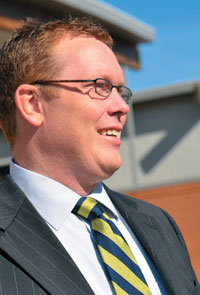
Possibility stems from harmony, says Mayor Ed Malloy (above, brokering fuel as President of Danaher Oil Company). He initiated a visioning process that brought together longtime residents like Suzan Kessel and Sally Denney with Fairfield newcomers like FACC executive director Rustin Lippincott. In another segment of old meets new, the 1960s-era Parsons College organ has been restored by Dan Glass and John Connet and installed in the 21st-century Fairfield Arts & Convention Center in 2009.
Some in the meditation community wanted the building to adhere strictly to Sthapatya Veda architectural principles. Many fiscally conservative, traditional Fairfield residents were concerned the town would be saddled with a white elephant few would use.

“The nucleus was patient,” says Denney. “We worked together because we had a common goal.”

Today’s FACC is more than either Kessel or Denney imagined, both in terms of space and the way that space represents the community.

The $10 million facility — built with the financial support of 1,100 individuals and companies — includes a 522-seat theater, an art gallery, office space, and meeting rooms that make the site attractive for private music and cultural events as well as for regional conventions.

Acts that take the Center’s stage range from local dance recitals to mixed martial arts, comedy, Way Off Broadway (Iowa’s only professional music theater company), and professional touring companies. Other parts of the facility are busy with class reunions, wedding receptions, and business meetings.

Fairfield is a diverse community, and the Center is where you really see the community mix,” says Denney. “This whole project has been a boon for Fairfield. Any conflicts have been far outweighed by the good. The Center brings us together.”

Staying focused on strategic priorities, says Malloy, positions Fairfield for opportunity. Rustin Lippincott, who moved from Nauvoo, Illinois, in 2007 and is now FACC executive director, applauds the mayor’s leadership.

“Ed has created an environment where everyone in Fairfield feels part of the mix for making Fairfield what it is.”

He pauses and decides on a sports analogy: “There are a lot of players in Fairfield, and not many are standing on the sidelines.”

Related article: Iowa Outdoors: Fairfield’s Abundance Ecovillage: Harmonious Living With Nature — Off The Grid

See KRUU FM’s Tanner & Moore Dream Green show featured in The Iowan Magazine Jan/Feb 2012 issue: The energy of two inquisitive minds fuels on-air conversations in Iowa, about Iowa: page 1 and page 2.

Maharishi University of Management‘s Sustainable Living Center is featured in the current March/April 2012 issue, under [potluck] titled Beyond LEED, on page 10. http://www.iowan.com.

To find out more about Fairfield and neighboring Maharishi Vedic City, visit http://discoverfairfield.org.


See NPR: Fairfield, Iowa: Where ‘Art Belongs To Everyone’

Post Traumatic Stress and How Transcendental Meditation Can Help [Infographic]

November 12, 2011

Post Traumatic Stress and How Transcendental Meditation Can Help [Infographic]

Over half a million of our Veterans from Iraq and Afghanistan are suffering from Post Traumatic Stress (PTS). It stopped me in my tracks when one of my patients said, “it can happen once in your life, but one hundred times in your mind.” The echoes linger on… This is a very serious dilemma not only for our nations veterans, but for countless individuals that have experienced any variety of serious trauma in their lives. The stress surrounding the attacks from 9-11-2001 are a great example of this type of trauma on a much grander scale.

Post Traumatic Stress and How Transcendental Meditation Can Help [Infographic] is an informative graphic portraying the seriousness of Post Traumatic Stress and how Transcendental Meditation can help folks to cope with this disorder. Click on this link to see the infographic: http://www.normanrosenthal.com/blog/2011/11/post-traumatic-stress-and-how-transcendental-meditation-can-help-infographic.

Brought to you by Norman Rosenthal MD.

Traumatic stress is a type of stress that exists on an entirely different level than that of the stress you and I encounter on a daily basis. Our bodies do not know how to process the impact that these scarring events have had on us, and in return the impression left on the brain is one that needs healing and recovery to restore its natural state of holistic functioning.

My desire is to help to provide individuals with the best tools available in treating and alleviating these serious mental and physiological patterns. With knowledge, guidance and practical tools we can start to reduce the painful flashbacks from our stress born incidents of the past. A little bit of specific help to restore hope, restore balance and restore the quality of life for the millions of people who are experiencing Post Traumatic Stress.

If you found this infographic informative please feel free to embed it on your website or share it on the social networks using the functionality seen below.

Wishing you Light and Transcendence,

Norman

———————————————————

Resources:
1) Learn more about Transcendental Meditation here.
2) Learn more about what the David Lynch Foundation is doing for our
Veterans at Operation Warrior Wellness.
3) Below is a relevant video titled: Mother of Iraq War Vet says Transcendental Meditation Saved Her Son’s Life

PTSD Infographic
Post-Traumatic-Stress-Disorder-PTSD-Transcendental-Meditation Brought to you by Norman Rosenthal MD.

Chandrika Tandon Benefit Concert in Iowa Helps Launch Global Peace Initiative

November 9, 2011

Chandrika Tandon Benefit Concert in Iowa Helps Launch Global Peace Initiative to Support 10,000 Maharishi Vedic Pandits

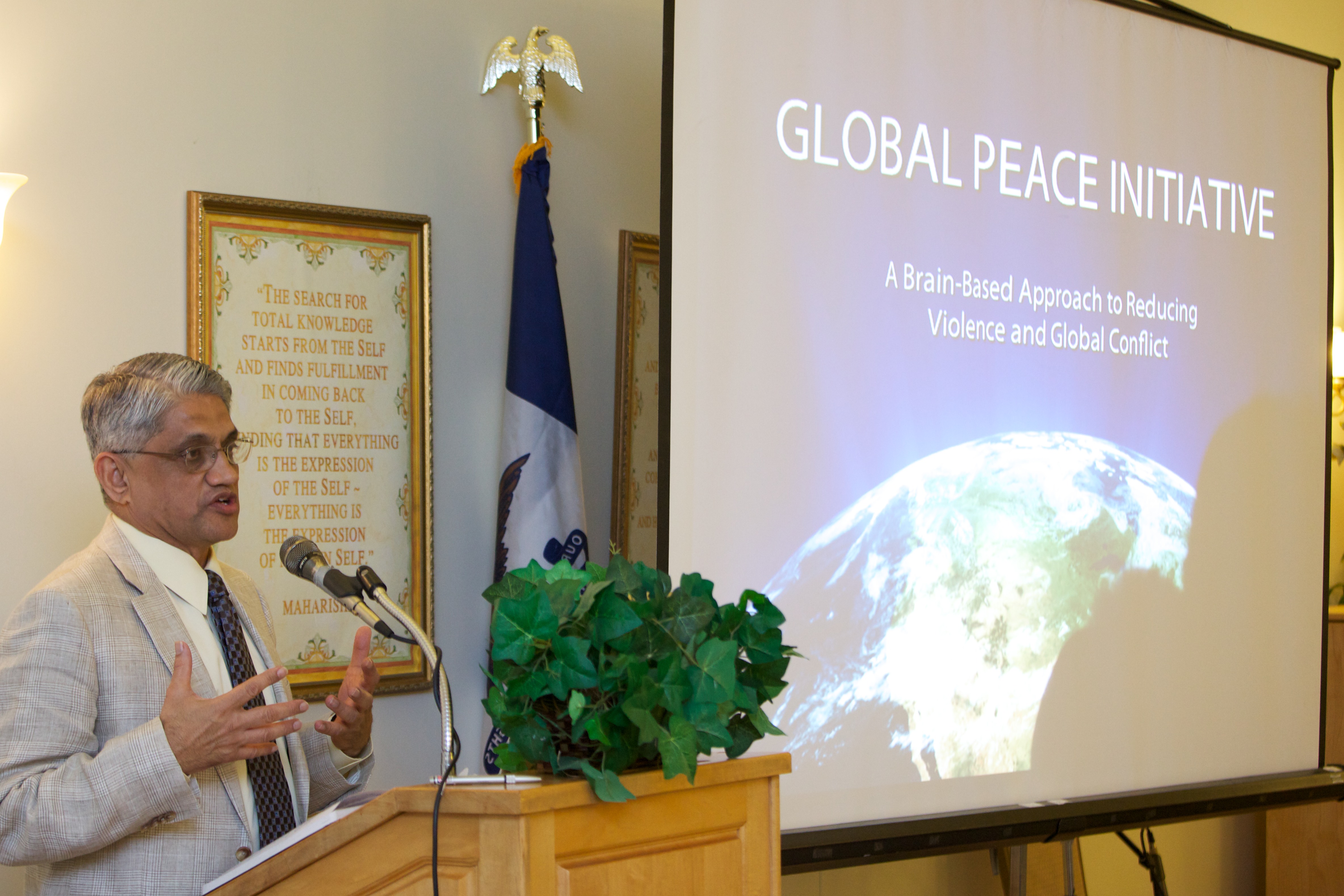
November 9, 2011: (MAHARISHI VEDIC CITY, IOWA) Leaders of the Global Peace Initiative hosted a Vedic Visitors Weekend, November 4 to 6, at Maharishi Vedic City in southeast Iowa, attracting Indo-Americans from cities as far away as Los Angeles and New York.

All the participants assembled for one purpose: to experience a weekend devoted to peace and all things Vedic: Vedic education, Vedic health, Vedic agriculture, and Vedic architecture.

The weekend culminated with Grammy-nominated world music artist, Chandrika Tandon, performing a stunning sold-out benefit concert at the Stephen Sondheim Theatre.

“The combination of different instruments and Chandrika’s voice revealed to me what World Music should be all about,” said Vinod Nayagar, a university student who attended the concert.

“All the sounds emerged from the same source, they resonated and built on each other’s vibrations at the subtlest, most blissful level of creation. The sounds were indistinguishable at transcendental moments—they created a harmony and unity from sound, which is the true purpose of music,” Mr. Nayagar said.

Ramani Ayer, retired CEO of the Hartford Financial Group and current Director of Development for the Global Peace Initiative, who served as a host of the weekend, said, “We invited Indo-Americans from around country to experience how powerful, valuable and relevant the practical application of ancient Vedic wisdom, as developed by Maharishi Mahesh Yogi, is to our daily lives and to the improvement of society.”

Leading Scientists Present Research on Meditation and World Peace

Fred Travis, Ph.D., Director of the Center for Brain, Consciousness, and Cognition at Maharishi University of Management in neighboring Fairfield, Iowa, is one of the world’s leading researchers on the brain, consciousness and meditation. His scientific presentation during the weekend on the effects of Transcendental Meditation on brain functioning was highlighted by slides and graphics illustrating the beneficial changes that occur as a result of regular TM practice.

From EEG signatures and connectivity maps, Dr. Travis showed how different meditation practices impact different parts of the brain. “Most meditations fall into two categories,” Dr. Travis said.

“First are ‘focused attention’ techniques, which require you to concentrate on an object, or a particular word or phrase. The second are ‘open monitoring’ techniques, which involve being mindful of your thoughts or breath without interfering with them. This approach attempts to still the mind and become an uninvolved witness to activity. But these attempts are on the surface level of the mind,” he said.

Dr. Travis then identified a third category—“automatic self-transcending”—a process that allows the mind to transcend its own activity. “This is the Transcendental Meditation technique, during which the mind transcends effortlessly, and arrives at the depth of consciousness, the source of the thinking mind, transcendental consciousness, or Samadhi,” Dr. Travis said.

Dr. Travis said that after several months of TM practice, the brain begins to demonstrate increased connectivity, even outside of meditation. “The brain functions more holistically, which accounts for the meditating student’s improved academic achievement. The student is able to absorb, integrate, and express knowledge more effectively,” Dr. Travis said.

Dr. G.V. Naidu, who traveled from St. Louis to attend the conference, said, “The scientific documentation of ‘The Neurophysiology of Enlightenment’ by Dr. Travis was impressive. And a subsequent presentation by physicist Dr. John Hagelin was a climax of the conference.”

World-Renowned Physicist Explains Global Peace Initiative

John Hagelin, Ph.D., a Harvard-trained, internationally renowned quantum physicist, provided the modern scientific understanding and corroborating scientific research documenting how groups of experts in the Transcendental Meditation and advanced TM-Sidhi program can neutralize violence and conflict and create world peace.

“Extensive research published in peer-reviewed scientific journals verifies that Transcendental Meditation dramatically reduces acute individual stress and its deleterious effects on brain and behavior far more effectively than other methods,” Dr. Hagelin said.

“But perhaps more interesting and important are the 23 published studies which show that relatively small numbers of people practicing the Transcendental Meditation and TM-Sidhi program together in a group can reduce crime, violence, and war throughout the entire population,” he said.

Citing studies conducted in the Middle East showing reductions in war death and violence by 70 percent, Dr. Hagelin said, “There is no approach to peace that has been so thoroughly tested and rigorously established. And now, since the arrival in America five years ago of the large group of Vedic Pandits, there has been a significant decrease in violent crime in America’s largest cities. We are mobilizing to add more numbers to the group, to create an even more positive effect in America.”

Thousands of Maharishi Vedic Pandits to Create Global Peace Effect through Yoga and Yagya

Ramani Ayer provided a vision of the goal of the Global Peace Initiative: To maintain permanent peace-keeping groups of 9000 Vedic Pandits in India and 1250 Vedic Pandits in the United States—the number established by research that is sufficient to create a concrete and demonstrative positive global effect.

“The Vedic Pandits’ daily practice of the TM and TM-Sidhi program establishes their consciousness in Yoga, the pure field of intelligence, at the basis of all creation. And their Vedic recitation from that deep and pure level creates a powerful influence of peace for humanity. This perfect combination of Yoga and Yagya will help create a much higher quality of life for the whole world’s population,” Mr. Ayer said.

The Global Peace Initiative is building an endowment fund to create and maintain these large groups of Vedic Pandits in perpetuity.

Maha Rudrabhishek with 121 Maharishi Vedic Pandits

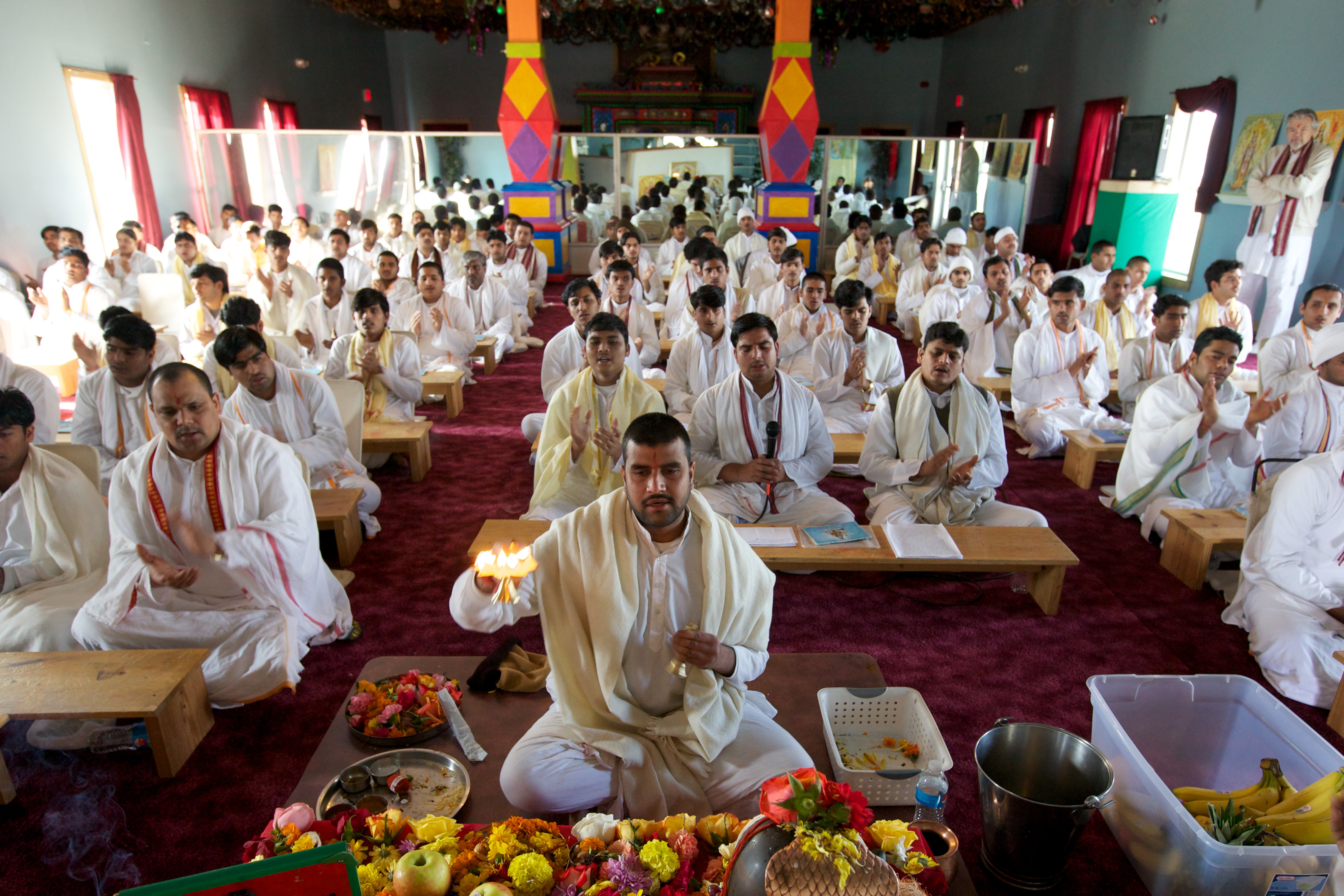
Another sublime highlight of the weekend was the performance by 121 Maharishi Vedic Pandits of Rudrabhsihek.

“It’s an amazing sight to drive over the rolling hills of Iowa and see spread before you a campus where nearly 1000 Maharishi Vedic Pandits from India reside,” said Meenakshi Ghai, from Chicago’s western suburbs, who made the four-hour drive from Chicago with her daughter-in law to attend the weekend. “It was a non-stop wonderful experience packed into 36 hours.”

Mohan Pillai from Long Island, New York, who attended the conference with his family, said, “I cannot describe in words what is was like to hear such a powerful chanting of the Rudrabhishekam. The inner feeling was so good—it was beyond words. I could understand how such large groups of well-trained Vedic Pandits can create peace.”

G.V. Naidu expressed enthusiasm for the global initiative: “We were pleasantly surprised to see that Maharishi Vedic Vishwa Vidyalaya is training thousands of Vedic Pandits here in America as well as in India. These Vedic Pandits are propagating and sustaining ancient Vedic culture. At the same time, they are conducting fundamental research on the positive effects of meditation—far more than any other organization. I wish more people will participate in future seminars conducted by Maharishi University of Management,” Mr. Naidu said.

Mr. Ayer concluded: “As Indians who cherish the Vedic tradition in our hearts, we should feel very proud that this great knowledge has given us a practical means to create peace in the world.”

For more information, visit www.GlobalPeaceInitiative.org and www.VedicPandits.org.

Also see Global Peace Initiative: 13 Questions and Answers with Ramani Ayer, Chandrika Tandon Concert to Benefit 1000 Maharishi Vedic Pandits Launches Global Peace Initiative, and Lavina Melwani interviews Chandrika Tandon on her Grammy Award nomination.

How The Uncarved Blog got its name

November 7, 2011

How The Uncarved Blog got its name by Ken Chawkin

Some readers have asked me about the name of my blog, what it means, and how I came up with it. When I explain it to them they say I should write it down for others to see. So I just added it to the About section, and have also decided to include is as its own post. Here it is:

Heather Hartnett at the David Lynch Foundation, encouraged me to set up my own blog and post all the TM-related articles I was sending around. So, when I thought of the word, blog, it reminded me of the word, block, the uncarved block specifically, a term from Taoism that means the uncreated pure potentiality from which all things are created, the Tao, the source of the 10,000 things. It also reminded me of the unmanifest pure Creative Intelligence Maharishi talks about in his Science of Creative Intelligence, the field of pure potentiality; also the Unified Field of all the Laws of Nature, the Veda within Atma, Sutratma, the Self. And since ‘block’ and ‘blog’ sounded so similar, I thought it was a clever poetic way of coming up with a name.

I first read about the uncarved block in a wonderful book, Creativity and Taoism, by Chang Chung-Yuan. In it he described how the Taoist artist, a sculptor in this case, used to meditate, fast, purify himself first, and then go into the forest to find the right tree that for him contained the vision of what he was called to create. He would take that block of wood back to his studio and carve it out. Think Michelangelo freeing the statue from the marble he was carving.

Same message in the Bhagavad Gita translated and commented on by Maharishi Mahesh Yogi, the founder of the Transcendental Meditation program and Maharishi University of Management: Transcend, Be, then act; and, established in Being perform action. Established in the Self, act in tune with Natural Law. Then you’ll be more successful in actualizing whatever inspired vision, or idea, you had that motivated you to create, whether it’s a poem, a painting, a piece of sculpture, or a blog post.

I certainly enjoy blogging, and glad I started. It’s a fun creative process using digital words, images, and sounds, to carve out something meaningful for myself and hopefully my readers. Of course, there’s so much more one can do in terms of the look and functionality of a blog. That takes up even more time, so I’ll leave that up to the good folks at WordPress.com to keep coming up with more ways to improve the experience, both for bloggers and readers. Enjoy exploring The Uncarved Blog, and thank you for visiting!

And in case you were wondering what the small colored abstract square you see next to the link in your finder at the top left, or on the right next to my comments, is all about, it’s one of Ken West’s photos, used as the blog picture, or icon, for The Uncarved Blog. Here is the complete photo © 2008 Kenneth G. West Jr.. Click on it and it will open up in a larger format. I chose it for its beauty and abstract quality; it can mean different things. For more information and links to a video and photo gallery, check out this blog post: Ken West and his unique landscape photographs are featured on IPTV show Iowa Outdoors.

Another Fall Haiku

November 6, 2011

Another Fall Haiku

The wind is blowing
Leaves on the ground are running
Winter is coming

*

Another Fall Haiku
(2nd version)

Cold winds are blowing
Fall leaves are running … running
Winter is coming

© Ken Chawkin
November 6, 2011
Fairfield, Iowa

See The Fall in Five Haiku and 13 Ways to Write Haiku: A Poet’s Dozen

Lavina Melwani interviews Chandrika Tandon on her Grammy Award nomination

November 6, 2011

FEBRUARY 11, 2011

A Corporate Trailblazer Goes for Grammy Gold

By LAVINA MELWANI

Also see: Chandrika Tandon and ‘Soul Call’ at the Grammy Awards (includes music video clip)

[GRAMMY1]Philip Montgomery for The Wall Street Journal

Grammy-nominated musician Chandrika Tandon plays a Tambura, a traditional Indian stringed instrument, in her home on the Upper East Side.

She is the quintessential underdog, the unknown. Chandrika Krishnamurthy Tandon, a financial advisor and a trustee of New York University, is also a nominee for the Grammy Award in the Best Contemporary World Music Album category, and she’s up against veterans and superstars of the music world—Bela Fleck, Bebel Gilberto, Angelique Kidjo and Sergio Mendes.

Ms. Tandon’s résumé doesn’t exactly read like that of a music diva: A graduate of the Indian Institute of Management in Ahmedabad, she was a partner at the corporate consulting firm McKinsey and Company before founding Tandon Capital Associates in 1992. Apart from her work at NYU, she is a board member of the American India Foundation (AIF) and the founder of Tandon Foundation. There’s not a musical note in there—she’s better known on Wall Street than in Woodstock.

Indeed, Ms. Tandon, a 56-year-old Upper East Side resident, earned her Grammy nomination without a major record label or any star power behind her. Yet “Soul Call,” her second self-produced album on her own Soul Chants label, has become a sleeper hit, garnering more than 36,000 followers on Facebook. One, an expecting mother, wrote that her unborn baby kicks and dances when she listens to it; another wrote: “This music is like digging a tunnel deep into my soul.”

The Journal spoke with Ms. Tandon about mixing business with music and the prospect of taking home Grammy gold on Feb. 13 in Los Angeles.What was your reaction when you heard of the Grammy nomination?

Utter shock and wonder. I have such gratitude that the community of music industry folks has taken the time to listen to an unknown. What it’s done is made the music accessible to so many more people than would have heard it otherwise.

Was music a big part of your growing up years in India?

We lived in a joint family where everyone loved to sing, and music would always be playing on the radio. When we had power cuts, my sister, brother and I would sing in the dark—we didn’t care how long the power cuts lasted! (Ms. Tandon’s sister is PepsiCo CEO Indra Nooyi.) We were a simple family where education was so important. Music was my soul but I chose to pursue a career in business.

Tell us about the journey from business success to composing ‘Soul Call’?

Ten years ago I realized that the happiest moments of my life were tied to music and decided to make it center-stage in my life. I searched far and wide to find great masters to give me a rigorous grounding in classical Hindustani music and devoted hours of study despite my tough work schedule. This whole journey has been about going deep into myself, of viewing the world through a kaleidoscope rather than a single lens. We have one short life, are given certain resources and have an obligation to use them. It’s all about giving back, and sharing. That’s why all proceeds of “Soul Call” go to community-building causes.

How have your worlds of business and music intersected?

Music keeps me centered at my deepest level and has made me a more expansive person. I am learning every day that it is easy to radiate grace if you can find it within. This journey has also helped me redefine my concept of perfection—many birds in the forest can sing sweetly even if they are not all nightingales…. we have to honor them all and it does not compromise excellence. After listening to ‘Soul Call’, some of my most reserved business acquaintances are much more forthcoming about their passions and their spirituality, and I hope some have been inspired to actively follow their dreams, even as a second innings.

How much has music affected your life as a New Yorker?

I am a New Yorker inside and out, having lived here for 31 years. I get to listen to all the great Western and Indian musicians more easily here—and sometimes go to the same concert many times! I just love the city, and am very involved in great institutions here, like NYU, where I get to work with some of the greatest minds ever. One of my great passions is a community choir which I founded and conduct for the seniors in the Queens Hindu temple. We perform ancient Sanskrit chants set to rocking western harmonies, using Indian classical and western vocal training techniques for people who have never sung before. Each session is a shared celebration.

With the Grammy ceremony just days away, what are your thoughts on winning—or not winning?

That’s not the way I think of my life; I don’t think of winning or losing. I think of the Grammys as a happening at a point in time. I’m not trying to use this as a stepping stone to something else. I live by the words of the mystic Kabir:

When ‘I’ was there, the Divine was missing.
When ‘I’ left, the Divine took over.

So the quest is to lose myself and go with the flow.

Copyright ©2011 Dow Jones & Company, Inc. All Rights Reserved

Also see: Chandrika Tandon Concert to Benefit 1000 Maharishi Vedic Pandits Launches Global Peace Initiative, Global Peace Initiative: 13 Questions and Answers with Ramani Ayer, and Chandrika Tandon Benefit Concert in Iowa Helps Launch Global Peace Initiative.

Global Peace Initiative: 13 Questions and Answers with Ramani Ayer

November 6, 2011

Global Peace Initiative: 13 Questions & Answers with Ramani Ayer

Ramani Ayer, former Chairman and CEO of The Hartford Financial Services Group (USA), Chairman of the Brahmananda Saraswati Foundation Development Council

1. What is the Global Peace Initiative?

Ramani: It is a powerful, practical, scientific, and highly cost-effective initiative to reduce violence and conflict in the world. We call it a “brain-based approach to peace.”

2. What do you mean by a “brain-based approach to peace?” And how is it different than other approaches to reduce conflict and terrorism?

Ramani: I think the approach is different because conventional approaches to reducing social violence don’t address the underlying cause which is acute societal stress—whether its political, ethnic, or religious. All of our behavior is directly linked to brain functioning. We know now how stress impacts the brain. It shuts down the prefrontal cortex—the CEO of the brain. Everyone has heard of the “fight or flight” response. Stress can also over stimulate the amygdala, the brain’s “fear center,” causing fear-driven, and aggressive, violent, antisocial behavior. Acute stress on a societal scale impacts the brain and behavior of everyone in society, and that fuels crime and social violence. The brain-based approach to peace solves the problem on a deeper level.

3. How does it work?

Ramani: It is actually simple to understand. Extensive scientific research shows that an easy to learn, evidence-based meditation practice, revived by Maharishi Mahesh Yogi from the Vedic Tradition of India called Transcendental Meditation (TM) dramatically reduces acute individual stress and its deleterious effects on brain and behavior in a far more effective way then other methods. Equally important, TM and its advanced procedures called the TM-Sidhi program activate the prefrontal cortex and different areas of the brain, while deactivating the amygdala—the fear center of the brain. Research has shown it to be highly effective in treating acutely stressed individuals –even difficult cases such as soldiers with PTSD and prisoners in jail.

4. I can understand how meditation works to reduce stress in a person, but how does it reduce societal violence?

Ramani: I do not think it is surprising that if you reduce stress on an individual level, it causes a corresponding reduction of stress on the societal level. But what is surprising, and what has been shown by extensive research, is that a small proportion of a population practicing TM and the TM Sidhi program in a group produces a significant reduction in social stress, and crime and violence. To understand how it actually works, one has to turn to a “field model of consciousness” in which consciousness, at its deepest level, is a field that underlies and connects individuals throughout society.

5. Isn’t a “field model of consciousness” beyond our current theories?

Ramani: It may seem to be, but such a theory is consistent with the latest findings of physics, physiology and neuroscience. In any such model the peace promoting influence of a group will grow as the square of the size of the group. This is what makes the  “brain-based approach to peace” practical. It only takes about 9000 individuals—the square root of 1% of the world’s population practicing the TM and TM-Sidhi program in a group in one place to create an effect large enough to significantly reduce global violence and conflict.

6. Is there any proof?

Ramani: Yes. To date there have been over 50 demonstration projects and 23 scientific studies that confirm the effectiveness of the “brain-based approach to peace.” This research has been carefully scrutinized by independent scholars and published in top academic journals. The demonstration projects have been conducted in many parts of the world including those most prone to violence, such as the Middle East. What the demonstrations show is a dramatic reduction in violence, crime, and war and increased peace and positivity in society. As far as I am aware, there is no approach to create peace that has been so thoroughly tested and rigorously established.

7. Have any of these demonstrations been conducted in India?

Ramani: The first sustained global demonstration project of this approach was held in India from 1987-1990. It involved a group of 7,000 highly trained Maharishi Vedic Pandits from India. The group was located for several years in Noida, outside Delhi.  During the time of the demonstration there were historic, unprecedented, totally unexpected changes in the world: the fall of the Berlin Wall, the end of apartheid, end of the Cold War. It was an amazing time for our world family.

8. Why did the demonstration end?

Ramani: Quite simply, we ran out of funds to support the large group of Maharishi Vedic Pandits. Today, with a larger world population than the 1980’s, in order to create and maintain this peaceful effect on a global scale will require a permanent group of 9000 Vedic experts in one place. This is the square root of one percent of the world’s population, which is a formula derived from science. To endow such a group requires a fund of about $1.1 billion—which is negligible when compared to the 8 trillion cost of global violence in 2010.

9. Why was a large group of Vedic Pandits from India used to create the effect of peace? Could not any group practicing TM and the more advanced TM-Sidhi program create the effect?

Ramani: Yes, any sufficiently large group of properly trained advanced meditation experts can create this coherent and peaceful effect. But the Maharishi Vedic Pandits, who also practice Transcendental Meditation and its advanced techniques, have a crucial advantage. As beneficiaries of their great family traditions for centuries, these Vedic Pandits have learned how to recite in Sanskrit specific peace-promoting sounds from the level of the Unified Field, the Transcendent—sounds that Maharishi describes as “reverberations of Natural Law.” Through this precise art and science of Vedic recitation, the Vedic Pandits amplify the peace-creating effect. It is for this reason that Maharishi said, “When the Vedic Families of India are able to uphold their tradition of daily recitation of the Vedas from the transcendental level of consciousness then the whole world enjoys peace.”

10. Are there any efforts underway now to build and maintain a large group of Vedic experts?

Ramani: Yes. Maharishi Mahesh Yogi, the founder of this Vedic Peace Technology and the Global Peace Initiative, created in the geographical center of India (near Jabalpur) a 1,700-acre campus for Vedic Pandits. Currently, there are 1,500 Vedic experts in residence there. And very fortunately, in America, at Maharishi Vedic City in Iowa, there is a second campus with about 1,000 Vedic Pandits.  Our goal is to raise the number to 9,000 Vedic experts in India and 1,250 Vedic experts in the USA. This will complete the first phase of the Global Peace Initiative. Subsequent phases will focus on creating additional groups of Vedic experts sufficient to focus specifically on individual countries.

11. What is the money used for that is being raised?

Ramani: Donations from around the world principally are received by The Brahmananda Saraswati Foundation (BSF), a tax-exempt (501c3) organization in the U.S and it’s sister organization in Europe that shares its goals and mandate. The foundation is independently audited. Maharishi established the trust in the name of his Guru, Swami Brahmananda Saraswati, to create a permanent financial basis for peace for the world. The funds are used to create infrastructure on the campuses, train the Vedic experts (which takes years to do), and then pay the Vedic experts an appropriate salary.

12. What kind of training do the Vedic Pandits receive?

Ramani: It is a very thorough training that takes place in three phases. The first phase is in the local villages; the second phase is in regional centers; and the third phase is in the national centers established throughout India. It is important to note that those who complete the training receive academic degrees from Maharishi Vedic Vishwa Vidyalaya, a statutory University established by the government of Madhya Pradesh in India. In the past Maharishi’s organization has actually trained about 50,000 of these Vedic experts, but never been able to maintain them in a group.

13. You were CEO of one of the largest financial firms in the world. How did you get involved in this initiative?

Ramani: I personally had benefited in my own life by practicing Transcendental Meditation. It helped me in so many ways as an individual. And when I met Maharishi, and I saw his deep concern for the future of the world and how he had worked most of his life to create this opportunity for mankind, I really felt I should do whatever I could to see his work come to fruition. Most people don’t even think world peace is possible, that it’s a dream. But I am convinced we now have a scientific, practical, and reliable way to use mankind’s most ancient knowledge, the Veda, to usher in a new destiny for mankind. It’s a very big thing—historic—and it is a joy to be part of the global efforts. As Indians who cherish the Vedic tradition in our hearts, we should feel very proud that this great knowledge has given us a practical means to create peace in the world.

For more information, visit www.GlobalPeaceInitiative.org and www.VedicPandits.org.

See: Chandrika Tandon Concert to Benefit 1000 Maharishi Vedic Pandits Launches Global Peace Initiative and Chandrika Tandon Benefit Concert in Iowa Helps Launch Global Peace Initiative.

Chandrika Tandon Concert to Benefit 1000 Maharishi Vedic Pandits Launches Global Peace Initiative

November 5, 2011

Chandrika Tandon Concert to Benefit 1000 Maharishi Vedic Pandits Launches Global Peace Initiative

Chandrika Krishnamurthy Tandon, a 2011 Grammy nominee for world music, will perform a benefit concert Sunday, November 6, at the Sondheim Center for the Performing Arts in Fairfield, Iowa, as the grand finale of the Vedic Visitors Weekend taking place November 4-7.

Sponsored by the Global Peace Initiative, the Vedic Visitors Weekend will offer influential Indo-American leaders a taste of one of the most Vedic communities in North America — Maharishi Vedic City, just north of the campus of Maharishi University of Management in Fairfield, Iowa.

“This special concert will launch the Global Peace Initiative, an intensified global effort to establish large, permanent groups of Maharishi Vedic Pandits in India and America,” said Raja John Hagelin. “These two groups will create an unshakable foundation for lasting peace and the fulfillment of Maharishi’s great legacy for the world.”

A world-renowned performer, Ms. Tandon is known for music that celebrates the grace in our innermost selves. The concert will be a major production, with Ms. Tandon bringing her seven-piece ensemble from New York City.

She will also be joined by some of Fairfield’s finest musicians, including Rick Stanley, Tim Britton, Werner Elmker, and more.

“Chandrika’s soulful and refined music matches the expansive mission of the Global Peace Initiative,” said event producer Michael Sternfeld. Ms. Tandon was trained by masters in Hindustani, Carnatic, South American, and jazz traditions. Her album Soul Call has topped world music charts and garnered great acclaim, including a Grammy nomination.

Ms. Tandon was recently instructed in the Transcendental Meditation program. Proceeds from the concert will go to help support the Vedic Pandits.

“This event also presents a special opportunity for our community to express their heartfelt appreciation to the Maharishi Vedic Pandits for all they do to nourish our community and the world on so many levels,” said Maureen Wynne, chief development officer of the Global Peace Initiative.

The concert will be Sunday, November 6, at 7:45 p.m. at the Sondheim Center for the Performing Arts in the Fairfield Arts & Convention Center.

General admission is $15, and $8 for MUM students, faculty, and staff. Tickets are available at the Sondheim box office, online at http://www.FairfieldACC.com, and by phone at 641-472-2787.

Dozens of Indo-American leaders are expected for the weekend. They will enjoy a tour of Maharishi Vedic City, including Maharishi Vastu® homes, the Maharishi Vedic Observatory™, and the Maharishi Vedic Organic AgricultureSM  program.

They will also visit the Maharishi Vedic Pandit campus and have the opportunity to attend classes at Maharishi University of Management.

————
Also reported in Iowa Association of Private Colleges and Universities: Grammy Nominated Musician Performs at MUM.

See: Global Peace Initiative: 13 Questions and Answers with Ramani Ayer, Chandrika Tandon Benefit Concert in Iowa Helps Launch Global Peace Initiative.