Mary Oliver went Swimming, One Day in August, to deepen and quiet her spirit, then wrote about it. The poem was published in RED BIRD (2008) and posted @maryoliverofficial Instagram with other wonderful poems. It is a perfect metaphor for transcendence and renewal. We may not be able to swim in the sea, but we can dive daily into our own consciousness with our TM practice to experience “the deepening and quieting of the spirit,” then come out refreshed to take on the day.
Swimming, One Day in August

It is time now, I said,
for the deepening and quieting of the spirit
among the flux of happenings.

Something had pestered me so much
I thought my heart would break.
I mean, the mechanical part.

I went down in the afternoon
to the sea
which held me, until I grew easy.

About tomorrow, who knows anything.
Except that it will be time, again,
for the deepening and quieting of the spirit.
Publisher Beacon Press on Red Bird
“Red bird came all winter / firing up the landscape / as nothing else could.” So begins Mary Oliver’s twelfth book of poetry, and the image of that fiery bird stays with the reader, appearing in unexpected forms and guises until, in a postscript, he explains himself: “For truly the body needs / a song, a spirit, a soul. And no less, to make this work, / the soul has need of a body, / and I am both of the earth and I am of the inexplicable / beauty of heaven / where I fly so easily, so welcome, yes, / and this is why I have been sent, to teach this to your heart.” — Taken from Mary Oliver’s publisher Beacon Press on Red Bird.
See this remembrance of Mary Oliver (1935-2019) and her astonishing poetry, with links to articles, interviews, and readings, as well as more of her favorite poems I’ve loved and posted over the years.
— Written and compiled (citing sources) by Ken Chawkin for The Uncarved Blog.
See this remembrance of Mary Oliver (1935-2019) and her astonishing poetry, with links to articles, interviews, and readings, as well as more of her favorite poems I’ve loved and posted over the years.
— Written and compiled (citing sources) by Ken Chawkin for The Uncarved Blog.
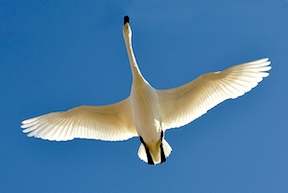
Mary Oliver’s poem, Swan, asks us if we see, hear, and feel what she does, drawing rich references to the beautiful aspects of a swan, culminating in two powerful questions.
Did you too see it, drifting, all night, on the black river? Did you see it in the morning, rising into the silvery air, an armful of white blossoms, a perfect commotion of silk and linen as it leaned into the bondage of its wings; a snowbank, a bank of lilies, biting the air with its black beak? Did you hear it, fluting and whistling a shrill dark music, like the rain pelting the trees, ...like a waterfall knifing down the black ledges? And did you see it, finally, just under the clouds — a white cross streaming across the sky, its feet like black leaves, its wings like the stretching light of the river? And did you feel it, in your heart, how it pertained to everything? And have you too finally figured out what beauty is for? And have you changed your life?
The questions that Mary Oliver asks her readers at the end of the Swan poem remind me of the one she asks at the end of The Summer Day (aka “The Grasshopper”).
See this remembrance of Mary Oliver (1935-2019) and her astonishing poetry, with links to articles, interviews, and readings, as well as several of her favorite poems I’ve loved and posted over the years.
— Written and compiled (citing sources) by Ken Chawkin for The Uncarved Blog.
Do you remember hearing a cricket chirping at night? Did you enjoy listening to its song, or was it annoying? Two well-known poets wrote about their encounters with a cricket, but from different points of view—the poet and the cricket.
I first found this poem, Nothing Is Too Small Not to Be Wondered About, by Mary Oliver. Attentive to all creatures, including the smallest of them, she wonders what happened to the cricket after it stopped its singing.
I then came across another poem about a cricket, Postlude, by Rita Dove. But it’s written from the perspective of one with something to say, and the magic that can happen when we stop and listen.
The cricket doesn’t wonder
    if there’s a heaven
or, if there is, if there’s room for him.

It’s fall. Romance is over. Still, he sings.
If he can, he enters a house
    through the tiniest crack under the door.
Then the house grows colder.

He sings slower and slower.
    Then, nothing.

This must mean something, I don’t know what.
    But certainly it doesn’t mean
he hasn’t been an excellent cricket
    all his life.

Mary Oliver, “Nothing Is Too Small Not to Be Wondered About.” Felicity: Poems. New York: Penguin Press, 2016.
I found that one on Best Poems, and then as it appears with line breaks on page 27 of Felicity posted at the University of Arizona Poetry Center under Poems of Love and Compassion.
2nd cricket poem
PostludeRita DoveStay by the hearth, little cricket.
—Cendrillon
You prefer me invisible, no more than
a crisp salute far away from
your silks and firewood and woolens.
Out of sight, I'm merely an annoyance,
one slim, obstinate wrinkle in night's
deepening trance. When sleep fails,
you wish me shushed and back in my hole.
As usual, you're not listening: time stops
only if you stop long enough to hear it
passing. This is my business:
I've got ten weeks left to croon through.
What you hear is a lifetime of song.
Read about Mary Oliver (1935-2019) and her astonishing poetry in this memorial acknowledgment to her poetic legacy. It contains links to articles, interviews, and poetry readings, as well as many of her favorite poems I’ve loved and posted over the years.
— Written and compiled by Ken Chawkin for The Uncarved Blog.
I recently discovered Ada Limón. I found her refreshing and her poetry accessible. She is the author of six poetry collections and is the recipient of fellowships from the Guggenheim Foundation, the New York Foundation for the Arts, the Provincetown Fine Arts Work Center, and the Kentucky Foundation for Women. This past summer she was selected as the 24th U.S. Poet Laureate for 2022-2023.
Here are 3 related sequential videos: a Library of Congress interview, followed by a PBS interview and announcement, and Ada Limón giving her inaugural reading as the 24th Poet Laureate Consultant in Poetry at the Library of Congress. I added a bonus video at the bottom, from 2019—Life of a Poet: Ada Limón.
1. July 12, 2022: Ada Limón: 24th Poet Laureate (19 min)
Ada Limón talks about her poetry and her appointment as U.S. Poet Laureate with Library of Congress Chief Communications Officer Roswell Encina, in the Library’s Poetry Room.
When asked how she writes, Ada explains that composing a poem is an all-body experience for her. She involves all her senses, not just her mind. She is asked what inspires her, and replies: “I find inspiration in so many different things. I always say the muse is, or my muse is the world. It’s everything.”
At 6:45, she expresses the essence of what it means to be a poet.
But I think I’m always amazed by how deep attention can turn into a poem, that deep looking is a way of loving. And it can transform the smallest thing into something of great importance. And no matter how many years I’ve been writing poems and no matter what I’ve done, that is the thing that brings me the most joy, that gives me shivers, the way that looking and attention and really giving your all to something can transform it.
I’m always amazed by how deep attention can turn into a poem, that deep looking is a way of loving…can transform the smallest thing into something of great importance…the thing that brings me the most joy, that gives me shivers, the way that looking and attention and really giving your all to something can transform it. (edited)
Ada Limón, 24th U.S. Poet Laureate
The other side of the equation, of course, is how the poet is also transformed by this process. It is obvious that Ada Limón was meant to be a poet, and now a poet laureate.
But what she said reminds me very much of what Rainer Maria Rilke wrote about this experience. I discovered it in Jane Hirshfield’s book, Nine Gates: Entering the Mind of Poetry, in the chapter on Poetry and the Mind of Indirection, pages 119-120. Rilke gets to the essence of what that deep attention, deep looking (and loving), can bring a devoted poet. Hirshfield writes:
Both readings of Novalis’s aphorism—that an awareness in the things we wish to observe and know, and that the way we come to them matters—enter into a letter from Rilke, sent in the winter of 1920 to Baladine Klossowska, a lover and fellow writer with whom he shared a passionate correspondence.
This next paragraph, translated by Stephen Mitchell, reveals that essential art of deep seeing, and its surprising hidden reward of spiritual transformation.
These Things whose essential life you want to express first ask you. “Are you free? Are you prepared to devote all your love to me . . . ?” And if the Thing sees that you are otherwise occupied with even a particle of your interest, it shuts itself off; it may perhaps give you some slight sign of friendship, or word or a nod, but it will never give you its heart, entrust you with its patient being, its sweet sidereal constancy, which makes it so like the constellations in the sky. In order for a Thing to speak to you, you must regard it for a certain time as the only one that exists, as the one and only phenomenon which, through your laborious and exclusive love, is now placed at the center of the universe, and which, in that incomparable place, is on that day attended by angels.
These Things whose essential life you want to express first ask you. “Are you free? Are you prepared to devote all your love to me . . . ?” … In order for a Thing to speak to you, you must regard it for a certain time as the only one that exists, as the one and only phenomenon which, through your laborious and exclusive love, is now placed at the center of the universe, and which, in that incomparable place, is on that day attended by angels. (edited)
Rainer Maria Rilke in a letter to Baladine Klossowska
For John Keats, this experience of reverse deep seeing was to inhabit a state of being perceived outside himself. It involved negating his Self to become The Other, what he described as ‘negative capability’.
2. Jul 27, 2022: PBS NewsHour: Ada Limón on becoming the new U.S. poet laureate (6 min)
Ada Limón has been named the nation’s new poet laureate. Jeffrey Brown recently met with Limón to learn more about her life’s path, one that includes backyard groundhogs, Kentucky bluegrass, pokeweed and plenty of poetry. It’s part of our arts and culture series, “CANVAS.”
3. Sept 29, 2022: Live! at the Library: U.S. Poet Laureate Ada Limón Opening Reading (56 min)
Award-winning poet Ada Limón will give her inaugural reading as the 24th Poet Laureate Consultant in Poetry at the Library of Congress, with an introduction by Librarian of Congress Carla Hayden. The historic reading marks the beginning of Limón’s laureateship, and it traditionally launches the Library’s literary season.
4. January 30, 2019: Hill Center poetry series, The Library of Congress. (63 min)
Poet Ada Limón discussed her work with Ron Charles, book critic at the Washington Post. It was a rich interactive and intimate conversation, introducing and then commenting on her reading certain meaningful poems from her life. Enjoy Life of a Poet: Ada Limón.
“I do, because it involves a wonderful contradiction, which is, in order for it to happen, you have to be there, and you have to disappear. Both. You know, nothing feels as good as that. Being there and disappearing—being possessed by something else. Something happening through you, but you’re attending it. There are few other things in the world like that, but writing is pretty much a relief from the self—and yet the self has to be utterly there.”
Read about Mary Oliver (1935-2019) and her astonishing poetry in this memorial acknowledgment to her poetic legacy. It contains links to articles, interviews, and poetry readings, as well as many of her favorite poems I’ve loved and posted over the years.
Mary Oliver lived her life that way: “To pay attention, this is our endless and proper work,” and put it into a 3-line poem, Instructions for living a life: Pay attention. / Be astonished. / Tell about it.
In our efforts to fluently express ourselves, writing, primarily, is a process of self-discovery. Burghild Nina Holzer says journal writing allows us to discover who we are and what we have to say.
Talking to paper is talking to the divine. Paper is infinitely patient. Each time you scratch on it, you trace part of yourself, and thus part of the world, and thus part of the grammar of the universe. It is a huge language, but each of us tracks his or her particular understanding of it.
WHO ARE YOU?, a poem in the film, Words and Pictures, invites us to write and discover who we are. There’s a fascinating story behind it.
In Learning by Teaching, Donald M. Murray said: The most accurate definition of writing, I believe, is that it is the process of using language to discover meaning in experience and to communicate it.
A good writer uses words to discover, and to bring that discovery to other people. He rewrites so that his prose is a pleasure that carries knowledge with it. That pleasure-carrying knowledge comes from self-understanding, and creates understanding in the minds of other people.
— Written and compiled (citing sources) by Ken Chawkin for The Uncarved Blog.
Our attention is the greatest gift we can give to someone, or something. It can transform our world. Mary Oliver’s poem, Mockingbirds, teaches us how to listen, and experience the wonders around us.
If you suddenly and unexpectedly feel joy,
don’t hesitate. Give in to it. There are plenty
of lives and whole towns destroyed or about
to be. We are not wise, and not very often
kind. And much can never be redeemed.
Still, life has some possibility left. Perhaps this
is its way of fighting back, that sometimes
something happens better than all the riches
or power in the world. It could be anything,
but very likely you notice it in the instant
when love begins. Anyway, that’s often the
case. Anyway, whatever it is, don’t be afraid
of its plenty. Joy is not made to be a crumb.
These two poems by Mary Oliver describe the nurturing effect of rainwater in nature deep within the body of the earth and inside her own.
LINGERING IN HAPPINESS
After rain after many days without rain, it stays cool, private and cleansed, under the trees, and the dampness there, married now to gravity, falls branch to branch, leaf to leaf, down to the ground
where it will disappear—but not, of course, vanish except to our eyes. The roots of the oaks will have their share, and the white threads of the grasses, and the cushion of moss; a few drops, round as pearls, will enter the mole’s tunnel;
and soon so many small stones, buried for a thousand years, will feel themselves being touched.
At Blackwater Pond the tossed waters have settled after a night of rain. I dip my cupped hands. I drink a long time. It tastes like stone, leaves, fire. It falls cold into my body, waking the bones. I hear them deep inside me, whispering oh what is that beautiful thing that just happened?
Both of these poems remind me of this short poem by William Stafford.
B.C.
The seed that met water spoke a little name.
(Great sunflowers were lording the air that day; this was before Jesus, before Rome; that other air was readying our hundreds of years to say things that rain has beat down on over broken stones and heaped behind us in many slag lands.)
Quiet in the earth a drop of water came, and the little seed spoke: “Sequoia is my name.”
 The Uncarved Blog