Posts Tagged ‘Maharishi University of Management’

Des Moines Register: Oprah in Iowa: Fairfield meditation segment airs Sunday

March 24, 2012


Oprah in Iowa: Fairfield meditation segment airs Sunday

By TODD ERZEN | FILED UNDER – News | 1:28 PM, Mar. 23, 2012

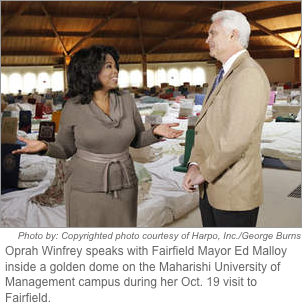
The media icon paid a stealthy six-hour visit to the Maharishi University of Management last October and will tell the country about her newfound devotion to Transcendental Meditation at 8 p.m. on Sunday as part of her new weekly series, “Oprah’s Next Chapter.”

Fairfield Mayor Ed Malloy, who took the media mogul on a tour of one of the university’s golden domes before she meditated there with about 400 other women, said Winfrey already had a working knowledge of Transcendental Meditation based on her experience with inner-city school systems.

The practice has been introduced there to children suffering from academic and behavioral problems with the help of Maharishi board of trustees member David Lynch, the television and film director whose private foundation promotes “Consciousness-Based Education and World Peace.”

“It’s had phenomenal results (in schools) and I think she became intrigued by that,” said Malloy, who has practiced Transcendental Meditation for 38 years. “Oprah’s bright and energetic and gregarious and thoughtful and provocative and we are honored and tickled to be featured by her in this way.”

Watch a sneak preview of the show

Sneak Preview: Oprah Visits America’s Most Unusual Town

Oprah spends the day in Fairfield, Iowa—one of the safest, greenest and most unusual communities in America. It’s the last place you’d expect to find two huge golden domes built for the thousands of residents who rush there to meditate twice a day. Watch a sneak preview; then tune in for the full episode of Oprah’s Next Chapter on Sunday, March 25, at 9/8c.


Transcendental Meditation first came to Fairfield by way of the Maharishi Mahesh Yogi, who gained international fame as the guru to the Beatles before transforming the bankrupt Parsons College property into his namesake university in 1974.

In 2001, the Maharishi’s followers incorporated their own town, called Maharishi Vedic City, about two miles north of Fairfield. Sales of non-organic food are banned and buildings are designed to follow principles the Maharishi established, such as facing east and featuring a golden roof ornament. About 1,300 people live there, and an estimated one-quarter of Fairfield’s 10,000 residents also practice Transcendental Meditation.

Winfrey has tried to make a similar impact on her employees by encouraging them to meditate twice during each work day.

Paul Chesnutt-Winer, who hosted Winfrey in his home and will be featured with his family on Oprah’s television show, said the practice of Transcendental Meditation could not have made a better friend.

“She’s an amazing combination of being a strong, executive woman and really a lot of fun,” he said.

See this earlier post by Todd Erzen on Mar 22, 2012 with links to a preview of the show and interview with Dr. Oz on Oprah’s visit to Fairfield and company-wide practice of the Transcendental Meditation technique. Fairfield sees itself through Oprah’s eyes on Sunday.

For information on Transcendental Meditation, visit www.tm.org.

Related articles: Chicago Sun-Times: Oprah will talk about transcendental meditation on OWN | The Fairfield Ledger:Fairfield readies for Sunday debut on Oprah network | OWN: Oprah Visits America’s Most Unusual Town, Sunday, March 25, 8 p.m. CT, 9-10 p.m. ET/PT | KTVO: Fairfield to be featured on Oprah Winfrey Network | Oprah writes in O Mag about her visit to TM Town and meditating with ladies in their Golden Dome | Some Reports on Dr. Oz’s Interview with Oprah about TM and her Next Chapter | Oprah meditates with ladies in MUM Golden Dome | Reports of Oprah’s visit to Fairfield, Iowa | Oprah says she and her staff meditate, enjoy a Quiet Time twice a day—Facebook Live interview. Also see The Iowan: Sizing Up Small Towns: Rethinking Success in Rural Iowa: Fairfield Thinks Inclusively.

The Fairfield Ledger: Fairfield readies for Sunday debut on Oprah network

March 22, 2012

Fairfield readies for Sunday debut on Oprah network

Mar 21, 2012

Sunday’s televising of “Oprah’s Next Chapter” featuring Fairfield and Transcendental Meditation is expected to generate interest in the community.

A number of initiatives are under way to aid tourists and potential visitors.

“There’s a lot of excitement surrounding the airing,” said Maharishi University of Management alum Mariam Daudi, a coordinator for many of the initiatives. “The whole community is coming together to prepare in case there’s a big response. It’s fulfilling to work with so many different community leaders.”

Involved parties include Fairfield officials, Fairfield Area Chamber of Commerce, Fairfield Arts & Convention Center, Maharishi School, M.U.M., Maharishi Vedic City, Maharishi Foundation, David Lynch Foundation and Ideal Community Group.

The convention center is developing a self-guided tour for visitors. A one-day training session for volunteer ambassadors also is in the works.

The welcome and information center at the Maasdam Barns site on Highway 1 South is expanding its hours.

Plans are under way to open the Taste of Fairfield visitors’ weekends in May and June to those who don’t practice the Transcendental Meditation technique. Planning also continues for M.U.M’s Experience the Self event to be held July 10–22.

Oprah visited Fairfield Oct. 19 to film for the hour-long program. It airs on the Oprah Winfrey Network at 8 p.m. Sunday.

Locally, O.W.N. can be accessed on channel 203 on Mediacom, channel 279 on Direct TV, channel 90 on Lisco and channels 189 and 885 on Dish Network.

Student Activities at M.U.M. is hosting a viewing of the program at Dalby Hall in the Argiro Student Center. Doors open at 7:30 p.m.

For more information about the program, visit www.oprah.com/own.

Reprinted with permission from The Fairfield Ledger. Article URL: http://fairfield-ia.villagesoup.com/news/story/226103?cid=14836

Addendum: Members of  the Fairfield community are invited to a live viewing of Oprah’s New Chapter, Sunday, March 25, at 8 pm CT (doors open at 7 pm) at the Sondheim Theater, Fairfield Arts & Convention Center. Free Admission – First come first seated.

See

The Iowan: Beyond LEED: Maharishi University’s Sustainable Living Center

March 5, 2012

[potluck] Beyond LEED

Fairfield, Iowa – March 1, 2012

MUM Sustainable Living Center

Maharishi University of Management's Sustainable Living Center

Compiled by Carol Bodensteiner and Mary Gottschalk

More and more new or renovated structures in Iowa trumpet their commitment to reducing demands on air, water, and energy resources — some even achieving platinum status in LEED (Leadership in Energy and Environmental Design) certification (currently the highest level recognized by the U.S. Green Building Council). The folks at the Sustainable Living Center (SLC) in Fairfield are aiming higher.

Rising to the Living Building Challenge (an international performance-based certification program) and incorporating both Building Biology principles and Maharishi Vedic architecture guidelines, the SLC design introduces such features as the use of naturally hygroscopic materials to self-regulate humidity, the use of natural building materials, and complete water and energy self-sufficiency — the ability to go off the grid.

According to David Fisher, Director of the Sustainable Living Program at Maharishi University of Management (MUM), this higher standard is “doable with current technology.” For example, the combination of insulation, solar and wind powers, and geothermal heat will allow the SLC to generate excess electricity, which will be contributed back to the campus power grid. Similarly, by collecting rainwater for drinking and running black/gray water through a peat moss filtering system for irrigation, the building will have net zero water usage.

In addition to being resource-neutral (and, possibly, resource-positive), the SLC has other unique features, including 16 whole aspen tree trunks that provide major structural support for the building and 26,000 earthen blocks manufactured by MUM students out of local clays. To avoid any toxic chemicals, plaster has been made from sand, cow manure, and soil; paints are milk-based with color pigments derived from clay, minerals, and spices.

When the building opens this spring as classroom and office space for the Bachelor of Science program in Sustainable Living, the SLC will still be a work in progress, says Fisher. “But we’re going to open so our students can share in the experience of showing the construction industry how it can be done.” — M.G.

For information on the Sustainable Living Center, contact David Fisher at dfisher@mum.edu and visit thesustainablelivingcenter.com. Learn more about Building Biology and Vedic architecture online at baubiologie.de (choose English language) and maharishivastu.org.

Rendering courtesy Sustainable Living Center

Related article: Iowa Outdoors: Fairfield’s Abundance EcoVillage: Harmonious Living With Nature — Off The Grid.

For more information about The Iowan check out these three options:

MUM President Dr Bevan Morris Suggests Ghana Should Consider Consciousness-Based Education

February 3, 2012
   Education  |  3 February 2012

Consider Consciousness-Based Education
Through 15 Minutes Quiet Time

The President of Maharishi University of Management in the United States, Dr Bevan Morris, says the country should consider the adoption of consciousness-based education through which a learning technique known as transcendental meditation or ‘quiet time’ is used to improve academic performance and discipline in schools.

He explained that transcendental meditation was a simple technique to aid the development of total brain functioning so that students could unfold the inner reserves of brain potentials by increasing their creative intelligence, reducing their stress and anxiety and having greater success in their academic performance.

At a presentation on consciousness-based education in Accra, Dr Morris said scientific evidence was so strong that the technique could change students’ lives in positive ways, adding that more than 51 countries in the world had adopted the technique which was working well for their students.

“They (students) just need 10 to 15 minutes practice in the morning and in the afternoon, added to their regular academic programme. They (students) just sit down comfortably in a chair and close their eyes and follow a simple technique that allows the mind to settle down to a more restful stage until they (students) reach a stage of restful alertness where the whole body is deeply relaxed and the mind is silent and peaceful, and when they come out from that they come out with great joy and energy to go ahead and study what they have to study during the day,” he said.

The act, he said, led to excellent academic results and better behavior where the problem of misbehavior such as fighting, destruction of school property and bullying in school was common around the world.

Dr Morris said in tackling indiscipline, it was not adequate to enforce rules and regulations which students were asked to adhere to.

He said with the evidence and experience all over the world, it would be great opportunity for Ghana to look at the practice seriously to be introduced in schools in the country.

The teachers of transcendental meditation, he said, went through four or five months of intensive study to become skillful, adding that there were already teachers of transcendental meditation in Ghana.

Dr Morris said the university was ready to assist in the implementation of transcendental meditation in the country.

He said in practicing the technique, pre-tertiary students could adopt 10-15 minutes while tertiary students could adopt 20 minutes in the morning and afternoon.

He said in the course of transcendental meditation, students did not need to concentrate on anything but would just relax their mind.

Dr Morris said transcendental meditation was not a religious practice, and that it was only a systematic development of brain functioning and higher consciousness.

“TM comes from an ancient tradition in India, ”he emphasised.

The President of Maharishi Foundation in Ghana, Dr T.K. Orgle, said there were two training centres at Labone and Odorkor.

He said TM was being practiced at a school in Chorkor.

The Headmaster of the Manhean Senior High School, Mr Joseph Amuah, said it was up to the country to decide which way to go, as far as transcendental meditation was concerned.

Source: Emmanuel Bonney – Daily Graphic
Also see Permanent World Peace CAN be created says Dr Morris

Maharishi University’s Rao and Bargerstock published in Management Accounting Quarterly

January 15, 2012

Rao and Bargerstock published in Management Accounting Quarterly

Rao and Bargerstock

Manjunath Rao, a Ph.D. candidate at Maharishi University of Management, and his doctoral thesis advisor, Associate Professor, Andrew Bargerstock,  had a paper published in the Fall 2011 issue of Management Accounting Quarterly, the refereed online journal of the Institute for Management Accountants (IMA).

Rao noticed an apparent disconnect with companies not walking their talk. It seems the more mature lean manufacturing plants are still using the older standard costing methods. The paper, Exploring the Role of Standard Costing in Lean Manufacturing Enterprises: A Structuration Theory Approach, was posted online the first week of the year, and presents the theory and research plan for his dissertation. It will address why a majority of manufacturers continue to use traditional standard cost accounting even as they adopt lean manufacturing.

Rao will attempt to understand the nature of this discrepancy, and demonstrate the need for change, for companies to become more current in the way they do business. The system of Lean Management focuses on adding value to customers while streamlining operations and eliminating waste. It grew out of management principles used by the remarkably successful Toyota Motor Corporation.

Mr. Rao said he is very pleased with all of the support the IMA has given him for this research. “The IMA helped me in collecting data for my research by sending out the survey questionnaire to their members, and last June they invited me to participate in their 92nd Annual Conference at Orlando, Florida.”

Lean Accounting Award from the Lean Enterprise Institute Goes to an Accounting Professor and 2 Ph.D. Candidates

Winners of the LEI Excellence in Lean Accounting Award

In September, 2011, Rao was recognized nationally as one of two Ph.D. students who were awarded the Lean Accounting Student of the Year. An accounting professor and two doctoral candidates received 2011 Excellence in Lean Accounting Awards, sponsored by the nonprofit Lean Enterprise Institute (LEI) at the seventh annual Lean Accounting Summit in Orlando, Florida.

And last month, Rao received a $4,000 research grant from the IMA’s Research Foundation’s Doctoral Student Grant Program. The Program is designed to assist accounting doctoral students who are pursuing research that has the potential to contribute to the management accounting profession.

Accounting Methods: Lean vs. SCVA

According to Lean accounting theory published in numerous books and articles, mature lean manufacturing companies are expected to eliminate the use of standard costing and variance analysis (SCVA). However, field reports suggest that many companies continue to retain SCVA even after they have successfully implemented an effective system of work cell metrics.

SCVA is taught worldwide as the traditional method for controlling costs in manufacturing operations by averaging input costs and quantities over the entire production process. It involves setting quantitative average cost and quantity targets for key categories of inputs: material, labor and overhead. Reports are typically generated each month that summarize and compare actual costs to standard costs. Differences (variances) are investigated to determine root causes of unexpected results.

By contrast, in a lean manufacturing company, work cell teams (typically 6-10 people who perform a few sequential tasks) develop the relevant data they need to control quality and costs in real time (as compared to monthly reports with SCVA). From the perspective of Lean Management, work cell metrics are clearly superior to SCVA reports. Mature lean companies are therefore expected to eliminate the more outdated method of reporting.

Surprisingly, there has been no significant research study that has tested the lean accounting theory that mature manufacturers will eliminate SCVA. Rao’s research will gather such information via survey and he will also collect data to understand why companies are retaining SCVA.

Structuration Theory and Vedic Science

Rao utilized GiddensStructuration Theory, a general social theory model, to test the relevancy and completeness of questions on his survey. In his dissertation, Rao will show how Giddens’ theory mirrors Maharishi’s consciousness-based Samhita concept that explains the relationships among the knower, the known, and process of knowing.

“For a long time there was a debate in Western Sociological Sciences regarding Objective versus Subjective approach to knowledge,” explains Rao. “Giddens adopted a reconciliatory approach by stating that objective and subjective approaches are two sides of the same coin. He formulated the structuration theory wherein he introduced three concepts: Structure (object), Agency (subject), and Systems (wherein duality of structure and agency interact).”

According to Rao, “This three-concept model clearly overlaps with the Samhita model where Maharishi speaks of the same three concepts using the language of Vedic Science: Chandas (object), Rishi (subject), and Devata (process or Systems).”

Giddens also emphasizes the interaction of these concepts in three dimensions: Domination, Signification and Legitimation, which Rao says also mirror other concepts in Maharishi’s Vedic Science, the three gunas, or  fundamental operating principles found in nature (Prakriti) and their doshic counterparts, qualities known as Rajas (Pitta=Domination), Sattva (Vata=Signification) and Tamas (Kapha=Legitimation). If any one of these goes out of balance, problems occur.

To summarize Giddens, the Agency Dominates, through a System, which Signifies, and creates a Structure, which becomes Legitimate. This locks others into the existing interpretation of Reality. People get stuck, and there is no room to change to another way of looking at the world, managing or accounting more effectively on the work being done.

It is human nature to resist change, and that includes companies. A quote from Arthur Schopenhauer (1788-1860) on recognizing truth, accepting a different worldview, a different paradigm, seems very relevant here: All truth passes through three stages. First, it is ridiculed. Second, it is violently opposed. Third, it is accepted as being self-evident.

Research from a Consciousness-Based Education Framework

Rao credits M.U.M. founder, Maharishi Mahesh Yogi, for his “Samhita” concept, the togetherness of three basic elements, Rishi, Devata, and Chandas, or Knower, Knowing, and Known, a unique feature of Maharishi University of Management’s Consciousness-Based Education, which, Rao says, made it easier for him to understand difficult material.  “I was able to grasp the wholeness of the problem without getting lost in the details. It has helped me see the forest without getting lost in counting the trees.”

According to Dr. Bargerstock, Rao’s dissertation adviser, “Manjunath’s research has garnered significant attention by experts in the field of lean accounting.  In June 2011, the IMA invited Manjunath to give a poster presentation of his research plan at their annual conference in Orlando, Florida.  In September, 2011, he was named as one of two Ph.D. students nationally who were recognized as Lean Accounting Students of the Year at the Lean Accounting Summit in Orlando, FL.  In December, Manjunath received a research grant award of $4,000 from the IMA.  And now, he is recognized again by the IMA with the publication of this article.  We are very pleased with the progress of Manjunath’s dissertation.”

This is Mr. Rao’s first published article. “I am really thrilled to have my article published even while working on my Ph.D. dissertation.”  He says, “This has made it easier for me to establish relevance for my research in addressing issues currently faced by the management accounting profession.”

Manjunath Rao is a Certified Cost and Works Accountant from India (Grad “CWA), a Certified Management Accountant (CMA), with MBA and Masters in Accountancy (MSA) degrees from the US. He hopes to complete his Ph.D. in Management by June of this year.

Source: Rao and Bargerstock Article Published in Management Accounting Quarterly.

Reported in Iowa Association of Independent Colleges and Universities: MUM Student Receives National Management Accounting Grant, and in MUM’s Achievements and The Review.

Related articles: Maharishi University MBA Students Win National Business Simulation Competition and Iowa and Nepal Rotary Clubs Provide Well for City in Nepal.

Iowa and Nepal Rotary Clubs Provide Well for City in Nepal

December 7, 2011

Rotarians from Fairfield and Nepal Unite for Winning Proposal

Rotarians Andy Bargerstock, Doug Flournoy, and Naya Raj Baral

Fairfield Rotary was instrumental in organizing 16 regional clubs to raise $122,000 for a new well to supply fresh water to serve 10,000 residents of the Jaluke Community in Gaidakot, Nepal.

FAIRFIELD, IA: A community of 10,000 people at the base of the Himalayas in Chitwan province in Nepal will now have a well, thanks to a winning grant proposal submitted to the Rotary International Foundation by Andy Bargerstock, director of the MBA program at Maharishi University of Management, and MBA alumnus Naya Raj Baral.

The grant of $45,700 will cover the costs of a borehole well, pumps, 400,000-liter reservoir tank, and training on the use and maintenance of the water system for the Jaluke Community in Gaidakot, Navalparasi, Lumbini Zone, Nepal.

Dr. Bargerstock is director of the International Service Committee for Fairfield’s Rotary Club, and Mr. Baral, the CFO at Maharishi Ayurveda Products International, is a current member of the Fairfield Rotary Club, and former member of a Rotary Club that meets two miles from the site of this project.

“During a Nepal trip to visit family and friends in Spring 2011, Naya learned about this project that had been presented by a local engineer to the Nepal Rotary Club,” Dr. Bargerstock said. “When he returned to Fairfield, he contacted me. With approval from our local board of directors, we formed a team to develop the application and raise financial support from regional Rotary Clubs. Sixteen regional clubs or members contributed to raising $16,000 as Fairfield’s requirement for co-sponsorship of the grant application.”

Projects that seek funding in excess of $25,000 from the Rotary Foundation are judged on a competitive basis. On an annual basis, only 20-30 such projects receive this degree of funding. With other matching formulas built into the grant application, the total project has generated $122,000.

Dr. Bargerstock says that Rotary is about relationship building. “This project is a good example of the Rotary Club’s focus on relationships since the successful grant application emerged from the collaboration of the clubs in Fairfield and Nepal.”

He emphasized that Rotarian Doug Flournoy from Indian Hills Community College was key in guiding the grant application process, and that Mr. Baral’s relationships with people in Nepal were critical for building credibility.

For more information, visit Jaluke, Nepal Clean Water Project – Page.

Also mentioned in The Buzz about Fairfield: Big Give, and IndiaWest: Grant Provides 10,000 Residents with Water in Nepal.

Also see Maharishi University MBA Students Win National Business Simulation Competition and Maharishi University’s Rao and Bargerstock published in Management Accounting Quarterly.

Chandrika Tandon Benefit Concert in Iowa Helps Launch Global Peace Initiative

November 9, 2011

Chandrika Tandon Benefit Concert in Iowa Helps Launch Global Peace Initiative to Support 10,000 Maharishi Vedic Pandits

November 9, 2011: (MAHARISHI VEDIC CITY, IOWA) Leaders of the Global Peace Initiative hosted a Vedic Visitors Weekend, November 4 to 6, at Maharishi Vedic City in southeast Iowa, attracting Indo-Americans from cities as far away as Los Angeles and New York.

All the participants assembled for one purpose: to experience a weekend devoted to peace and all things Vedic: Vedic education, Vedic health, Vedic agriculture, and Vedic architecture.

The weekend culminated with Grammy-nominated world music artist, Chandrika Tandon, performing a stunning sold-out benefit concert at the Stephen Sondheim Theatre.

“The combination of different instruments and Chandrika’s voice revealed to me what World Music should be all about,” said Vinod Nayagar, a university student who attended the concert.

“All the sounds emerged from the same source, they resonated and built on each other’s vibrations at the subtlest, most blissful level of creation. The sounds were indistinguishable at transcendental moments—they created a harmony and unity from sound, which is the true purpose of music,” Mr. Nayagar said.

Ramani Ayer, retired CEO of the Hartford Financial Group and current Director of Development for the Global Peace Initiative, who served as a host of the weekend, said, “We invited Indo-Americans from around country to experience how powerful, valuable and relevant the practical application of ancient Vedic wisdom, as developed by Maharishi Mahesh Yogi, is to our daily lives and to the improvement of society.”

Leading Scientists Present Research on Meditation and World Peace

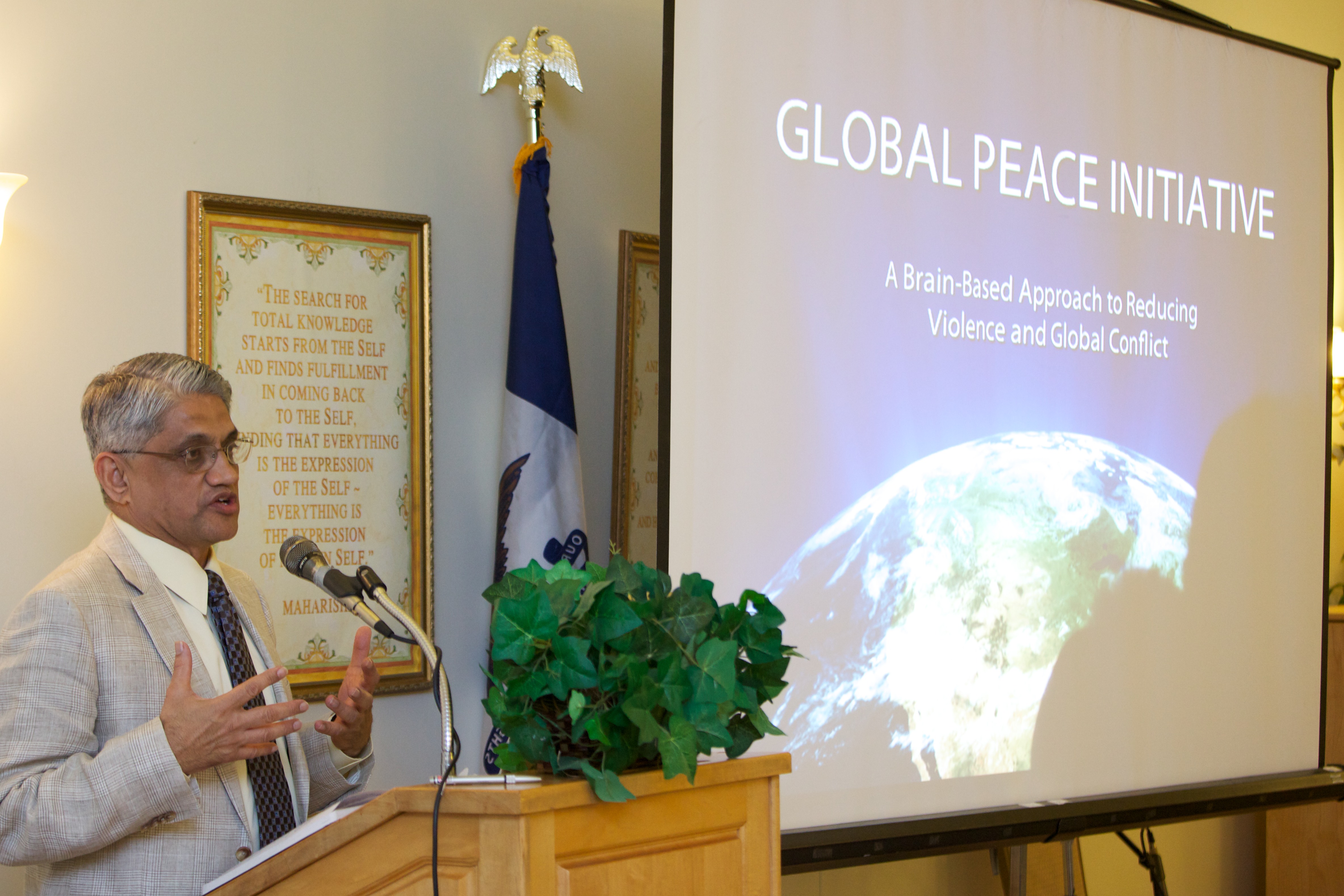
Fred Travis, Ph.D., Director of the Center for Brain, Consciousness, and Cognition at Maharishi University of Management in neighboring Fairfield, Iowa, is one of the world’s leading researchers on the brain, consciousness and meditation. His scientific presentation during the weekend on the effects of Transcendental Meditation on brain functioning was highlighted by slides and graphics illustrating the beneficial changes that occur as a result of regular TM practice.

From EEG signatures and connectivity maps, Dr. Travis showed how different meditation practices impact different parts of the brain. “Most meditations fall into two categories,” Dr. Travis said.

“First are ‘focused attention’ techniques, which require you to concentrate on an object, or a particular word or phrase. The second are ‘open monitoring’ techniques, which involve being mindful of your thoughts or breath without interfering with them. This approach attempts to still the mind and become an uninvolved witness to activity. But these attempts are on the surface level of the mind,” he said.

Dr. Travis then identified a third category—“automatic self-transcending”—a process that allows the mind to transcend its own activity. “This is the Transcendental Meditation technique, during which the mind transcends effortlessly, and arrives at the depth of consciousness, the source of the thinking mind, transcendental consciousness, or Samadhi,” Dr. Travis said.

Dr. Travis said that after several months of TM practice, the brain begins to demonstrate increased connectivity, even outside of meditation. “The brain functions more holistically, which accounts for the meditating student’s improved academic achievement. The student is able to absorb, integrate, and express knowledge more effectively,” Dr. Travis said.

Dr. G.V. Naidu, who traveled from St. Louis to attend the conference, said, “The scientific documentation of ‘The Neurophysiology of Enlightenment’ by Dr. Travis was impressive. And a subsequent presentation by physicist Dr. John Hagelin was a climax of the conference.”

World-Renowned Physicist Explains Global Peace Initiative

John Hagelin, Ph.D., a Harvard-trained, internationally renowned quantum physicist, provided the modern scientific understanding and corroborating scientific research documenting how groups of experts in the Transcendental Meditation and advanced TM-Sidhi program can neutralize violence and conflict and create world peace.

“Extensive research published in peer-reviewed scientific journals verifies that Transcendental Meditation dramatically reduces acute individual stress and its deleterious effects on brain and behavior far more effectively than other methods,” Dr. Hagelin said.

“But perhaps more interesting and important are the 23 published studies which show that relatively small numbers of people practicing the Transcendental Meditation and TM-Sidhi program together in a group can reduce crime, violence, and war throughout the entire population,” he said.

Citing studies conducted in the Middle East showing reductions in war death and violence by 70 percent, Dr. Hagelin said, “There is no approach to peace that has been so thoroughly tested and rigorously established. And now, since the arrival in America five years ago of the large group of Vedic Pandits, there has been a significant decrease in violent crime in America’s largest cities. We are mobilizing to add more numbers to the group, to create an even more positive effect in America.”

Thousands of Maharishi Vedic Pandits to Create Global Peace Effect through Yoga and Yagya

Ramani Ayer provided a vision of the goal of the Global Peace Initiative: To maintain permanent peace-keeping groups of 9000 Vedic Pandits in India and 1250 Vedic Pandits in the United States—the number established by research that is sufficient to create a concrete and demonstrative positive global effect.

“The Vedic Pandits’ daily practice of the TM and TM-Sidhi program establishes their consciousness in Yoga, the pure field of intelligence, at the basis of all creation. And their Vedic recitation from that deep and pure level creates a powerful influence of peace for humanity. This perfect combination of Yoga and Yagya will help create a much higher quality of life for the whole world’s population,” Mr. Ayer said.

The Global Peace Initiative is building an endowment fund to create and maintain these large groups of Vedic Pandits in perpetuity.

Maha Rudrabhishek with 121 Maharishi Vedic Pandits

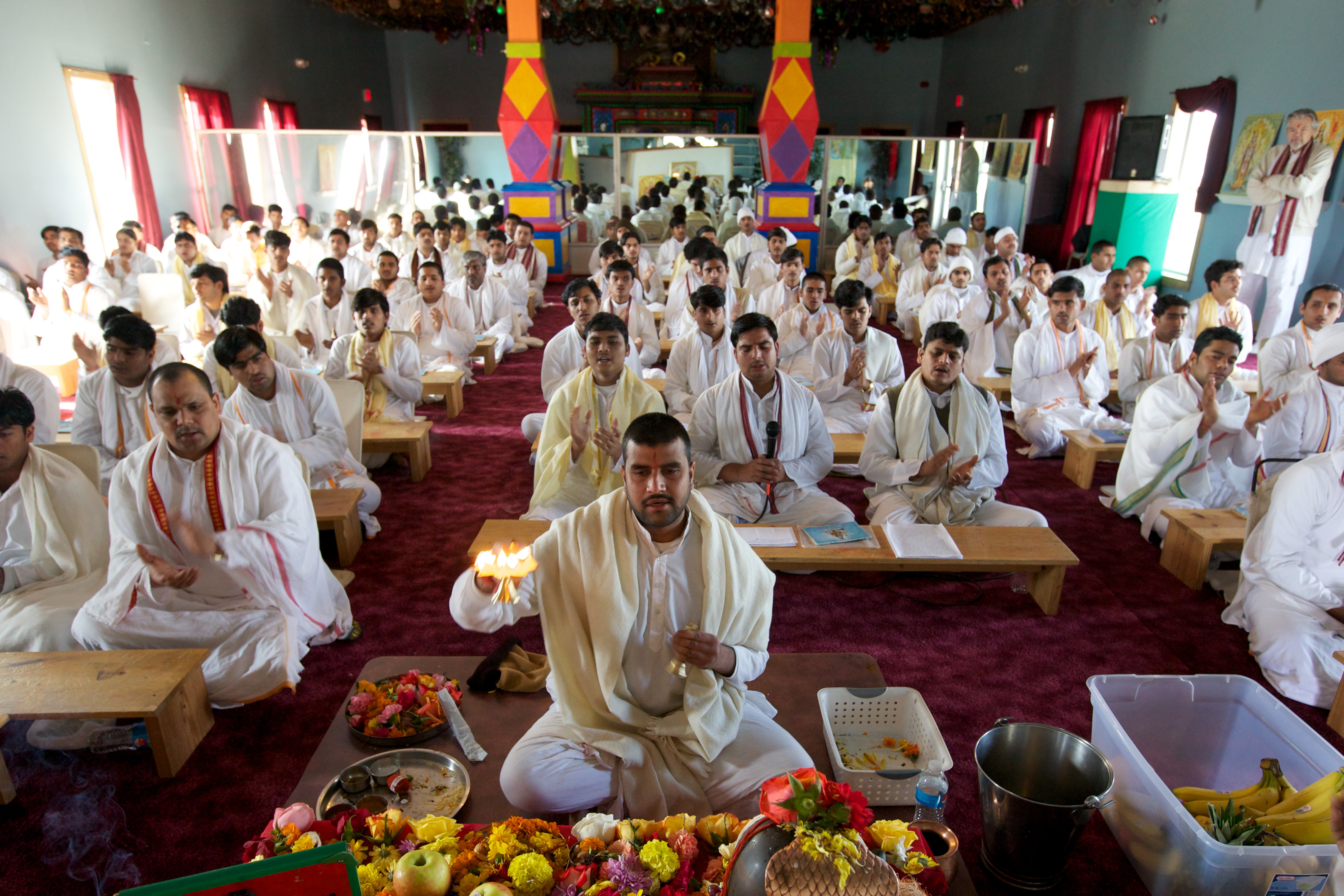
Another sublime highlight of the weekend was the performance by 121 Maharishi Vedic Pandits of Rudrabhsihek.

“It’s an amazing sight to drive over the rolling hills of Iowa and see spread before you a campus where nearly 1000 Maharishi Vedic Pandits from India reside,” said Meenakshi Ghai, from Chicago’s western suburbs, who made the four-hour drive from Chicago with her daughter-in law to attend the weekend. “It was a non-stop wonderful experience packed into 36 hours.”

Mohan Pillai from Long Island, New York, who attended the conference with his family, said, “I cannot describe in words what is was like to hear such a powerful chanting of the Rudrabhishekam. The inner feeling was so good—it was beyond words. I could understand how such large groups of well-trained Vedic Pandits can create peace.”

G.V. Naidu expressed enthusiasm for the global initiative: “We were pleasantly surprised to see that Maharishi Vedic Vishwa Vidyalaya is training thousands of Vedic Pandits here in America as well as in India. These Vedic Pandits are propagating and sustaining ancient Vedic culture. At the same time, they are conducting fundamental research on the positive effects of meditation—far more than any other organization. I wish more people will participate in future seminars conducted by Maharishi University of Management,” Mr. Naidu said.

Mr. Ayer concluded: “As Indians who cherish the Vedic tradition in our hearts, we should feel very proud that this great knowledge has given us a practical means to create peace in the world.”

For more information, visit www.GlobalPeaceInitiative.org and www.VedicPandits.org.

Also see Global Peace Initiative: 13 Questions and Answers with Ramani Ayer, Chandrika Tandon Concert to Benefit 1000 Maharishi Vedic Pandits Launches Global Peace Initiative, and Lavina Melwani interviews Chandrika Tandon on her Grammy Award nomination.

Chandrika Tandon Concert to Benefit 1000 Maharishi Vedic Pandits Launches Global Peace Initiative

November 5, 2011

Chandrika Tandon Concert to Benefit 1000 Maharishi Vedic Pandits Launches Global Peace Initiative

Chandrika Krishnamurthy Tandon, a 2011 Grammy nominee for world music, will perform a benefit concert Sunday, November 6, at the Sondheim Center for the Performing Arts in Fairfield, Iowa, as the grand finale of the Vedic Visitors Weekend taking place November 4-7.

Sponsored by the Global Peace Initiative, the Vedic Visitors Weekend will offer influential Indo-American leaders a taste of one of the most Vedic communities in North America — Maharishi Vedic City, just north of the campus of Maharishi University of Management in Fairfield, Iowa.

“This special concert will launch the Global Peace Initiative, an intensified global effort to establish large, permanent groups of Maharishi Vedic Pandits in India and America,” said Raja John Hagelin. “These two groups will create an unshakable foundation for lasting peace and the fulfillment of Maharishi’s great legacy for the world.”

A world-renowned performer, Ms. Tandon is known for music that celebrates the grace in our innermost selves. The concert will be a major production, with Ms. Tandon bringing her seven-piece ensemble from New York City.

She will also be joined by some of Fairfield’s finest musicians, including Rick Stanley, Tim Britton, Werner Elmker, and more.

“Chandrika’s soulful and refined music matches the expansive mission of the Global Peace Initiative,” said event producer Michael Sternfeld. Ms. Tandon was trained by masters in Hindustani, Carnatic, South American, and jazz traditions. Her album Soul Call has topped world music charts and garnered great acclaim, including a Grammy nomination.

Ms. Tandon was recently instructed in the Transcendental Meditation program. Proceeds from the concert will go to help support the Vedic Pandits.

“This event also presents a special opportunity for our community to express their heartfelt appreciation to the Maharishi Vedic Pandits for all they do to nourish our community and the world on so many levels,” said Maureen Wynne, chief development officer of the Global Peace Initiative.

The concert will be Sunday, November 6, at 7:45 p.m. at the Sondheim Center for the Performing Arts in the Fairfield Arts & Convention Center.

General admission is $15, and $8 for MUM students, faculty, and staff. Tickets are available at the Sondheim box office, online at http://www.FairfieldACC.com, and by phone at 641-472-2787.

Dozens of Indo-American leaders are expected for the weekend. They will enjoy a tour of Maharishi Vedic City, including Maharishi Vastu® homes, the Maharishi Vedic Observatory™, and the Maharishi Vedic Organic AgricultureSM  program.

They will also visit the Maharishi Vedic Pandit campus and have the opportunity to attend classes at Maharishi University of Management.

————
Also reported in Iowa Association of Private Colleges and Universities: Grammy Nominated Musician Performs at MUM.

See: Global Peace Initiative: 13 Questions and Answers with Ramani Ayer, Chandrika Tandon Benefit Concert in Iowa Helps Launch Global Peace Initiative.


SIERRA: AMERICA’S COOLEST SCHOOLS: Maharishi University of Management

August 22, 2011

The Nonconformist Class | AMERICA’S COOLEST SCHOOLS

Going green may finally be “normal,” but some schools with eco-agendas remain miles from mainstream

By Tim McDonnell

Maharishi University of Management

Courtesy of Shane Ernest

The Beatles’ onetime spiritual adviser, the late Maharishi Mahesh Yogi (sometimes called the “giggling guru”), founded Maharishi University of Management, in Fairfield, Iowa, as a place for “consciousness-based education.” The school’s buildings face east and have a central nucleus, and rooms are aligned with the sun’s movement according to the strictures of an ancient Indian architectural style. The first U.S. university to offer a four-year degree in sustainable living, MUM balances modern clean technology and 5,000-year-old Vedic philosophy based on Sanskrit texts.

The dining hall serves food that’s entirely vegetarian and organic. To graduate, each student is required to have maintained a plot on the campus’s farm. Above, students celebrate the completion of their permaculture class with a feast made of ingredients harvested from their gardens.

Attending to the earth is hardwired into the school’s signature (and trademarked!) practice, Transcendental Meditation. From it, says Robbie Gongwer, the program developer for MUM’s Sustainable Living Center, “students get this subjective experience of an interconnectedness to life.”

Students find their centers at Maharishi

May 6, 2011


The  Spring 2011 issue of DUH Magazine, Drake University Honors Magazine, in Des Moines, Iowa, describes the unique features of living and learning at Maharishi University of Management, in Fairfield, Iowa, including conversations with teachers, administrators, and students. In the editor’s letter, The spark behind this year’s magazine, Editor-in-Chief Jessica Kinkade comments on the theme for their Spring issue, and how the feature article written by Josie Berg-Hammond exemplifies that theme. Here’s an excerpt:

We chose spark … because we wanted to write stories that would get people thinking—that would spark ideas and curiosity. So this magazine is intended as a catalyst—something to inspire you to have new conversations. … And what sparks conversation and change more than differences? And being open to those differences and letting things inspire us?

Our biggest feature story, written about Maharishi University of Management in Fairfield, Iowa, is perhaps the most genuine example of what it means to be open to this spark of inspiration. l can’t remember how I first heard about the Maharishi, but I was shocked to find out the whole school practices Transcendental Meditation every day. No one in Des Moines seemed to know about it, and I got in my head that it must not be a real school. It couldn’t be. But writer Josie Berg-Hammond was determined to get the real story and see what it was all about. She came back from her visit smiling from ear to ear.

Before l’d even read her story, she was so excited about it. She met so many new people and they were all so friendly. They told her about their schedules, how they eat organic foods, meditate every morning, are in bed by 10 p.m. and only take one class at a time. It all sounds so different from Drake, but the people, the core of the Maharishi community, are still just people … just like us. Their university experience has been a little different from ours, but they sparked thoughts in Josie, and that comes through in her story. The differences between two university communities sparked new relationships and conversations, and what is life about if not those new adventures?

This article was featured in their EVOLUTIONS section of the magazine.

Students find their center at Maharishi

Most high school students look forward to college as a time of new experiences: new friends, new classes, new parties. One thing most students don’t think about: meditation. For students at Maharishi University of Management (MUM) in Fairfield, Iowa, however, that’s at the top of the list.

The four-year, accredited university was founded by Maharishi Mahesh Yogi. The school, originally called Maharishi International University, took over the campus of a recently closed university in 1974 and opened its doors to hoards of students eager to learn through Consciousness-Based education. Now, the school has 1,233 full-time students, both undergraduate and graduate. While the school has many non-traditional students going back for second degrees or graduate school, there are many more students who arrive fresh out of high school.

Four years ago, when he was a high school senior, Brian Faulkner, 22, had a tough decision to make. He could go to a school where he could continue playing soccer or go to MUM where he could continue practicing Transcendental Meditation (TM).

“Now I feel like, thank God I came here,” Faulkner says.

Faulkner has been practicing TM since he was about 4, and it was important to him to continue the practice through college. Even though he had been in the habit for a while, Faulkner said his friends were surprised when he decided to go to MUM.

“The vast majority of my friends never knew I did TM,” Faulkner says. “Some thought I was in a cult; others just said, ‘OK, if you’re happy.’”

“It’s not a cult,” says first year student, Supriya Vidic, 26.

Vidic started school at Maharishi after six years of military service. She says she was ready to reach an inner peace she felt she was missing while she served in the military.

“It’s a total 180 from where I came from,” Vidic says. “With the military, I traveled outwards. Here I travel inwards.”

[TRANSCENDENTAL MEDITATION]
Many students find MUM because they’re looking for something different. Students want to focus on themselves just as much as on their schoolwork. For most, the regular practice of TM is crucial to their educational journey.

First year students are enrolled in an introductory course when they first begin at MUM. This gender-separated experience helps ease students into the MUM way of life. One of the most important things students learn in the class is how to practice TM.

TM is not something that someone can begin on his or her own. While anyone can learn, the practice must be taught. In its most basic form, TM is the practice of closing the eyes, sitting still and settling the mind. Students and professors alike believe TM allows the mind to transcend to a point of pure awareness, allowing the mind to rest deeply and the brain to function with more coherence.

Fred Travis, an MUM professor, says it takes about four days to learn TM and about six months to stabilize it.

“We can ask every student who comes here to learn TM because they can do it. It’s not unattainable,“ Travis says. “Once you get the idea of how the mind transcends, you can do it on your own.”

Students meditate for 20 minutes in the morning and 20 minutes in the afternoon or evening. Travis said this rests the brain and is crucial to Consciousness-Based education.

“You settle down to pure wakefulness,” Travis says.

[CONSCIOUSNESS-BASED EDUCATION]
A healthy vegetarian diet, low homework load and TM are all a part of MUM’s system of Consciousness-Based education. Classes at MUM are set on a block system. This means that students go to one class five days a week from 10 a.m. to 3 p.m. Students are completely immersed in one course for a month and then take a three-day weekend and start up another month-long course.

Professor Travis has spent his career crusading for Consciousness-Based education. He suggests that a switch to this type of learning creates a less stressful, more fruitful academic experience for both professor and student.

“Consciousness-Based education says that the student is the core,” Travis says.

The method encourages less homework, more class time on one subject, sleep, exercise and a healthy diet. Students are encouraged to be in bed by 10 p.m. and are never assigned more than an hour and a half of homework each night, leaving them time to hang out with friends or join extra-curricular groups.

Travis believes that this type of lifestyle is much better than the classic education model. Most students at other universities take about five classes a semester and spend varied amounts of time on homework—all-nighters fueled by energy drinks—for different classes, which often leads to a sporadic schedule. Travis doesn’t think that’s right.

“You don’t sleep, you don’t get good food and then you go out and party,” Travis says. “The brain has no time to relax.”

Travis also finds the class structure of traditional universities lacking. Instead of a lecture class with a final exam at the end, he believes students should be interacting with each other and the professor in order to retain information.

“Final exams are structured forgetting,” Travis says. “With active learning, the professor stops talking and lets the students talk.

[THE FOOD]
Just like any other college campus, MUM has a cafeteria where many of the students eat three meals a day. But MUM’s cafeteria is 100 percent vegetarian with mostly local food and vegan options. And in a world of pre-prepared meals, the MUM cafeteria relies on fresh ingredients every day, often newly harvested from its own garden.

Though most people would find the food at MUM to be a huge step up from the classic cafeteria fare, it’s not always easy to get accustomed to it. According to Ila Zeeb, the director of the first year experience at MUM, students don’t always like the food right away. “For some students, this food is a huge change from home,” Zeeb says.

While many students do enroll as vegetarians, others are confronted with a completely different diet.

Graham Torpey, 24, who graduated from Syracuse University and is now a graduate student at MUM, is thrilled with the meal offerings.

“Man, my health was bad when I was at Syracuse,” Torpey says. “This place is a treasure trove for me. Now, I have a great meal every day.”

The students are also knowledgeable about what food is offered in the cafeteria. Brooke Hadfield, 28, a second-year student from Australia, says it’s important to her to know about her food.

“The honey is the only thing here today that I can think of that isn’t organic,” Hadfield says. “I mean, where else do you get organic food for every meal?”

[SOCIAL LIFE]
Once their bellies are full of organic quinoa and locally grown vegetables, many students head back to their dorm rooms for the evening. Of the 1,233 full-time students at MUM, 544 live on campus. At MUM, students have a single room to themselves, which the university cites as a way to ensure that students have their own quiet, private space.

The dormitories don’t discriminate based on age or gender. That means at MUM, where there is an abundance of nontraditional students, a 20-year-old could have a 60-year-old student for a neighbor. Students don’t seem to mind, though, embracing the opportunity to live in harmony with any age.

“I, personally, like the variety and diversity of ages and culture in the dorms,” Hadfield says. “There’s inherent peace in this environment. It’s easy to live amongst other ages.”

When students aren’t doing their hour and a half of homework in their dorm rooms, Hadfield assures that they’re partying just like any other college student. “The social life here is so much fun,” Hadfield said. “I’m more social here than I am anywhere else.”

Although Des Moines may be the “big city” of Iowa, MUM’s home city, Fairfield, has a pretty bumpin’ social scene. Faulkner described the downtown area as “an oasis of creativity.” In a town of about 9,500, Fairfield has more restaurants per capita than San Francisco and a booming art and music scene. Along with its resident university, Fairfield provides young adults with unique social experiences.

Students and professors at MUM are the first to admit their school is different from most. Transcendental Meditation and Consciousness-Based education are crucial to their academic and personal life. Students are joined together not just by school pride, but also by a deeper journey of self-exploration.

“MUM is a place to grow,” Hadfield said. “A place to expand our potential to function in the most healthy way; the most conscious way.”

To see how the article actually looked, click on this title, Students find their center at Maharishi, to download a pdf of it. This article originally appeared in Drake University Honors Magazine, Spring 2011. The staged photos taken by photographer Sarah Andrews and used with this article actually have nothing to do with our students. That was one of the editor’s decisions for the colorful layout. 

Final note: As part of her final school project, Josie creating a website linking Iowa farmers to Des Moines chefs who are serving their food. So if you’re planning on eating locally in Des Moines, check out the Capital Palate.

See this article by Grandview University journalism students: Maharishi University featured in ALT magazine.