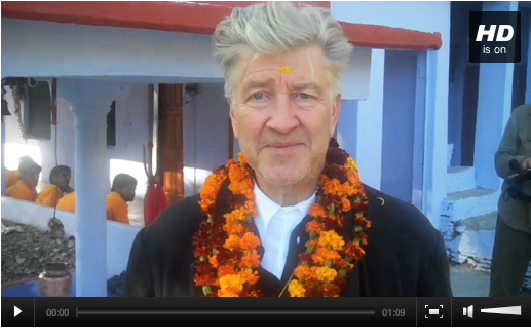
David Lynch on his next film, in Uttarkashi, India, at Maharishi’s house

December 13, 2009

December 10, 2009

DAVID IN INDIA – MAHARISHI’S HOUSE

http://dlf.tv/category/david-in-india/

David Lynch is in India right now, starting work on his film on Maharishi Mahesh Yogi—the founder of Transcendental Meditation. David’s first report comes to DLF.TV from high in the Himalayas, in the small town of Uttarkashi, known as the “Valley of the Saints,” where for thousands of years, seekers of truth have gathered to meditate and rise to enlightenment. Maharishi spent two years in silence in Uttarkashi, from 1953 to 1955, following the passing of his teacher, Guru Dev. More reports from David to follow.

You can also follow Bob Roth, DLF VP, who’s traveling with David, on Twitter. http://twitter.com/bobbyroth. Click back to Dec 4th and read up. Found this interesting comment in one of Bobby’s tweets: Fernando Sulichin and Rob Wilson who work with Oliver Stone and Spike Lee are producers—along with Tabrez who produced Slumdog Millionaire.

Fascinating stuff! This looks like it promises to be the definitive documentary on Maharishi. We all look forward to that, whenever it comes out, hopefully some time next year.

PEACEFUL POETS: Filmmaker Haydn Reiss on Rumi and Stafford and the Power of Words

December 9, 2009

Haydn Reiss on Rumi & Stafford

Two Documentaries on Poets of Peace

BY TONY ELLIS

Filmmaker Haydn Reiss

The moral dilemma most often thrust in the face of those who oppose war goes something like this: What would you do if the lives of your loved ones were being threatened right in front of you? Would you not grab any weapon available in order to protect them? So why not fight to defend your country?

National Book Award-winning poet and World War II conscientious objector William Stafford (1914-1993) wrote in his journal: “The question, ‘Wouldn’t you fight for your country?’ begs the real question which is, ‘What is the best way to behave here and now to serve your country?’ So the real answer would be, ‘If it was the right thing to do, I would fight for my country. Now let’s talk about, what is the right thing to do?’ ”

This was one of the quandaries I discussed recently on the phone with Haydn Reiss, producer and director of Every War Has Two Losers: A Poet’s Meditation on Peace, a thoughtful and beautifully crafted documentary based on the writings of Stafford, and Rumi: Poet of the Heart, a previous work about the life of the Sufi mystic poet. Both films feature comments from a number of well-known poets, writers, and thinkers, including Robert Bly, Coleman Barks, Michael Meade, Alice Walker, Huston Smith and Deepak Chopra.

Reiss, a self-confessed “producer for hire,” has been involved in a range of visual media from Hollywood features (JFK and Jacob’s Ladder) to TV shows, but it is obvious his real passion lies in his work about these two poetic masters, separated in time by more than 700 years, and the potential of their words to move the hearts and minds of men away from conflict.

Reiss believes Stafford, like many of his fellow conscientious objectors, was no starry-eyed idealist. He accepted that conflict is always a possibility in the course of human affairs, says Reiss. But Stafford didn’t believe war was inevitable or even advisable. In Stafford’s view the consequences of war are rarely, if ever, beneficial to humanity. He encouraged everyone to consider the motives of those who urge us to war before getting caught up in the fever of victory. “How do we know war is the answer?” asks Stafford in his journal. “How can there be a nation we don’t like? That’s a fiction put onto a million different people. It has been created by interests you might well do to analyze.”

“It would be very satisfying to think,” says Reiss in an interview on the film’s website, “that after viewing the film you would ask yourself, at a deep level, what you really believe about war. And the follow-up question of ‘How did I come to believe that?’ ”

“I think we have been very successfully indoctrinated into accepting that war is a given, it’s what human beings do,” Reiss continues. “The distinction is, and I think this is what Stafford is saying, is ‘Yes, we do and can make war. But what else can we do?’ The undiscovered possibilities in human behavior are what we should pursue. The die is not cast; imagination and creativity are not in short supply. That this is the real, pragmatic work of the world.”

We live in such a culture of violence that sometimes it is hard to imagine how the actions or words of one person can be heard above all the clatter. Stafford believed peace is achieved gradually, created one person, one small step at a time. “Artists and peacemakers are in it for the long haul,” Stafford writes in his journal. “Redemption comes with care. Here’s how to count the people who are ready to do right: 1 . . . 1. . . 1.”

His chosen medium was poetry. In a poem entitled “A Ritual to Read to Each Other,” composed in Iowa City on June 23, 1953, he wrote:

For it is important that awake people be awake,
or a breaking line may discourage them back to sleep;
the signals we give—yes or no, or maybe—
should be clear: the darkness around us is deep.

In Every War Has Two Losers, Stafford’s friend Michael Meade comments, “Something very deep in the human heart wants beauty, love, and relatedness more than it wants destruction, war and violence.” This theme is further explored in Rumi: Poet of the Heart, a tender and insightful portrayal of the life and work of Sufism’s most cherished poet. Reiss is a big believer in the power of poetry to take us to deeper understanding. “It’s alchemical,” he tells me, and quotes from William Blake’s poem “Jerusalem”: “I give you the end of a golden string, only wind it in a ball, it will lead in at Heaven’s gate built in Jerusalem’s wall,” a theme I discovered Stafford often used in his lectures. “Poetry can take us to a place where nations and newspapers are not so important as what is happening out in the fields and the birds and the wind,” says poet Coleman Barks in the film. His soulful translations of Rumi’s poems have made them famous worldwide. Deepak Chopra suggests that if more poetry was read to children we could substantially change the world for the better.

Stafford wrote a poem a day after rising before dawn and spending time in contemplation and reflection. “I have an appetite for finding the perfect language to describe the experience of life you’re having right now,” he once said. “Every now and then I break off a piece of that and call it a poem.” Rumi poured out thousands of lines of exquisite verse as he struggled to deal with the devastating loss of his friend and mentor, Shams of Tabriz.

“Rumi’s poetry emerged from grief, which we do our utmost to avoid,” comments Robert Bly when interviewed. It is as if his heart, in being broken open, became a container for an immense divine love. “I am so small I can barely be seen,” wrote Rumi. “How can this great love be inside of me?”

Rumi’s message of love described by Rumi: Poet of the Heart is so profound and essential it has the power to touch the soul within each of us. “Everyone loves Rumi. He has no enemies,” someone comments in Reiss’s film. “I fly with Rumi. I forget I am on the earth,” says another. It is a wonderful and revealing irony that in this time of widespread “Islamophobia,” Rumi, an Islamic mystic, should be the best-selling poet in America. He touches a universal nerve. The lesson to learn is this: if we can reach into our hearts and see the world through the eyes of a poet like Rumi, we can form bonds that unite us, whatever our culture or religion. Peace is the natural by-product of this experience. War, on the other hand, thrives on fear and division. “If loving everyone is too much to ask,” says Reiss, paraphrasing Kurt Vonnegut, “at least we should respect each other and maybe occasionally it will turn into love.”

“Love is the religion. The universe is the book,” says Coleman Barks, quoting a Sufi master. Stafford wrote on behalf of “the unknown good in our enemies,” comments one of his friends in the film.

Can the actions of one individual or a few well-chosen words really make a difference in this large chaotic world? Reiss believes so. On the website for Every War has Two Losers, he includes this quote from Stafford: “Every thought re-orders the universe.” And at the end of our conversation, he passes on this gem of wisdom from folksinger Pete Seeger. Seeger would say that life is like a seesaw and each of us is a grain of sand. It’s important which side of the seesaw you put your grain of sand. You never know which grain will be the one that tips it in the right direction.

Haydn Reiss will be visiting Iowa in spring 2010. Watch for upcoming announcements of his talk and film screenings.

For more information on both films and to watch trailers, visit www.rumipoet.com for Rumi, and www.everywar.com for Stafford.

To read more of William Stafford’s writings visit http://williamstaffordarchives.org/.

Tony Ellis is a Fairfield-based writer and poet. He blogs regularly at www.iowasource.com. To read more of his work, visit www.tonyellis.com. This article appears as the cover story of the December 2009 issue.

Also see Every War Has Two Losers, a Haydn Reiss film on poet and conscientious objector William Stafford and A Fascinating Approach to Peace.

PATH LIGHTS debuts on DLF.TV for one week

December 6, 2009
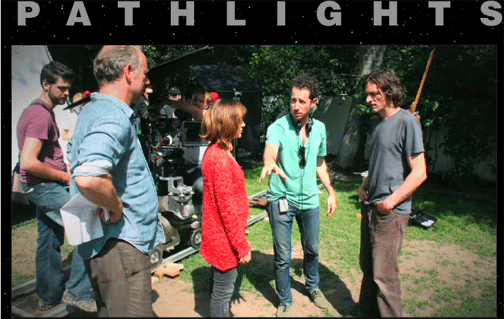
On location, left to right: Xander Berkeley, Sarah Utterback, director Zachary Sluser, lead actor John Hawkes.

Director Zachary Sluser has turned Tom Drury’s New Yorker short story into a short film now debuting on David Lynch Foundation Television. It is up for one week only, from December 2-9, 2009. After this showing, it will be presented at film festivals in 2010.

I highly recommend watching the short film, and the 3-part Behind The Scenes series on the making of this film. Some of the staff at DLF.TV were invited to film and interview the people involved in the making of this short feature—actors and crew. Very inspiring. Gives you a deeper insight and appreciation for these fine young filmmakers from MSAE, MUM, Fairfield, and their LA friends working on set. The value of TM is also mentioned. The bliss generated by everyone dedicating themselves to the project, for free, is special, and DLF.TV was able to capture it—a great example of what this young and vibrant new online TV channel is all about—celebrating consciousness, creativity and bliss. Catch the wave: http://dlf.tv/2009/pathlights/

Path Lights, introduced at the Woodstock Film Festival, has now been selected for the international competition at the 32nd Clermont-Ferrand Short Film Festival, Jan. 29-Feb.6, 2010 in south-central France. It’s the premiere short film festival (they screen short films exclusively) in the world and the second largest film festival in France after, Cannes.  Over 5100 short films were submitted and there are usually around 75 international (non-French) short films in competition. Very exciting. http://www.clermont-filmfest.com/index.php?m=226&c=3&id_film=100077897&o=88.

Following that acceptance was news that Path Lights has been invited to participate in the 39th International Rotterdam Film Festival, which will take place January 27–February 7, 2010. Rotterdam is probably the 4th major film festival after Cannes, Berlin, and Venice.    …. more to come ….

Some recent articles on Path Lights debuting on DLF.TV

THE NEW YORKER
Q&A: Tom Drury
http://www.newyorker.com/online/blogs/backissues/2009/12/q-a-tom-drury.html

IFC.com: The Independent Eye: Turn on your Path Lights.
By Alison Willmore on 12/02/2009
http://www.ifc.com/blogs/indie-eye/2009/12/path-lights.php

USATODAY POPCANDY
David Lynch Foundation spotlights a noteworthy short film
http://content.usatoday.com/communities/popcandy/post/2009/12/david-lynch-foundation-spotlights-a-noteworthy-short-film/1


PASTE MAGAZINE
By Emily Riemer
David Lynch Television Presents Short Film Path Lights
http://www.pastemagazine.com/articles/2009/12/david-lynch-television-presents-short-film-pathlig.html

The Millions: Curiosities
Oh, Tom Drury, how I love thee.
http://www.themillions.com/2009/12/oh-tom-drury-how-i-love-thee.html

UPDATE: Path Lights is now available on Vimeo: https://vimeo.com/117333877.

President Obama, Peace in the Middle East: Scientific solution to your political problem?

December 2, 2009

President Obama, Peace in the Middle East: Scientific solution to your political problem?

Wednesday, 02 December 2009 17:52

Peace in the Middle East is easily within our grasp, as indicated by a new scientific paper recently published in the “Journal of Scientific Exploration.”

The study addresses the possibility that a relatively small group of people practising the Transcendental Meditation™ and TM-Sidhi programme®, as founded by Maharishi Mahesh Yogi, twice daily together in a group can create peace in the Middle East.

The hypothesis is not new. Fifty studies have found that when 1% of the population practises Transcendental Meditation, or sufficiently large groups practise the TM-Sidhi programme together twice daily, it can have a positive influence on society as a whole. The studies show, for example, decreased violence, crime, car accidents, and suicides, and improved quality of life in a society. Critics had questioned the credibility of the evidence in light of the unconventional nature of the proposition.

Reduced conflict and improved quality of life in the Middle East:

August-September 1983

A composite sociological index closely tracks the size of a group practising the Transcendental Meditation and TM-Sidhi programme. (See details in text below.)

The new analysis addresses this question more thoroughly than previously. It presents new statistical evidence that all credible conventional explanations – such as military and political events, public holidays, and the weather – could not explain the observed statistically significant changes in sociological variables shown in an earlier study on the influence of groups practising the TM-Sidhi programme (Orme-Johnson DW, Alexander CN, Davies JL, Chandler HM, & Larimore WE. International peace project in the Middle East: The effect of the Maharishi Technology of the Unified Field. Journal of Conflict Resolution 1988 32:776-812, findings illustrated above). The observed changes in the Middle East included reductions in war deaths of 75%, war intensity of 45%, in crime of 12%, in fires of 30%, plus there were improvements in national mood of 27% and the stock market of 7% during the experimental period.

Although conventional factors did have a measureable influence on the level of violence and other sociological variables, the effect of the Transcendental Meditation group was, according to the researchers, both independent of these other factors and approximately two to five times stronger.

Brain research has found that Transcendental Meditation increases coherence in brain functioning. Lead author of the new study David Orme-Johnson, former Chairman of the Psychology Department at Maharishi University of Management, suggests that: “Given the assumption of Maharishi’s theory that individuals are the units of collective consciousness, increased coherence at the individual level could be expected to have a positive effect on the population level”.

According to a number of earlier studies, this effect is magnified when, in addition to Transcendental Meditation, the more advanced TM-Sidhi programme, which includes Yogic Flying, is practised in a group. In this case, the square root of 1% of a population practising Yogic Flying in a group is the threshold at which changes in social trends begin to be observed. Interestingly, this effect appears to be irrespective of national borders and different cultures. According to the theory, a group of 10,000 generating such an influence of coherence would be sufficient to noticeably influence the collective consciousness of the whole world.

If the science is so watertight, and the potential benefits so great, the obvious question, then, is: Why has no one yet established such a group anywhere in the world? One reason why policy makers have been reluctant to do so is that they take the view that conventional military and political factors must have more influence than Transcendental Meditation and Yogic Flying. However, the new research has shown that this assumption is quite incorrect.

A coherence-creating group of 10,000 people could be established for less than 0.2% of the world’s military expenditure, and yet, according to the research, could ensure a stable state of world peace.

The David Lynch Foundation for Consciousness-Based Education and World Peace, founded by the award-winning filmmaker, joined with Paul McCartney in April to raise funds to teach Transcendental Meditation to one million at-risk children. The benefit concert in New York is said to have raised £2m on ticket sales and fund raising continues. The philanthropic Foundation is already involved in teaching Transcendental Meditation in schools in the Middle East with the explicit aim of creating permanent peace in the region.

Dr. Orme-Johnson is available for interview: Tel 850-231-2866 See his website: http://www.truthabouttm.org
Dr. David Leffler is available for interview and to set up interviews with other military-related people. See this website: http://www.StrongMilitary.org  Tel 845-489-8653

Beautiful film on Algerian artist Malek Salah by Amine Koudier

November 30, 2009

Malek Salah: Majnûn Laylâ – Artist

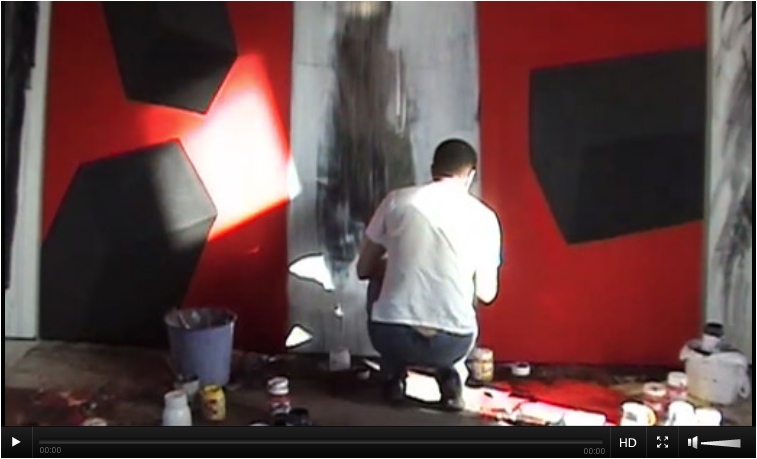
Enjoy this short film about the Algerian contemporary artist Malek Salah as he prepares for the inaugural exhibition titled ‘Majnûn Laylâ’ for the new Modern Art Museum of Algiers, the first of its kind in the Arab world. The film brings deep insight into Salah’s world—his creative process, the information contained within his work, his relationship to his art, and through it, with the Algerian society.

This beautiful film of a meditating Algerian artist, Malek Salah, is a fine example of a famous artist profiled by one of our MUM students, who later became a videographer for DLF.TV. The young filmmaker, Amine Koudier, a senior student at the time in MUM’s digital media class, was asked to make this film to accompany an opening exhibit of the new Modern Art Museum of Algiers (MaMa), the first of its kind in the Muslim world.

When Amine showed it to me I was really impressed and encouraged him to translate and add English sub-titles and enter it into competitions. I ended up helping him with the French to English translation, and he won first place wherever he entered it. He took the top 2008 Award of Excellence in the student category from the Iowa Motion Picture Association and Winner in the student film category of 2008 Landlocked Film Festival.

David Lynch visited the students when he was here last year and commented on this film. He said he loved the artist, his work, and what he had to say about it, and how Amine had portrayed it—high praise for a student. Amine was later hired to work at David Lynch Foundation Television upon graduating. Read an excellent article in the Iowa Source written by Mo Ellis about him and the film.

Watch the 13-minute film Malek Salah: ‘Majnun Layla’ on DLF.TV, on Vimeo, or on YouTube Part 1 and Part 2. Also see David Lynch Foundation Television to premiere David S. Ware: A World of Sound. The Ware and more profiles by Amine and other DLF.TV filmmakers are available here.

This blog post was published November 30, 2009. After working for the David Lynch Foundation, Amine would become a teacher of Transcendental Meditation and later taught TM and filmmaking at Maharishi University. He gave a wonderful interview to Nylon Magazine, and later invited a photographer from the Ottumwa Courier into his classroom as part of her profile on the university.

Home is where the heart is – Felicia Hoo

November 29, 2009

Living Guides – Profile

By Willy Wilson | Nov 06, 2009

Home is where the heart is – Felicia Hoo

–––––––––––––––––––––––––––––––––––––––––––––––––––––––––––––––––––––––––––

Fifteen miles west of Kuala Lumpur sits the quintessential upper middle class Malaysian suburb of Kota Kemuning, Shah Alam. There are acres of private club houses, newly-built malls, public schools and Wet World Waterpark.

Dry, quiet and remote, these thoughts came to mind when I first visited the area. But what seems to be monotonous life in Kota Kemuning could very well be its best offering, for many of the residents here prefer a quiet suburban life to a hectic existence in the city. Or at least that is the case of Felicia Hoo.

For Felicia, Kota Kemuning offers an unmatched convenience for her family, her business and herself. The jovial woman is the CEO of Samaria Sdn Bhd by day, a single mother by fate and an artist by choice. She runs a multi-million dollar worth of cutlery business, sends her two boys to school and takes time to paint from her mini studio – all of which are done within Kota Kemuning.

“The tranquility this area offers is supreme,” she says, “the kind of peacefulness you only get outside of Kuala Lumpur.”

Although Kota Kemuning is far from the city centre, Felicia maintains that the area is by no means a secluded one. Thanks to the well linked major expressways such as the North-South Central Link, Federal Highway, Damansara-Puchong expressway and the proposed Kemuning-Federal Highway link.

“It is just the best location for me and my family,” Felicia comments proudly of her area.

Nostalgic and Alluring

Stepping into Felicia’s 2-storey bungalow feels like a trip down the memory lane. There is an arresting nostalgic appeal that is usually present in your grandparents’ house; the kind of old house charm that instantly makes you feel at ease.

Part of it could be due to a Singer sewing machine and an old stereo that are perched in one corner of the living room, while the other could be because of the old-fashioned arrangement of the furniture, the simple selection of fabric for the curtain and the natural greeneries the house is surrounded by. Whatever it is, it is hard to resist the allure of this house.

Yet, from the outside, it is a mere modern bungalow with an extensive garden, a spacious living room and a lot of canvasses propped against the walls. Such contrast makes this house, well, charming.

The first floor consists of two living rooms, a kitchen and a guest room that is converted into a mediation room. Three bedrooms on the second floor are occupied by Felicia and her two sons.

“People always say that my house has an air of an art gallery,” says Felicia of her cosy house. Which is understandable; there are at least sixty canvassed paintings scattered around the house, all of which are done by the lady herself. The well-ventilated house has two big doors that allow fresh air and sunlight to come into the house.

The central area of the house is a mini studio with high-ceiling concept from where Felicia paints. “I prefer my house to be this way,” says Felicia, “It gives me an inner peace.”

Felicia asserts that she does not feel the need to decorate her house with fancy stuff. What she looks for in a house, according to her, is comfort.

“A house that provides you with a peace of mind is priceless. Your home is worth millions when it houses your heart,” she says. How true!

For the Love of Art

Felicia Hoo is not the typical CEO with a power suit, two assistants and three mobile phones. She is, indeed, more of a jeans-and-funky-hairstyle kind of CEO. As if that is not rare enough, Felicia is also a soon-to-be Transcendental Meditation (TM) instructor, an avid traveller and an occasional host in household product exhibitions. Yes, she does all these while having her cutlery business rolling.

Of her occasional hosting gigs, Felicia comments, “I had been given chances to do a 45-minute food carving demo to visitors during exhibitions like HomeDec.” She does not consider such shows as merely a part of marketing strategy, but also a chance to bond with her customers.

“There are so many things I would like to share with people,” she says, “And it is not just about my business, but also about my passion in meditation, arts and green lifestyle!”

Ever an advocate for green cause, Felicia is set to educate her customers about this issue. She has started this effort by utilising 100 percent non-toxic materials for the production of Samaria products. It is not surprising, then, that her business only gets bigger by the day.

She credits her house for her tremendous success. Which Feng Shui guru did she seek advice from, you may ask!

“I never had any Feng Shui advice from anyone,” she says.

“What we all need is a place where we belong. I can go into a state of total absence from stress and anxiety from work when I paint here,” she says, pointing at one corner in the kitchen, where a cloth-coated wooden table, a few chairs and a fan are placed modestly.

“I sketch faces, emotions and natural beauty here. When I get a solid idea, I spill it onto a canvas and start painting at my mini studio,” says Felicia.

Her abstract arts are quite impressive, especially considering the fact that she has never been trained professionally.

“Better yet, I will have my first solo exhibition in Iowa, United States, next year. The art gallery and I are firming things up now,” she says, “I have my home to thank for this exhibition.”

The moral of the story is: to make your home a comfortable space for your mind, body and soul is to write your own success story both in personal and professional life. Just ask Felicia!

–––––––––––––––––––––––––––––––––––––––––––––––––––––––––––––––––––––––––––

This article was the result of a group assignment in one of HUC Professor Mohan Gurubatham’s classes on entrepreneurship in Kuala Lumpur, Malaysia. One of the student groups contacted The Star to interest them in an interview with Felicia Hoo, a friend of Mohan’s who visited their class. Mohan, who also lives and teaches part time at MUM, says, “She epitomizes following your heart and bliss, a classic rags to riches story of single parent mother, bottom up, and my students volunteered to rebrand her business and shape her strategy. She is a firm believer in doing nothing and accomplishing everything from the source of thought!!! She is going to be a TM teacher.”

After Willy Wilson, the student who wrote this article, thanked Dr. Mohan for the class, Mohan replied that it had been a pleasure for him as well, and that Felicia was going to Thailand to train as a TM teacher very soon. The end of the article mentions that she will have her “first solo exhibition in Iowa, United States, next year. The art gallery and I are firming things up now,” she says.

A good guess would have it in one of Fairfield’s more prominent art galleries. More to come….

UPDATE: Nov 17, 2022

Feli Hoo not only became a TM teacher, she turned her business over to her sister/CEO, retired, married Danish psychiatrist and TM teacher, Henrik Westergaard, and moved there. Read about it in their interview with Mary Swift for TM Home: What happens if you add a daily dose of Transcendental Meditation to the life of a businesswoman from Malaysia and a psychiatrist from Denmark? Here’s how the practice of TM transformed this lovely couple—and how each of us can become our own therapist and find our way home.

Filmmaker Responds To BC Government Arts Cuts

November 28, 2009

Filmmaker Responds To BC Government Arts Funding Cuts

Artless PSA Goes Viral

Kryshan Randel and Cara Yeates Join Forces With Top Art Venues To Create “A World Without Art”

ARTLESS, an independently produced public service announcement about the arts funding cuts, was released online Tuesday as part of a campaign to protest the BC government’s current and planned arts funding cuts. The ad, which imagines a grey artless world, is shot in some of Vancouver’s most iconic artistic venues. This powerful visual statement is rapidly gaining attention.

After its premiere as a part of the Wrecking Ball Cabaret on Monday, this PSA received over 1000 hits its first day on YouTube. ARTLESS is currently featured on the Facebook and Twitter pages of many of BC’s top entertainers, and is spreading fast to theatres, schools and TV stations. It can be seen at artlesspsa.wordpress.com

Kryshan Randel and Cara Yeates were assigned the theme “A World Without Art” by the Wrecking Ball Committee. Immediately, they had the ambitious idea of filming inside some of Vancouver’s most important artistic venues, including the Orpheum, Fifth Avenue Cinemas and Grunt Gallery, emptying them of their art and replacing it with grey. To create further impact, the ad features twelve year old rising star Alex Ferris (RV, The Time Traveller’s Wife) wandering through the stark venues, trying to imagine what art looks like. His journey is accompanied by a haunting song, which was provided by a local elementary school choir.

The team consisting of Randel (Director/Co-writer), Yeates (Co-writer/Producer), Toby Gorman (Director of Photography) and Mathieu Wacowich (Co-Producer), was small but fearless. The shoot was a tremendous challenge; five locations photographed in one ten-hour filming day on Gorman’s one day off from on-set work. “My guerrilla filmmaking background helped us make our day, but barely – it was the hardest thing I’ve ever done”, says Randel.

But the hard work is already paying off. Alan Franey director of the Vancouver International Film Festival has committed to passing this PSA onto the festival’s contact list and screening it at the VanCity Theatre. ARTLESS will be soon featured on Novus Television and KVOS. And the message is being delivered to schools across BC. Every hour Randel and Yeates are updated of more good news in regards to its exposure.

The team of working artists is dedicated to this cause. Randel has a personal investment in the issue. His short drama GLIMPSE recently won the NSI Short Filmmakers Award. GLIMPSE was funded by the Kick Start program, which was recently cancelled due to the funding cuts. Randel’s career is on the rise; his short horror film JACK, made in collaboration with many of BC’s top talents including Zach Lipovsky (ON THE LOT), won four awards including the Grand Jury Prize at this month’s Bloodshots Film Festival. Judge Dan O’Bannon (creator/writer of ALIEN, writer of TOTAL RECALL) praised the film’s entertaining blend of humor and horror. BC’s arts funding is a strong component of Randel’s future as a filmmaker in Vancouver. If it goes, he may be forced to go as well.

Yeates just finished a whirlwind international tour with her one woman plays SOME RECKLESS ABANDON. Her work has been supported by the BC Arts Council in the past and she’s hoping to get funding for her latest project. Cara was just awarded the first ever Joanna Marratta award for artistic achievement and community leadership at the Vancouver Fringe.

At the moment, all of Randel and Yeates’ energies are concentrated on getting the PSA screened everywhere they can. Yeates notes “as artists we are fighting these cuts the only way we know how, through our art”.

To spread the word about ARTLESS please visit: artlesspsa.wordpress.com

Pirene’s Fountain: Jane Hirshfield on Poetic Craft

November 26, 2009

Interview

Deep Craft : A Conversation with Jane Hirshfield

Pirene’s Fountain is privileged to present Jane Hirshfield in this issue, speaking to us both as one of the finest poets writing today and as a mentor and teacher. The idea to offer a craft-oriented interview came about from letters and queries sent by readers looking to enhance their poetry writing, and we thought there would be no better way to begin an ongoing discussion of craft issues in Pirene’s Fountain than to invite the thoughts of a master poet on the subject. In this exchange, rather than concentrate on mechanics, we try to understand some of the rare, indefinable qualities that pulse in a poem and make it real, tangible, and breathing—words capable of charging the imagination for years to come. Ms. Hirshfield shares her insights here in response to questions based on her essays, both a series of recent ones (published in such periodicals as The American Poetry Review and The Associated Writers Programs Chronicle)and those collected in her highly acclaimed book on craft, Nine Gates: Entering the Mind of Poetry (HarperCollins, 1997). Now considered a classic of its kind, Nine Gates has been taught to students of architecture, dance, and the visual arts as well as to writers of both poetry and prose. Works of insight, wisdom and learning, grounded in philosophy, world literature, and ruminations about the essential nature of art, Hirshfield’s essays are meditations on life as well as on poetry. In these explorations of poetic craft, Hirshfield conjures meaning and beauty, revealing how words, in poetry, can come to overspill their own brim, and how poetry reflects and expands upon the most central issues of human life.

With Ami Kaye
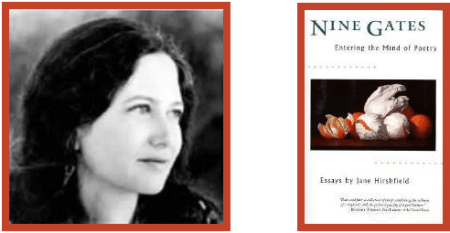
Ami: Jane, it’s an honor to speak with a poet who brings such a rare and deep vision both to poems and to thinking about how poems work. Perhaps we can start right off by talking about the trope of “hiddenness,” the subject of a recent essay that appeared in The AWP Chronicle. Early on, you quote a line from Keats’s “Ode on a Grecian Urn”: “Heard melodies are sweet, but those unheard are sweeter.” You go on to comment, “Many poems hold certain of their thoughts in invisible ink.” Can you please tell us something more about hiddenness and craft?

Jane: I’ve come more and more to believe in the presence and centrality of that invisible ink—or, to use a different metaphor, to believe that there is a set of hidden clockworks beneath the surface of any poem we find ourselves moved by. This is true, paradoxically, even of poems that seem to tell everything outright. A poem may seem naked or plain, but if it moves us, there will always be something else at work, under the surface of its words. This second, undertow life is what differentiates poetry from instruction manuals, journalism, or, for that matter, a diary-type journal. Good poems always travel in more than one direction. They do not soothe us with platitude knowledge, they broaden us with complication, multiplicity, permeability to the subtle, and with unexpected perceptions, gestures of language, and comprehensions.

In addition to this larger scale dimension of hidden energies in poems, there is also a set of particular craft devices that might be described as “invisible ink.” One example is the deliberate choice to leave something out. A poem can convey an emotion or event’s presence by walking around it, revealing its shadow, alluding without naming, pressing back against it. Poems can create meaning in the same ways that mimes create walls, tables, balls, out of thin air and their own responses. This mode of communication falls into the category of what rhetoric calls periphrasis. Think of those Chinese scrolls in which the moon is a circle left uncolored. It is simply the paper, unpainted. That is an act of visual and physical periphrasis—the ink brush touches everything but the moon itself, which is, as in the physical sky, beyond any actual touch or reach.

In more subtle ways, as well, a sense of something present but unspoken makes a poem feel not only richer, more subtle, and more tactful but also more convincingly “true,” because it seems three-dimensional. What has a front, a back, an unseen interior, feels to us real. Yet another example of “invisible ink”: if some emotion or event seems impossible to describe effectively, or perhaps at all, it can still be conveyed by leaping over it, going straight to some aftermath condition. You can describe a storm, or you can describe the wreckage afterward—the boat in a field half a mile inland from shore tells us most everything we need to know of water and wind. What the reader imagines in the absence of words is often more powerful than anything words could evoke, because the reader’s own thoughts, associations, and experience can perfume the poem.

Ami: In the essay “Poetry and Uncertainty,” which first appeared in The American Poetry Review, you allude to Keats again, this time to his idea of “negative capability” ( “…. Negative Capability, that is when man is capable of being in uncertainties, Mysteries, doubts without any irritable reaching after fact & reason.”). The essay goes on to examine that concept in a number of different ways. Can you tell us more about how uncertainty relates to poetry and its making?

Jane: It’s always hard for me to summarize my essays, but the gravitational center of that one is that good poetry always includes not only knowing but also some real measure of not-knowing. Uncertainty is the basic condition of life, a condition that most of the time we try to ignore. Good poems let that essential unknowability into the room, and we are changed—our relationship to our lives is changed—by agreeing to its presence.

I’m in general wary of certainty, which tends to limit not just the imagination but also compassion. We do need to know things of course. Facts exist, and they matter. There are objective truths, at least for the purposes of daily life. Yet our certainties also create fixity and boundary in us, and a surfeit of sureness can lead to rigor mortis of intellect and heart. It’s a poet’s job to be vulnerable, and at risk. The subject haunts my poems as well as the essay, and has been much on my mind in recent years, raised in no small part by the seeming increase of fundamentalist beliefs in the world. Those reified beliefs’ effects seem to me universally disastrous, no matter which ones or whose they are. I am aware of the irony of the seeming certainty with which I say this. But I’ve come to feel that nothing is more dangerous to self and others than a person sure of her or his own rightness. When I find myself adamant, in life or in a poem, I try to catch that tone, and administer a useful antidote—a question. “Is that so? Is it the whole story?” Sometimes I’ll end up letting a statement stand, sometimes I’ll change it, or add to it. The habit of questioning a little further is what matters—it throws open the doors to the new.

The defining gesture of a lyric poem, for me, is that its words create and then preserve, in revisitable form, some act of discovery. This means there must be some point in a poem’s composition when the author cannot really know what he or she is going to say— the already known cannot be discovered. Many poems of course hold re-discoveries, refreshments of discovery.  That is no less real. Some realizations or recognitions cannot be made what food producers call “shelf-stable”— they need to be created from scratch each time. The realizations I most care about are like this: they are fragile and evaporative and can only be held aloft as a hot-air balloon or soufflé is, by some active counterforce to the ordinary gravities of complacency, sleepiness, and received comprehension.

To find your way to any discovery requires exceptional attention. The mind and heart and tongue need to be free of shackles if they are to leap. The teaching motto of the Korean Zen teacher Seung Sahnim was “don’t-know mind.” The Japanese Soto  Zen teacher Suzuki-roshi famously said, “In the beginner’s mind there are many possibilities, in the expert’s, only one.” Then there was Sartre, who described genius as what we invent in desperate circumstance. That statement points to the necessity for heat—for the passion that causes attention and language to rise beyond their ordinary capacities and satisfactions.

To make a new poem, you need a new person. This moment’s person, with this moment’s needs. Otherwise, you might as well simply read one of the many great poems already written. The only reason to want to write something new is that you need to find something out for yourself, to run the old problem freshly, through your own life, tongue, perceptions, and feelings. Poetry is the antithesis of mathematics. In poetry, the old problems (love, loss, suffering, bewilderment, Wordsworth’s excess of emotion, the ancient conundrums of philosophy and myth and spirit) remain perhaps constant—these things are bedrock in human life. But their solutions need to be re-found each time, and will never be exactly the same as the one found before.

I’ll add one more thing. The expansions of subject matter and style in lyric poetry over the past thousand years or so are a matter of not only new persons but also of new “problems” being let in to the field of the poem. Men, for instance, did not know until quite recently that there were poems to be written about fatherhood and their children— then suddenly we find Galway Kinnell writing a poem about the birth of his son. That kind of discovery also has to do with uncertainty and not knowing. A person has to “not know” what poetry is, what belongs or doesn’t belong in a poem, to bring something new into poetry. Basho had to not know that haiku were only a parlor game and amusement. Gerard Manley Hopkins had to unbind his ears from known metrics and musics. What can be found when expertise is replaced by exploration is breathtaking. But to explore, you need to venture past the edge of the already constructed map, whether physical, conceptual, or emotional.

Ami: This reminds me of something you wrote in one of your earlier essays, “Poetry and the Mind of Indirection,” in Nine Gates. You wrote about attentiveness, craft, and their opposite: “Craft and consciousness matter. But a poet’s attention must also be open to what is not already understood, decided, weighed out. For a poem to be fully alive, the poet needs to surrender the protection of the known and venture into a different relationship with the subject—or is it the object? Both words miss—of her attention. The poet must learn from what dwells outside her conceptions, capacities, and even language: from exile and silence.” Can you please say a little more about how  “knowing” and “not-knowing” balance each other in working with craft in making a poem?

Jane: Most of the time, when we talk about craft in poems, we naturally speak of things that are able to be spoken of. We talk about what we know and what we can say. And so we say, “Verbs are stronger blacksmiths of meaning than adjectives are, yet sometimes, the plainest adjective, a color, for instance, can bring enormous expansion to a poem, simply by engaging the senses.” We say, “Each moment of your reader’s granted attention is a gift you must repay with something worthy; every syllable, every comma, must be in the poem for good reason.” We say, “There are at least seven different forms of ‘you,’ and if you change between them mid-poem, the reader must be able to know that has happened, or will be confused.” We say, “Some poems pause to look at something outside their given world; these window-moments bring light and air, volume and contrast, and can be what allows the unbearable to be fully felt.”

These are the kinds of craft points I make when I teach. I teach punctuation as a form of orchestration and musical notation. I teach close reading, rhetoric, transitions. But the opposite of all this, equally important, cannot be taught; it can only be remembered and acknowledged. After a poem is written, something of what has happened outside the writer’s consciousness can sometimes be named. But during the writing, the poet cannot know everything about the poem. In lyric poems, I suspect the poet often enough may not know much of anything. Not what it is about, not where it is going. The poem needs its first draft intoxication, its subversive trickster energies, its whistling in the dark, its unexpected and unfendable off pang of longing. A poem too sure of itself will have no crack for breathable air to enter, and will die for lack of permeability. Poems that are alive will have a life of their own, beyond the control of the writer. The writer’s only task when that life arrives is to get out of its way.

We are the amanuenses of our poems. They dictate us. Or so it seems to me. We learn everything we can of craft so that what we know can be of service to what wants to come through us.

Ami: In yet another recent essay, “Poetry and the Constellation of Surprise,” you wrote: “Good poems provide an informing so simultaneously necessary and elusive that they are never, it seems, taken in fully, and can never be fully used up.” Can you say more about this insight?

Jane: That essay began with a question I suddenly realized I had been carrying in the back of my mind: How is it that we never tire of reading a great poem? No matter how many times I’ve read Cavafy’s “Ithaka,” for instance, it has never failed to move me. The same is true of great paintings—we do not tire of them, we do not exhaust them. I thought about this for months, and finally came up with the ideas that underlie the sentence you’ve quoted. But it took the whole essay to spell out the recipe for elusiveness and necessity. All I can say briefly is what the essay’s title says: poetry’s perennial newness has something to do with discovering and then preserving, for perennial re-discovery, something surprising. This is done in the way a magician sustains the surprise of the rabbit, or the way a winding road preserves the shock of the glittering, tall city it leads to: the traveller cannot take the destination in ahead of time, because, while moving toward it, you can only see what is there, immediately around you. Poems are not lab notebooks—they are the experiment itself, which must be run completely each time, inside the reader. If a poem were some summarizable “conclusion,” we would not need the poem.

That’s probably all I can say, short of saying it all…

Ami: Let’s go on then to another subject. We are fortunate to live in a world where we can read the literature of many cultures, first written in many languages. Reading works from other traditions, you’ve said in your essay on translation in Nine Gates, enriches and informs our own. We must also celebrate the diversity of the many styles, schools and forms of poetry in existence, for surely the world is large enough to house them all. In your essay, “The World Is Large and Full of Noises,” you speak of the delicate balance between freedom and fidelity in translating. Could you elaborate on that thought, and also on the way that the practice of translation can change a writer’s relationship to her own work?

Jane: I always like to begin by acknowledging that there are different philosophies of translation. Walter Benjamin famously suggested that the qualities of the original language (not only its sounds, but also its idiosyncracies of grammar, word order, and so on) should be preserved in a translation. Other translators advocate the approach I’ve followed in my own translations, what Octavio Paz describes as “the same effects by different means.” You might at first think of these two approaches as “fidelity of surface” vs. “fidelity of sense,” but any time you divide poetry up so simply, you end up in trouble—the substance and meaning of any poem is in the physical sounds it makes as much as in its ideas. Word choices, rhythms, sentence structures, dipthongs, and trochees—what other body does a poem have? Poems are not ghosts: their feet are countable, and real.

A few translators of great genius, such as Richard Wilbur, manage to convey both sound and sense quite closely. A rhymed sonnet in French can become a rhymed sonnet in English. This is less easily done, though, in languages more diverse. A Japanese poem might have no specified grammatical voice; a Chinese poem might not indicate whether its verb tense is past, present, or future. In bringing such poems into English, you almost always have to make a choice. In such cases, certain kinds of freedom are in fact fidelity. The same holds for cultural background information that may not be in a poem’s words, but would be known to everyone in its home culture. Whether by footnote or adjective, that information needs to be given, if the reader is to have access to the full poem, and not be left standing outside a window, peering in at food she cannot eat and fire whose warmth she cannot feel. It’s the translator’s task to find a poem’s core heat, and to carry that embering coal across time and language unextinguished.

Translation is also (as you’ve alluded to in your question) the way that new modes and structures come into a poetic tradition. The sonnets of Keats and Donne and Millay and Gwendolyn Brooks came to us first in sonnets written in Italian. The imagism that changed American poetry so profoundly in the early 20th century came from long-standing poetic strategies of China and Japan. The Spanish poets gave American literature the “deep image” and surreal freedoms. Neruda and Ponge swung wide poetry’s embrace of everyday objects. It was the translated Bible that gave Whitman his armature, his embouchement, his praise of all being. The Urdu ghazal has influenced contemporary American poetry far more than is generally realized.  And that is how it should be. When new techniques of thought and feeling come into a language, if the graft takes at all, it will soon be indistinguishable as immigrant or native. The accent is recognizable perhaps for a generation, but the discovery becomes as common a heritage as bread or pizza.

For the question of translation’s effects on a poet who translates, practicing translation is not unlike practicing scales—inevitably, you internalize. Certain gestures and moods cannot help but enter your own lexicon of expression. Kenneth Rexroth’s essay on translating poetry is brilliant on this point, and on another as well: one reason to translate good poems, Rexroth says, is that it keeps you in such good company. For me, the year I spent translating the classical-era Japanese women’s poems that became The Ink Dark Moon felt like a love affair—it was an exhilarating and intimate encounter; my pulses would race when I turned to the poems each week. It also became an extended exercise in openness to alternative possibility, and left me a writer with a very different relationship to revision. The experience of translating a poem seven or ten different ways, and feeling how each can be faithful to the original in its own way, is revelatory. A cook never makes the same dish twice—the salt is different, the flame is different, even the water is different. And the tongue of the cook is different. Translating poems makes clear that the same is true of words. Put two of them next to each other a thousand times, they will say a thousand slightly different things. That discovery was deeply liberating for me as a writer, and it can be learned more freely in translating than in working with your own poems: in translating, the original remains reliably there, and cannot be lost or damaged, only served.

Ami: One final question.  In the chapter of Nine Gates called “Facing the Lion,” about a poet’s relationship to difficulty, pain, and “shadow” (in the Jungian sense), you wrote: “The trick , then, is to let the lion into the house without abandoning one’s allegiance to the world of the living: to live amid the overpowering scent of its knowledge, yet not be dragged down entirely into its realm. This is the reason Dante is forbidden pity when he looks upon the damned—to feel their fate too intimately would put his own salvation at risk. What is required is a certain distance—made, in part, through the mind of art itself. Every poet is a Scheherazade, acceding to fate while at the same time delaying it. And Scheherazade’s salvation, not unlike Dante’s, is accomplished by abundance and imagination, by her offering the cruel king the one thing he cannot do without: a story worth hearing. For it is not our death the lion wants to eat, but our lives. In the difference lies one of the great source-springs of poetic power.”  Could you share with us something more about this idea of the poet as a Scheherazade?

Jane: Scheherazade, of course, is the young woman who narrates the stories we have come to know as The 1001 Nights. The underlying movement of those tales, which most of us learn so young that we are unable to see them for what they are, is the story of the reassembling and cure of a broken heart and psyche. That is of course the King’s—a man who, betrayed by his wife, will not risk his heart again. He decides to sleep each night with a new virgin, who is slaughtered at dawn. Many have died when Scheherazade, the King’s vizier’s daughter, volunteers for her turn in his bed, but with a plan—once the King has had his way with her, she begs permission to tell her younger sister one final bedtime story, which dawn interrupts. The King, who has been listening, keeps her alive for one more night, to hear its end. But one story leads to the next, each interrupted. This goes on for 1000 nights, until the King has both fallen in love with the teller and, equally important, has come to understand that his own story is not exceptional, but part of the common lot.  Trickery, lust, betrayal come to all.  Laughter is a saving grace. Perspective and wisdom are possible. Connection, risk, desire, and ingenuity enlarge life; anger, coldness, and separation foreclose it. And so by the time Scheherazade completes her last tale, the King has been restored to an unfractured existence by his acknowledgment that life will be what it will be for us all. Words have reawakened first his curiosity, then his willingness to live.

Poems, Robert Frost wrote, are a momentary stay against confusion, beginning in delight and ending in wisdom. That progression is a good description of Scheherazade’s task—to take a person who has lost his ground of humanity and compassion, and, through the experience of moment by moment delight, through the lure of narrative skill and the evocation of life’s range, absurdity, and beauty, restore him to his wisdom and wholeness.

Poems are one way we relearn the capacity to go on, no matter what happens to us in the course of a life. Scheherazade does not fear death, nor does she court it—but she risks it, she moves toward it rather than away. Her one defense against the King’s ruined pride and ruinous power is a set of seductions: the seduction of well-crafted art, the seduction of human commonality, and (not to be underestimated) the seduction of her own presence, fully and vulnerably offered. All this seems to me to model something of direct use to aspiring poets.

Pirene’s Fountain is deeply indebted to Ms. Jane Hirshfield for her gracious participation in this illuminating conversation. With sincere gratitude, we also acknowledge her publishers for the works and extracts in the conversation above: The American Poetry Review, the AWP Chronicle, and HarperCollins for “Nine Gates: Entering the Mind of Poetry.” The materials and quotations from Jane Hirshfield’s works are used by permission of the author.  Please visit our Showcase to read more about this remarkable poet.

Also see the excellent Poetry Foundation biography on Jane Hirshfield, including poems, articles and more; Interview from FROGPOND with Jane Hirshfield on The Heart of Haiku; and What Rainer Maria Rilke inscribed on the copy of The Duino Elegies he gave his Polish translator.

New York Times: Research: Vital Signs: Regimens: Meditation, for the Mind and the Heart

November 24, 2009

Research

Vital Signs

Regimens: Meditation, for the Mind and the Heart

By RONI CARYN RABIN

Published: November 23, 2009

Could the mental relaxation produced by transcendental meditation have physiological benefits? A study presented last week at the American Heart Association meeting in Orlando, Fla., suggests that it may, at least in the case of people with established coronary artery disease.

Researchers followed about 200 high-risk patients for an average of five years. Among the 100 who meditated, there were 20 heart attacks, strokes and deaths; in the comparison group, there were 32. The meditators tended to remain disease-free longer and also reduced their systolic blood pressure.

“We found reduced blood pressure that was significant — that was probably one important mediator,” said Dr. Robert Schneider, director of the Institute for Natural Medicine and Prevention, a research institute based at the Maharishi University of Management in Fairfield, Iowa, who presented the findings.

The study was conducted at the Medical College of Wisconsin in Milwaukee, in collaboration with the institute.

The participants found transcendental meditation easy to learn and practice, Dr. Schneider said. He suggested that the stress reduction produced by the meditation could cause changes in the brain that cut stress hormones like cortisol and dampen the inflammatory processes associated with atherosclerosis.

A version of this article appeared in print on November 24, 2009, on page D6 of the New York edition.

DLF.TV Visits Billy Corgan

November 21, 2009

Smashing Pumpkins’ Drummer Auditions Documented in Video

Posted on Nov 19th 2009 4:00PM by Adam Horne

Back in September, we reported that Billy Corgan had found a replacement for original Smashing Pumpkins drummer Jimmy Chamberlin after a quick open casting call. Corgan’s choice of 19-year-old Portland, Ore. native Mike Byrne came as a huge surprise — but in the following video, we’re given a glimpse into the audition process that resulted in the eyebrow-raising pick.

The documentary footage shows the wide-eyed teenager living out the thrill of a lifetime as viewers are made witness to the birth of a musical relationship.

The candid footage comes courtesy of the David Lynch Foundation (DLF.TV), a non-profit artist promotion network, film house and meditation advocacy group founded by the controversial filmmaker. Lynch, whose dark, dreamlike work has plenty in common with the Pumpkins’ musical output, is a noted fan of Corgan’s. “Billy Corgan is a Magical Musician-a singer-songwriter with his own unique voice and way,” he says. “A deep honest coolness emerges every time and his music has big lasting power.”

This documentary short is not the first item the two artists have in common. Back in 1997, Corgan penned a song for Lynch’s film ‘Lost Highway,’ a story he shares in the interview portion of the video. Without giving too much away, let’s just say Shaquille O’Neal is involved. Have a look below.

See “BILLY CORGAN IS A MAGICAL MUSICIAN” DECLARES DAVID LYNCH