This Heavy Craft by Canadian Poet P.K. Page

February 22, 2010

This Heavy Craft

The wax has melted
but the dream of flight
persists.
I, Icarus, though grounded
in my flesh
have one bright section in me
where a bird
night after starry night
while I’m asleep
unfolds its phantom wings
and practices.

— P.K. Page

The National Film Board of Canada made a 38 minute video about her: Still Waters: The Poetry of P.K. Page (1990).

Transcendental Meditation for Barbados Prisoners

February 21, 2010

Prisons Superintendent pushes transcendental meditation for prisoners

Posted by admin on 2/19/10 • Categorized as Crime/police

Prisoners at the Dominica State Prison have received the opportunity to learn the art of transcendental meditation, as well as engage in competitive indoor and outdoor sports on the prison’s compound, according to Superintendent of Prisons Algernon Anthony Charter.

In his address at the closing of the January Criminal Assizes at the High Court of Justice on Thursday Charter said the transcendental meditation program which recently started is intended to help change the behaviour of prisoners.

“This will help them to relax …. We hope that it will help them to see and behave differently,” Charter noted.

He assured that this program would not give prisoners the power or ability to abandon the prison grounds.

“The inmates who are going to do transcendental meditation, we give the assurance that they will not leave the prison shores … we offer opportunities hoping that they change their cognition,” Charter said.

“We are also going to start very soon some competitive sports between the inmates, booth indoor and outdoor,” he added.

A skills training program is being conducted at the institution, where prisoners are taught construction.

“We continue to do some skills work with inmates in terms of construction. We are constructing a new kitchen, bakery, mess hall and stall room facility with the help of the inmates,” Charter informed.

He also gave an account of the population of the state prison, stating that 275 inmates are housed there – four females and 271 males.

Sixty-nine males and one female are convicted from the High Court, while 143 males and three females were sentenced at the Magistrate’s Court. Fifty-six males are on remand, including three males standing for trial.

The superintendent said that there are a small number of juveniles enrolled at the prison. They are housed separately from the adults. Charter said that most violent fights occur among juveniles.

Hermisha Rolle/staff reporter.

Peter Wallace’s story of how he met Maharishi

February 16, 2010

PETER WALLACE SPEAKS TO VEDIC SCIENCE CLASS

Listen to TM movement pioneer Peter Wallace’s address to the Masters in Vedic Science class on the campus of Maharishi University of Management, via KHOE 90.5 FM – World Radio – Including Maharishi Gandharva Veda Music Channel.  (mp3 90min, 82MB)

Emmerich Galler later created a video of Peter’s talk with images of Anandamayi Ma, Maharishi, Guru Dev, and others. Also read his notes. 

Here is another KHOE interview: Peter Wallace is interviewed by Dean of Faculty Cathy Gorini, in this installment in a series on the history of the TM Movement. Peter tells how his younger brother Keith, who did pioneering research on Transcendental Meditation, got involved. Keith is now Chairperson of the Department of Physiology & Health at M.U.M. Peter also speaks of the power and profundity of the Invincible America Assembly, of which he is a participant, as a manifestation of the greatness of Maharishi’s teaching. Recorded Oct 2 2011. (mp3 55min, 19MB)

Here is a 41:30min video interview uploaded by on Sep 3, 2011: Peter Wallace—Early History TM Movement and Maharishi

Short Transcription:

Jim Mayhew: My name is Jim Mayhew I am the founding facilitator of the Yogic Flyers for Heaven on Earth Foundation and today I have the great pleasure and privilege of interviewing a man that has been involved in the TM Movement right from the very beginning one of the first people to meet Maharishi. He has wonderful stories to tell of the early parts of the TM Movement. Very interesting insights to share, so without further ado… his name is Peter Wallace, by the way and he is from a family who has been very devoted to Maharishi for many years, and he is an successful artist and art dealer, his passion is Russian art and maybe if we have time later with the camera we will share some of his… So without further ado share some of your insights and experiences you had mentioned when you had first met Maharishi…

Peter Wallace: I guess it started really in Paris when I had an experience an existential experience to take charge of my own life and direct it in such a way that it would have some meaning. That involved figuring out what the meaning of life was and it involved doing something about it.

Other interesting related posts

Dr. Neil Paterson, Minister of Administration of the Global Country of World Peace, shared a relatively unknown chronology of how Maharishi’s private peace-creating efforts saved our world from total self-destruction. Watch this inspiring archived report from July 09, 2016 on Maharishi Global Family Chat.

Les Crane interviews Maharishi Mahesh Yogi | Who was Dear Prudence the Beatles sang to in India? What happened to her? Here is her story. | Watch the 1968 CBC film of Maharishi at Lake Louise | Watch the 2007 International History Channel documentary on Maharishi Mahesh Yogi

Meditation may be the Future of Anti-Aging, Part I

February 16, 2010

Meditation may be the Future of Anti-Aging, Part I

by Angela Eksteins, citizen journalist
See all articles by this author
Email this author

(NaturalNews) According to the American Academy of Anti-Aging Medicine, 90% of all adult illness is due to the degenerative processes of aging. Anti-aging medicine, aiming for longevity and optimal health, is most certainly the ‘specialty’ of the future and is based on the early detection, prevention and reversal of age-related disease. While science continues to search for answers, research has already revealed that meditation is a potent anti-aging practice that can take years off your physiological age.

STRESS = AGING

Aging is most certainly a complex issue with many factors coming into play, but one thing that researchers do agree on is that stress (mental, emotional, and physical) causes us to age.

Eva Selhub, MD, Medical Director of the Mind/Body Medical Institute says, “If we can affect the stress response, we can affect the aging process.” She says “There`s a reason why experienced meditators live so long and look so young.” (The Anti-Aging Effects of Meditation; http://www.more.com/2025/2674-the-a…)

In a recent interview with CNN, Dan Buettner, author of “The Blue Zones” and researcher into longevity hotspots around the world, suggests small lifestyle changes can add up to 10 years to most people`s lives. He says aging is 10% genetic and 90% lifestyle. Buettner stated that having mechanisms to shed stress, like prayer and meditation, was of high importance in the longevity hotspots he studied and a major factor in long-term health and aging.

Dr. Robert Keith Wallace was one of the first scientists to study the effects of meditation on aging and he published his findings in the International Journal of Neuroscience (16: 53 58, 1982). His research was based on the practice of Transcendental Meditation.

Dr. Wallace found that subjects with an average chronological age of 50 years, who had been practicing Transcendental Meditation for over 5 years, had a biological age 12 years younger than their chronological age. That means a 55-year-old meditator had the physiology of a 43-year-old.

Several of the subjects in the study were found to have a biological age 27 years younger than their chronological age. This study has since been replicated several times. Other studies have also shown the beneficial effects of Transcendental Meditation on the aging process. (The Transcendental Meditation Program; http://www.tmprogram.com.au/book/ch… )

History reveals many examples of seemingly `ageless` saints, dedicated to the practice of meditation, whose lives have demonstrated the enormous capacity of the human body to live much longer than today`s average life span.

Yes, these `ageless` saints and yogis practically dedicated their whole lives to meditation but even we, as average householders, can potentially live much longer, healthier lives. Meditation has revealed itself to be one of the most beneficial practices to relieve some of the stress related to aging.

Bernard Siegel, M.D., Professor, Yale University School of Medicine, wrote in Love, Medicine and Miracles (New York: Harper and Row, 1986): “Other doctors` scientific research and my own day-to-day clinical experience have convinced me that the state of the mind changes the state of the body by working through the central nervous system, the endocrine system, and the immune system. Peace of mind sends the body a `live` message, while depression, fear and unresolved conflict give it a `die` message.”

“The physical benefits of meditation have recently been well documented by Western medical researchers,” says Dr. Siegel. “Meditation also raises the pain threshold and reduces one`s biological age… In short, it reduces wear and tear on both body and mind, helping people live longer and better.” (Paramahansa Yogananda. 1995. The Bhagavad Gita, p 379-380)

Bibliography:
http://www.tmprogram.com.au/book/ch…
http://www.worldhealth.net/about-an…
http://www.more.com/2025/2674-the-a…
http://www.cnn.com/2009/HEALTH/11/3…
Paramanhansa Yogananda. 1995. The Bhagavad Gita, p. 379-380. Los Angeles: Self-Realization Fellowship

Share Buzz up!vote now

About the author

A passionate advocate for organic living and personal empowerment, Angela hopes to inspire others to live a healthy, wealthy life of purpose through her website www.thesoulroom.com
Angela’s expertise is organics, meditation & alternative healing techniques and philosophies. She holds qualifications in Natural Skin Care Product Development, Reiki, Thought Field Therapy, Organic Facials & Massage.
www.thesoulroom.com – PURE, CERTIFIED ORGANIC Skin Products, Health Products & Essential oils, Inspiration for the soul…
She is currently giving away a FREE EBOOK! Think & Grow Rich by Napoleon Hill – go to www.thesoulroom.com
Contact: thesoulroom@gmail.com

Remembering the Pillsbury Doughboy

February 10, 2010

A Bit of Sad News. Please join me in remembering a great icon of the entertainment community.

The Pillsbury Doughboy died yesterday of a yeast infection and trauma complications from repeated pokes in the belly. He was 71.

Doughboy was buried in a lightly greased coffin. Dozens of celebrities turned out to pay their respects, including Mrs. Butterworth, Hungry Jack, the California Raisins, Betty Crocker, the Hostess Twinkies, and Captain Crunch.

The grave site was piled high with flours. Aunt Jemima delivered the eulogy and lovingly described Doughboy as a man who never knew how much he was kneaded.

Doughboy rose quickly in show business, but his later life was filled with turnovers.. He was considered a very smart cookie, but wasted much of his dough on half-baked schemes. Despite being a little flaky at times, he still was a crusty old man and was considered a positive roll model for millions.

Doughboy is survived by his wife Play dough, three children: John Dough, Jane Dough and Dosey Dough, plus they had one in the oven. He is also survived by his elderly father, Pop tart.

The funeral was held at 3:50 for about 20 minutes.

In lieu of flours, just send a little dough.

If this made you smile for even a brief second, please rise to the occasion and take time to pass it on and share that smile with someone else who may be having a crumby day and kneads a lift.

Mashable: David Lynch Goes Mobile

February 10, 2010

Mashable | The Social Media Guide
About 15 hours ago Christina Warren 7

From “Eraserhead” to MMS: David Lynch Goes Mobile

Award-winning director (and three-time Oscar nominee) David Lynch (of Blue Velvet and Twin Peaks fame) and the David Lynch Foundation Television have teamed up with mobile video marketer Mogreet to bring video MMS messages to Lynch fans.

We spoke with Mogreet and the David Lynch Foundation about the technology, the purpose of the campaign and how the DLF is using social media and technology to further its message.

Spreading a Message With Mobile Video

The ever-increasing pace of smartphone adoption only underscores the growing importance of mobility. As we’ve seen with everything from mobile app stores to the Red Cross’s text message for Haiti campaign, mobile is an extremely valuable platform for brands and nonprofits to get their messages across.

Videovideo is an important communication driver, too, and when you combine the two technologies together, you end up with something potentially amazing.

Last month, we wrote about Thwapr, a company that specializes in doing mobile-to-mobile video. We see mobile video messaging as something that’s only going to continue to grow, especially as more and more companies realize just how many users are able to actually view video on their phones.

One of the companies that is really focused on mobile video marketing is Mogreet. Mogreet works with companies so that they can send video MMS messages to users that request their information. Because virtually every mobile phone sold since 2005 or so can support MMS messages that include video playback, the potential audience for these sorts of messages is huge.

I spoke with James Citron, the CEO of Mogreet, and he told me that the company has more than 2,700 device profiles in its database, meaning that if you have a cell phone, chances are, it can play one of Mogreet’s video MMS messages. Each video is encoded in a variety of different formats and it is sent to phones in the best format for that phone, so that users of an iPhone get a different experience than someone using a Motorola Razr, but each user gets the best possible experience for his or her device.

While this has primarily been used for commercial advertisers, Mogreet is interested in getting into the non-profit space too, because that’s perhaps an even better market for this sort of service. Think about it, what if you could donate and then get a video message back showing someone who is helped by your donation saying thanks? Or what if you could see what is going on in Haiti or some other place that needs aid? The non-profit organization’s message might be that much more powerful. After all, images often speak louder than words.

To that end, Mogreet decided to work with the David Lynch Foundation and bring some of Lynch’s talents — and messages — to his fans.

David Lynch Goes Mobile

The David Lynch Foundation Television is dedicated to documenting programs that awaken creativity and transform lives. To that end, the foundation has a website, DLF.TV, that has lots of video content of David Lynch and of people the Foundation has helped, as well as of other artists and friends who have support the Foundation’s vision.

The first mobile video message that the DLF will be sending to fans is of a short film that Lynch directed featuring the musician and artist Ariana Delawari. Delawari’s debut album, Lion of Panjshir was recorded in Kabul and Los Angeles, and reflects the cultures of both places. Delawari’s decision to return to Afghanistan in 2007 to record the album influenced her work and its overall sound. Like Lynch, Delawari is a student of transcendental mediation and like Lynch, it has also influenced her life and her work.

Lynch directed a six-minute short showing off Delawari’s style and voice. The style is unmistakable Lynch, from the background to the sound mix to the camera angles. It’s also a piece that works well when viewing on the web or on a mobile phone. To spread the word about Delawari — and to kick off a mobile-type of initiative — fans can text ‘LYNCH’ to 647338.

It’s an interesting approach to spread a message from an always-interesting director. It’s also something we expect to be a growing trend, especially as nonprofits start to embrace the power of mobile.

What do you think about mobile video? Are you a fan of David Lynch? What do you think of this initiative? Let us know!

Tags: , , , , ,

User reviews: video

Award-winning journalist pursues master’s degree at Maharishi University in Fairfield, Iowa

February 9, 2010

Daily Gate City captures awards

By the Daily Gate City
Published: Tuesday, February 9, 2010 11:48 AM CST

The Daily Gate City received six awards in this year’s Iowa Newspaper Association’s Better Newspaper Contests.

Nearly 4,000 entries in dozens of categories were judged by class, based on circulation. The Daily Gate City competed in Daily Class 1, which includes dailies with circulations of 9,999 and less.

The newspaper and staff writer Cindy Iutzi placed first in the best spot news story category with a story about a group of teenagers who floated down the Des Moines River and were stranded on an island overnight.

The Daily Gate City and Iutzi and staff writer Diane Vance finished second in the best news story category with a story about sexting, a practice in which sexually-suggestive and explicit photos are sent over cell phones.

The newspaper finished third with its coverage of education during the contest period. Most of the articles were written by Vance, who has left the paper and is pursuing a master’s degree at Maharishi University in Fairfield now.

The Daily Gate City and Iutzi received a third-place award in the best news photo category with a photo of the Parkersburg tornado taken at a storm spotters’ seminar in Keokuk.

Amanda Grotts of the DGC’s composing department placed third in the best ad designer category with a group of different ads.

In addition, the newspaper was judged third in the best newspaper Web site category.

The awards were presented Friday during the INA 2010 Convention and Trade Show in Des Moines.

The Des Moines Register was named the INA’s Newspaper of the Year for 2010. The Muscatine Journal placed first in general excellence among the Class 1 dailies.

Copyright © 2010 – Daily Gate City

Diane Vance graduated from Maharishi University of Management with a graduate degree in education, left to teach at a school, then returned to Fairfield to write, very well, for the Fairfield Ledger. Here is a personal article about her journey to Finding peace in Fairfield.

Stories from war: a writing workshop for military veterans

February 9, 2010

Stories from war

By MIKE KILEN • mkilen@dmreg.com • February 8, 2010

A writing workshop for military veterans was a tough sell. Grants were denied and help was hard to come by.

Maybe Emma Rainey’s idea was pie-in-the-sky.

But she had been a military kid who moved every year and didn’t know what was buried inside her war veteran father.

She had discovered writing later in life. The tiny, lithe former dancer enrolled at the University of Iowa and commuted from Fairfield, where she and four daughters moved with her husband from the West Coast so he could engage in Maharishi’s Transcendental Meditation. She lost the child custody battle after their divorce five years ago; it shattered her.

“Writing kept me sane,” Rainey said. “Writing is the space between holding it in and speaking.”

Then 18 months ago, during her commute to her graduate non-fiction writing classes, Rainey heard radio reports from Iraq and Afghanistan, already heartbroken by endless print stories on returning veterans’ struggles.

“One day I read one too many,” she said.

Few were interested in her idea: Writing could help the vets and studies show its positive therapeutic effects. She plowed ahead, anyway, and decided to pay for the free workshop out of her own pocket.

But John Mikelson, an advisor at the University of Iowa Veterans Center, was sold.

“A writing workshop in the city of literature seemed like a no-brainer,” he said. “Most vets have wonderful stories bottled up inside them. But getting them from their head to a pen is difficult.”

He helped get the word out to vets; one whom helped put up a Web site. UI’s Distance Learning Site offered space for the weekend workshop. Teaching assistants and professors offered to help teach writing.

Rainey’s 82-year-old father heard about it and wrote her an e-mail the week before the Jan. 15 Vets Midwestern Writing Workshop.

“Would you be interested in what an old Korean War vet had to say?”

“He tried sending the attachment 10 times before finally sending it snail mail,” Rainey said.

She opened the two-page piece. It was the story of his ship, blasting the coast of Korea and the backfire in turret number one. The siren. The 30 men lying dead. His men.

“He wrote about going back in the room with the body parts everywhere,” Rainey said.

She picked up the telephone to call him. He didn’t want to talk about it. Writing was a gap that was safe.

“Writing is the space between where they can get this out,” she said.

Any lingering doubts that the idea was good were over.

Forty men and women from all over the country, ages 20s to 70s, showed up for the workshop in Iowa City. They had questions and doubts, too. One said he wasn’t up to any “pissing contest” for most horrible story. Another wondered if it was just going to be a group therapy session.

But as they broke up into classes on style and characterization, poetry and point of view, description and dialogue, the weekend unfolded in a unique blend of sharing deep emotions and the art of communicating them well. The time flew by.

Eddie Allen, 64, of Iowa City arrived with no writing experience and little contact with veterans. After ruminating over his own experience for years, he wanted to hear others.

Events long buried surfaced, both big and small. Refusing a drink from his best buddy in Vietnam on the last day he would see him. What the war did to him over the next 38 years.

“I grew up in Oklahoma and went to Sunday school. All the sudden you are a soldier and then a warrior,” he said. “It’s a different mindset and even though you are not a warrior anymore it affects the way you do things for the rest of your life.”

He found poetry there. Writing instructors, counselors and other vets helped.

“It was like liquid love. There were no barriers between ages or professions,” Rainey said. “The most shocking thing to me was how uplifting it was. I thought it would be sad.”

It lifted her spirits to see a Vietnam vet sit for an hour with a published poet, talking words.

In the process, Rainey said, they could unburden themselves from the stories.

“The physical act of writing it down gives them permission,” she said. “Their story takes on its own energy and they can let it go without being bitter or shattered.”

Some moved from writing nothing but a grocery list to writing poems or essays. Given the tools, they could now find the right words.

The hum of the helicopter was still in their heads.

Or the shouting. Army veteran Mary Chavez of Reinbeck remembered the shouting. She grew claustrophobic on an overseas truck convey, which was forced to stop and let her out. Her superior screamed in her face about the danger she could cause.

She remembered the scream back home when her boss at work did the same after she made a mistake. She ran to the supply closet and sat there for hours.

“Writing it down helped detoxify some of the trauma,” Chavez said. “I was able to see it from a different perspective and it weakened the strength of it from my memories.”

Jon Kerstetter of Iowa City was already working on a book.

He was deployed three times to Iraq from 2003 to 2005 as part of a medical battalion with the Iowa National Guard.

He broke his ankle, then dislocated his shoulder. The injuries were worse than he first thought and he had 10 surgeries. One caused a debilitating stroke that required extensive cognitive therapy.

He had to give up his job as an Iowa City physician.

“I’m using writing as one of my vehicles for rehab,” he said.

“The telling of it is not so simple because they are complicated emotions. When you are writing something as tragic as war, you have to get involved. You have to relive the story.”

But it helped him purge. It helped him understand the complexities of combat.

“Soldiers have a predefined task and you keep your eyes on the task,” he said. “When you come away and have time to reflect, you understand how complex it is. You realize you are not all that powerful. It’s a machine that all has to work.”

Rainey had even fewer doubts after the weekend was over.

“Poetry amazed me,” a vet wrote on her workshop evaluation. “My pen writes poetry!”

She hopes to take the workshop to other cities, maybe even now land grants. Distance Learning officials were so impressed they kicked in the $1,500 of expenses for the weekend.

“There is a gap in understanding between vets’ experience and the population,” Rainey said. “That gap needs to be closed. We don’t know if we don’t hear their voices.”

A check arrived in the mail one day to go toward workshop expenses. It was from her father.

“He knew why I was doing it,” she said.

Register reporter MIKE KILEN tells the stories of Iowans across the state. Contact him at mkilen@dmreg.com

JOHN GAPS III / THE REGISTER

Writing instructor Emma Rainey (top right corner) goes over a paper as she meets with armed services veterans.
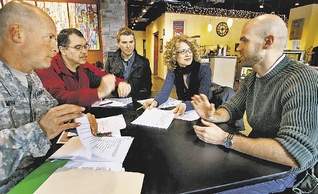
Writing instructor Emma Rainey looks to Luke Huisenga as he talks about his poetry with (left to right) Brian Smith, Dr. Jon Kerstetter and Luke Sheperd. She meets with armed services veterans to help them write creatively about their experiences at an Iowa City coffee shop.
Rainey talks with Luke Huisenga (foreground) as Luke Sheperd listens. “Writing is the space between where (vets) can get this out,” she said.

‘This is my aircraft, my office’

Following is a sample of a book worked on during the workshop by Jon Kerstetter, MD, COL, Iowa Army National Guard, retired.

Often, just before sunrise, I used to walk the flight line where the aircraft were waiting just at the edge of the runway, perfectly aligned, standing at attention. The rising sun would paint colors on their shapes. I would smell the JP-8 jet fuel, smell the hints of metallic oil and let my eyes feast on all that is military; on all the sun-colored, olive-drab, gray-green shapes, the dark browns and the dusty whites of military markings. The colors were like flowers in the desert. I could name each aircraft by the pattern of its colors, its faded spots and stains, and by its scattered chips of military CARC (Chemical Agent Resistant Coating) paint. I used to love to watch the morning pre-flights of the crew. Watch the checks and movements about the aircraft. Soldier ants at war. Occasionally, I would walk up and just touch one of the helicopters and let my hand move across the skin, feeling the rivets, the sand-scarred paint, feeling the door handle or the cockpit seams. I would breathe in the morning smells, the aircraft smells, the war smells, and be taken on a sort of mental excursion that drew me close to the familiar and nearer to the battle: the sights and sounds of army aviation, military medicine, rescue, resupply, interdiction, attack and medevac. This ritual would function like a liturgy of sorts, so that when I was finished I felt restored in faith, restored in my role as a soldier and as a flight surgeon. It made me bold to the point that I would lay claim on the aircraft – on the mission. This is my aircraft. No other doc in the entire Army has this aircraft. It belongs to me. It’s my office. It’s where I go to war.

Comments for

Stories from war

kennyji wrote:

Powerful article, Mike, on the cathartic effect of writing. Thank you. Reminds me of something Jesus said in the Gospel of Thomas. “If you bring forth what is inside you, what you bring forth will save you. If you don’t bring forth what is inside you, what you don’t bring forth will destroy you.”

2/9/2010 12:10:18 AM

Studies Show Meditation Can Benefit Your Heart

January 31, 2010


Studies Show Meditation Can Benefit Your Heart

Date: 28/01/10
Keywords: Alternative medicine , High Blood Pressure , Heart Disease , Transcendental Meditation

Meditation simply involves clearing your mind and relaxing your body to find a harmonious, serene, boundless, inner milieu. Basically, you train your mind to take a break… and now it turns out that if you have coronary heart disease and you practice meditation, you can lower your risk of heart attack, stroke, and death by as much as 50 per cent.

Forget what you’ve heard about meditation. If the word “meditation” conjures up images of incense, finger cymbals and crystals – don’t be put off if those things are not your style, because none of them are necessary to meditate properly.

Meditation simply involves clearing your mind and relaxing your body to find a harmonious, serene, boundless, inner milieu. Basically, you train your mind to take a break… and now it turns out that if you have coronary heart disease and you practice meditation, you can lower your risk of heart attack, stroke, and death by as much as 50 per cent.

Breath in… Breath out…

Two recent studies show significant heart health benefits for people who meditate daily and this doesn’t come from some hogwash-source. Both studies are mainstream. One was recently presented at the annual meeting of the American Heart Association (AHA) and one was published in the Archives of Internal Medicine. And the incredible thing is that in both studies all the subjects had coronary heart disease (CHD).

Previous studies have shown that a popular form of meditation known as transcendental meditation (TM) may actually help patients control blood pressure.

A class of ‘heart medication’

In the most recent study of the two, US researchers from The Medical College of Wisconsin collaborated with a natural medicine school in Iowa. The 200 CHD participants (average age 59 years, with narrowing of arteries in their hearts), were divided into two groups. Half received TM instruction and half did not.

Results: Over nine years, rates of heart attack, stroke, and death were all significantly lower in the TM group.

Lead researcher Dr. Robert Schneider, suggested TM should be thought of as a new class of heart disease medication. “In this case, the new medications are derived from the body’s own internal pharmacy stimulated by the Transcendental Meditation practice… But this is the first controlled clinical trial to show that long-term practice of this particular stress reduction program reduces the incidence of clinical cardiovascular events – that is, heart attacks, strokes and mortality.”

Dr. Theodore Kotchen, co-researcher of the study, professor of medicine, and associate dean for clinical research at the Medical College, was quoted as saying: “This study is an example of the contribution of a lifestyle intervention — stress management — to the prevention of cardiovascular disease in high-risk patients.”

The second smaller study, evaluated the efficacy of TM on components of metabolic syndrome and CHD. Metabolic syndrome is thought to be a contributor to CHD.

US researchers at the University of Southern California divided 103 CHD patients into two groups. Subjects in one group received 16 weeks of TM instruction. Compared to the placebo group, TM subjects experienced significantly better blood pressure control, reduction of insulin resistance components of the metabolic syndrome and improved heart rate variability. In addition, TM helped subjects control their response to stress.

You can find information about the TM technique used in the CHD study on the Transcendental Meditation Programme website at http://www.t-m.org.uk.

Just a moment away from peace of mind

If you are considering TM as a healthy habit but you are still unsure, here are a few things to help you make up your mind:

* Simple: The TM technique is a simple, effortless mental process practiced for 15–20 minutes twice a day, sitting quietly and comfortably in a chair with your eyes closed.

* Easily learned: The TM technique can be easily learned by anyone and is enjoyable to practice.

* Immediate benefits: The benefits of the TM technique are immediate and increase over time. The technique’s positive effects — for mind, body and relationships — have been verified by hundreds of research studies conducted at top medical schools and published in over 350 peer-reviewed scientific journals.

* No belief required: The TM technique does not involve belief or religion. In fact, you can be thoroughly sceptical and the technique will still be fully effective.

* Develops the total brain: Brain research shows that the TM technique develops the total brain, increasing creativity and intelligence and improving decision- making and problem-solving abilities.

* Reduces stress and high blood pressure: Medical school research funded by the National Institutes of Health shows that the TM technique is the most effective mind-body practice for reducing stress and stress-related disorders, including hypertension, high cholesterol, stroke and atherosclerosis.

Related Reading:

Meditation As A Tool For Good Health And Longevity

Heart Diet: Three Drug-Free Steps To A Healthy Heart


Sources:

“Effects of a Randomized Controlled Trial of Transcendental Meditation on Components of the Metabolic Syndrome in Subjects With Coronary Heart Disease” Archives of Internal Medicine, Vol. 166, No. 11, 6/12/06, archinte.ama-assn.org

“Study: Meditation Lowered Cardiac Risk by 50 Percent” Ivanhoe Newswire, 11/23/09, ivanhoe.com

Registered Office – Sea Containers House,
7th Floor, 20 Upper Ground, London SE1 9JD.

Agora Lifestyles Limited is registered in England and Wales
with company number 3303666 and VAT number GB 629 7287 94.

Copyright 2009 © Agora Lifestyles

Fairfield’s Sustainable Living Coalition Builds Green Educational Center

January 22, 2010

Dec 23, 2009 01:39PM

All for intelligent design: Sustainable Living Coalition draws from nature’s wisdom

By Linda Egenes


Submitted
The Sustainable Living Coalition built this 1,200-square-foot straw-bale, post-and-beam barn as a main classroom and administrative space.

It started in 2004 when a few people in Fairfield were looking for a sponsor for an environmental conference.

“We decided to form our own non-profit and called it the Sustainable Living Coalition,” says Diana Krystofiak, a founding board member of the SLC. “The goal was to combine people from different sectors to create a more sustainable Fairfield, which could then become a model for other communities.”

From the start, a driving force behind the SLC’s vision and educational initiatives was Lonnie Gamble, who with permaculture expert Grover Stock, began teaching a ten-week permaculture course called Big Green Summer. Hundreds of interns trained with Gamble and Stock, living in Gamble’s home. But Gamble and his wife, Valerie, couldn’t donate their time, money and home to educate interns indefinitely. A campus was needed.

A permaculture demonstration site

Fast forward to the fall of 2009. It’s a warm November day at the newly inaugurated SLC campus on the north edge of Fairfield. Briggs Shore and Frank Cicela, two administrators, are there.

Shore, a 27-year-old dynamo who trained as an SLC intern and was hired last year as administrative coordinator, is clearly passionate about her job.

“We bought the land in 2006 with a grant from Iowa’s Great Places,” she says.

The purpose of the campus, she explains, is to become a working permaculture farm and educational center with classes and internships.

Shore explains, “permaculture is a way to take the principles of intelligent design, found in nature, and apply it to absolutely everything in your life — how you get your food, water, shelter, heat (and) power, and (how you) dispose of waste.”

Cicela adds, “we want this to be a model, to establish best practices for natural building and rural farming that people can take back to their own communities.”

At age 40, Cicela brings a wealth of experience to the SLC, having established a similar nonprofit called Sustainable Indiana, and shows remarkable dedication by taking an unpaid leave from his job at Clipper Wind Power in Cedar Rapids to spend every other week working for the SLC.

Shore points to the 1,200-square-foot straw-bale, post and beam barn that is the main classroom and administrative space for the campus. “We broke ground in January 2009,” she says.

The building is functional but awaiting funds for plastering the outer walls, covering the gravel floor with flagstone and completing a five-room dormitory loft. It was erected in just four months with the help of an Amish construction crew for the foundation and dozens of volunteers who provided the massive man hours necessary for straw-bale building.

“We’re completely off the grid, and we provide our own power and water,” says Shore. She points to the rain catchment system, ten photovoltaic solar panels and one-kilowatt wind turbine that supply electricity and high-speed Internet. “We’re high-tech while being sustainable, rustic while still being modern.”

A spirit of collaboration

“One of our missions is to partner with other people and organizations,” says Cicela.

Collaboration takes many forms. The campus adjoins and makes use of two other sustainable sites for its workshops: the Abundance Eco Village and the Mullenneaux extended-family acreage, which includes three sustainable cob, straw and clay homes.

“We’re a few off-the-grid communities who happen to be close together and really good friends,” explains Shore.

Other collaborators include Grinnell College and Maharishi University of Management.

A vision for the future

Future projects include building four-season dormitory space to house 50 interns, a hospitality center, an elderhostel, underground cisterns to store drinking water from the rain catchment system, wetland waste management system, permaculture food forest, edible landscaping, and seed money to extend educational offerings.

But ambitious as these plans are, Gamble sees a more visionary goal. “The SLC is a way to foster ecological, micro-enterprises,” he says. As an example, the SLC bought equipment and loaned it to help a local baker get started, and launched the Edible Cityscapes Project, an eco-business that sells fruit trees and provides free labor to plant them properly.

Another project in the works: a micro-enterprise center, to help fund sustainable businesses. And the SLC is providing land and sponsorship to a John Jeavons mini-farm center, one of three in the U.S. to be established this spring.

For more information about the SLC, contact Briggs Shore at briggsshore@gmail.com or visit sustainablelivingcoalition.org.

Linda Egenes is a book author and freelance writer. She lives in Fairfield, Iowa.

Radish magazine is published by Small Newspaper Group and distributed by Moline Dispatch Publishing Co., L.L.C., 1720 5th Ave., Moline, IL 61265