Archive for the ‘Sustainable Living’ Category

OWN: Oprah Visits America’s Most Unusual Town, Sunday, March 25, 8 p.m. CT, 9-10 p.m. ET/PT

March 20, 2012

OWN: Oprah Winfrey Network presents a new episode of “Oprah’s Next Chapter” featuring America’s Most Unusual Town this Sunday, March 25, 8:00 p.m. CT (9-10 p.m. ET/PT).

On “Oprah’s Next Chapter,” Oprah Winfrey travels to Fairfield, Iowa—one of the safest, greenest and most unusual communities in America—to visit a school where daily Transcendental Meditation® (TM) practice is mandatory. Winfrey then visits the neighboring community of Maharishi Vedic City, where non-organic food is banned and all houses face East — adhering to an ancient Indian style that brings peace and harmony. Also, for the first time, cameras are allowed inside a top-secret, 80-acre compound where 800 Indian men live spending eight hours a day meditating and chanting. Later, Winfrey joins the community at their domes for evening meditation.

The episode will only be available in its entirety on the OWN TV network. However, clips and footage may be featured on www.Oprah.com. Once there, find out what channel the Oprah Winfrey Network is on in your area by entering your zip code on the right. Canadian viewers, click here. Watch a Sneak Preview here: Oprah Visits America’s Most Unusual Town.

Oprah spends the day in Fairfield, Iowa—one of the safest, greenest and most unusual communities in America. It’s the last place you’d expect to find two huge golden domes built for the thousands of residents who rush there to meditate twice a day.  Watch a sneak preview; then tune in for the full episode of Oprah’s Next Chapter on Sunday, March 25, at 9/8c. Please note: There will only be one episode, on March 25. http://www.oprah.com/own-oprahs-next-chapter/Sneak-Preview-Oprah-Visits-Americas-Most-Unusual-Town-Video

Addendum: Members of  the Fairfield community are invited to a live viewing of Oprah’s New Chapter, Sunday, March 25, at 8 p.m. CT (doors open at 7 p.m.) at the Sondheim Theater, Fairfield Arts & Convention Center. Free Admission – First come first seated. Also, being broadcast live for students in Dalby Hall, Argiro Student Center, on the Maharishi University campus. Doors open at 7:30 p.m. CT. Free admission

Related: Fairfield Ledger: Fairfield readies for Sunday debut on Oprah network | KTVO: Fairfield to be featured on Oprah Winfrey Network | Oprah writes in O Mag about her visit to TM Town and meditating with ladies in their Golden Dome | Some Reports on Dr. Oz’s Interview with Oprah about TM and her Next Chapter | Oprah meditates with ladies in MUM Golden Dome | Reports of Oprah’s visit to Fairfield, Iowa | Oprah says she and her staff meditate, enjoy a Quiet Time twice a day—Facebook Live interview.

Also see The Iowan: Sizing Up Small Towns: Rethinking Success in Rural Iowa: Fairfield Thinks Inclusively.

Iowa Outdoors: Fairfield’s Abundance EcoVillage: Harmonious Living With Nature — Off The Grid

February 23, 2012

The March/April 2012 issue of Iowa Outdoors has an 8-page spread (pages 52-59) featuring Fairfield’s Abundance EcoVillage. The article, Harmonious Living With Nature, was written by Mindy Kralicek with photos by Clay Smith.

Iowa Outdoors is a magazine of the Iowa Department of Natural Resources. Their editorial mission is to strive to open the door to the beauty and uniqueness of Iowa’s natural resources, inspire people to get outside and experience Iowa and to motivate outdoor-minded citizens to understand and care for our natural resources.

This feature article has over 20 colorful photos with text. Some of the topics discussed are Maharishi Sthãpatya Veda Architecture, Permaculture Systems, the use of solar panels, wind turbines, earth air tubes, living off the grid, sustainable communities. Check next month to see if they’ve posted it online. For now, you can download a PDF of this beautiful article here: Off The Grid.

It’s much easier to read the article in the original magazine layout with the photos and additional text (instructions how to order at the end of this article). The next best thing is to download the PDF of it. But for those who can’t, I also copied and pasted the article below without the photos and accompanying text.

(more…)

Maharishi University Sustainable Living Students Are Going Green In The Heartland—KTVO Report

November 23, 2011

Going green in the Heartland

Sustainable living students at Maharishi University in Fairfield are creating instruments that can be utilized for a “green”, environment-friendly lifestyle.

FAIRFIELD, IOWA — The future of sustainable energy may be right here in the Heartland.

At Maharishi University in Fairfield, about 90 students are enrolled as sustainable living majors. They create and use different types of equipment that contribute to a “green”, environmentally friendly lifestyle.

Lonnie Gamble is a professor in the program, which he sees as cutting edge.

“The program is really designed to give students the skills to help design, build and maintain sustainable communities,” Gamble said. “As such, it involves re-thinking every aspect of human endeavor in terms of sustainability. And a big part of that is energy, because energy is involved in everything that we do.”

The students work in groups to create and utilize their projects. Jimmy Leritz and his group took leftover vegetable oil from local restaurants and converted it to deisel fuel, that they use to fuel their school bus and the students’ own vehicles.

“This is so inspiring,” Leritz said. “To run an engine off of veggie oil, it really shows what we can do with the future of green energy.”

Robert Belding-Miller and his group built a wind tower as a source of energy.

“We’re trying to make this building entirely sustainable, so that’s a really good wind generator that will generate enough energy to power several classrooms here,” Belding-Miller said.

Yet another group project was the construction of an “information wall”, consisting of two differently colored light bulbs to alert the building’s visitors to the current status of energy supply.

“We have a yellow light for our solar system,” student Josh Wilson said. “As long as that light is on, we can use energy as much as we need to, to turn on our lights and to power our presentations. We’re excited that we have this system, because we’re able to show that even in an existing, old building, that there are things you can do to lower your energy usage.”

The focus on renewable energy is only just beginning, but the projects created by these students are the first steps toward a sustainable lifestyle.

“The work that these students are doing here at the sustainable living program is part of an effort that I think every human on the planet is going to be involved with,” Gamble said. “These guys are really on the leading edge of it. It’s very rewarding for me to work with young people in this way.”

3.2 News banner

BUILDINGS Magazine: A Zero Utility Bill Building

October 8, 2011

BUILDINGS Magazine
September 2011

You can read this article below, but there are two other ways to better see what it looks like online, in a digital version of the magazine: click here to browse the enhanced, rich media version from cover to cover: article is on pages 24-26, includes pop-out video, or click here to just see the article.

A Zero Utility Bill Building

One zero utility bill university is boldly pursuing off-grid for electricity, water, and sewer

By Jennie Morton

You wouldn’t expect to find a building of the future nestled in the hills of Iowa, but the Sustainable Living Center (SLC) is all about breaking the mold.

Commissioned by the Maharishi University of Management, the facility is a forward-looking project that draws from an “East Meets West” approach to sustainability. It is the first to integrate four separate building challenges: LEED Platinum, the Living Building Challenge, Building Biology, and Maharishi Vedic Architecture.

The result of combining ancient philosophies with the latest green technologies? A 6,900-square-foot building that’s off-grid for electricity, water, and sewer.

An Ambitious Plan
Since its inception, the Sustainable Living Center has evolved from an environmentally conscious project to one that minimizes its impact right down to the paint on the walls. Unlike other new buildings on campus, the design requirements were voiced by the faculty, students, and community members. While their first visions of the center were less far-reaching, the future occupants insisted on a building that teaches.

“Why off-grid? It’s never been done for a campus building as far as we know, and we wanted to demonstrate that it can be done,” explains David Fisher, director of the SLC and a university professor. “This is where the industry needs to go next, but they won’t do it unless they see it first. This will help to expand their vision of what is possible.”

One also doesn’t think of the Midwest as a hotbed for sustainable architecture, but it’s for this very reason that Maharishi University wasn’t thwarted. “Contrary to popular opinion, the Midwest is ideal for an off-grid building. It’s hard to imagine a place with more extremes with temperature, weather, and humidity. But if you can do it here, then you can do it anywhere,” Fisher says.

Overcoming Challenges
An intricately planned building of this magnitude requires an element of patience to temper unexpected complications. The first challenge was funding. Because the university was focused on another large project at the time, the SLC needed to secure funds from the onset. Once some excitement had been generated, the recession hit and stalled progress. Consequently, the center is being built in stages.

This economic reality may mean the building will go online without all the features required to be fully off-grid. However, the university remains optimistic. “Even short of the full goal, the building will compare favorably with, and even go further, than most green buildings,” says Fisher.

Conflicting opinions on green strategies were also a factor that had to be addressed to find consensus in the design. “People often have very sharp differences for the best way to go green,” Fisher says.

For instance, how does one determine whether in-floor radiant heating or a forced air system is the most suitable option when both reduce energy consumption? Fisher says many conversations like these were necessary to achieve the most optimal version of the building.

While the four challenges provided many options for sustainability, some produced a conflict of interest. For example, LEED honors recycled content, while Vedic Architecture supports the use of virgin materials only. The Living Building Challenge requires the protection or restoration of natural habits on the site, but only LEED specifies light pollution reduction.

“However, one reason for doing all four certifications is to try to be as inclusive as possible of different people’s ideas of what should be in a green building,” Fisher explains.

Another stumbling block came in the form of climate change, which impacted the center’s renewable energy output. “We discovered that the number of cloudy, wintery days with low temperatures and wind has increased more in the past 5 years than it has the last 20 years,” says Fisher. “We also found out that rainfall has gone up by 4 to 5 inches a year. We had to do some redesigning when we learned this.”

Creativity Yields Results
If you’ve assumed this progressive building is using cutting-edge or proprietary systems to get to its goal, you’d be mistaken. The university prides itself on using “state-of-the-shelf” technologies to prove that its goal can be achieved in the here and now with well-proven equipment and supplies, says Fisher.

This led to some out-of-the-box strategies to find solutions to common problems:

• “One strategy was instead of trying to make a building have a comfortable temperature at any humidity, we lowered the humidity. We know high humidity, whether cold or warm, makes people uncomfortable,” explains Fisher. “So we keep the humidity controlled with desiccant cooling, which actually provides a wider temperature range as a buffer.”

• Students drove innovation by insisting the amount of concrete in the building be reduced, so an alternative to cinder blocks had to be found. A nearby construction project excavated a ridge and the students saw the displaced soil as a resource. They ran a compressed earth block machine to compact the dirt into blocks. These became the thermal mass to help insulate the building and were also used for interior walls in classrooms and hallways.

• To negate any VOCs, even the paint on the walls has a biological origin. Earth plasters are mixed with sand and cow manure, paints have a powder milk base, and most pigments are derived from clays, minerals, or spices. “People today have a heightened awareness of what kinds of building materials are toxic or produce off-gassing,” says David Todt, vice president of expansion. “It’s important to demonstrate the kinds of techniques that will result in a more healthy building for people to work in.”

• To achieve zero-water status, extensive rainwater harvesting will be used and filtered with UV light for drinking water and toilets. All black and grey water will be processed in a septic tank and then by a peat moss system for irrigation needs.

Justifying the Cost
Though construction is still underway and anticipated to be completed within the next year, the final costs per square foot are projected to be $450. Fischer is quick to point out that while sizeable, the costs aren’t much higher than a typical LEED project.

Some have criticized the project as being twice as expensive as LEED, but those numbers are based on a certified project only, he says. Average costs for LEED Platinum projects are typically around $350 a square foot. The extra $100 for the SLC is balanced by the additional three certifications and the elimination of grid ties.

Given the high costs, Todt recognizes that the university’s commitment to sustainability won’t be easy for everyone to duplicate. “We know it’s not commercially feasible for everyone to do an off-grid building like we have,” Todt admits. “But this is a demonstration project – it makes a statement that this is the way we need to go in the future. If that means someone is doing a normal building and decides to go the extra mile with efficiency in one system, that’s what we want to help motivate.”

Fisher also stresses the benefits of grid independence. Calling the SLC a zero utility bill building, he hopes the building’s example will prompt others to think about a future that makes an off-grid facility a savvy move.

“We encourage others to keep in mind the effects of peak oil, climate change, and energy descent as you design your green building,” recommends Fisher. “You can have it all, and you can have it now. It’s just a matter of deciding if it’s worth it to you.”

Jennie Morton (jennie.morton@buildings.com) is assistant editor of BUILDINGS.

SIERRA: AMERICA’S COOLEST SCHOOLS: Maharishi University of Management

August 22, 2011

The Nonconformist Class | AMERICA’S COOLEST SCHOOLS

Going green may finally be “normal,” but some schools with eco-agendas remain miles from mainstream

By Tim McDonnell

Maharishi University of Management

Courtesy of Shane Ernest

The Beatles’ onetime spiritual adviser, the late Maharishi Mahesh Yogi (sometimes called the “giggling guru”), founded Maharishi University of Management, in Fairfield, Iowa, as a place for “consciousness-based education.” The school’s buildings face east and have a central nucleus, and rooms are aligned with the sun’s movement according to the strictures of an ancient Indian architectural style. The first U.S. university to offer a four-year degree in sustainable living, MUM balances modern clean technology and 5,000-year-old Vedic philosophy based on Sanskrit texts.

The dining hall serves food that’s entirely vegetarian and organic. To graduate, each student is required to have maintained a plot on the campus’s farm. Above, students celebrate the completion of their permaculture class with a feast made of ingredients harvested from their gardens.

Attending to the earth is hardwired into the school’s signature (and trademarked!) practice, Transcendental Meditation. From it, says Robbie Gongwer, the program developer for MUM’s Sustainable Living Center, “students get this subjective experience of an interconnectedness to life.”

Documentary shines a new light on rural energy

February 24, 2011

‘Sustain Angoon’ documentary shines a new light on rural energy

By Richard Radford | Capital City Weekly
Wednesday, February 23, 2011

“December and the Meter’s Spinning Backwards,” Southeast Alaska Conservation Council Energy Coordinator Dan Lesh wrote on the Sustain Angoon blog. He included photographs of the frozen landscape surrounding the demonstration house – the home of Angoon elders Peggy and Kelly Williams – and a video that indeed showed the electric meter rotating counterclockwise.

This is no small feat for a community which has energy costs that can add up to as high as $1,200 a household a month, about 6 to 8 times more expensive than in the Lower 48. Angoon is heavily dependent on non-renewable resources, and combined with a shrinking population and high unemployment, keeping up with the bills can prove to be a challenge.

What sent the wheel of progress spinning forward and the meter backwards? The Sustain Angoon Project, which tackled the problem of energy usage from several angles, involving a combination of weatherization, energy efficiency and renewable energy systems. The efforts of the project have culminated in a film, which will be shown this week at a special screening in Juneau.

The project has combined the collective efforts of several organizations including the Central Council of Tlingit and Haida Indian Tribes of Alaska, SEACC, the Tlingit-Haida Regional Housing Authority (THRHA), Angoon Business Center, and the Maharishi University of Management of Iowa.
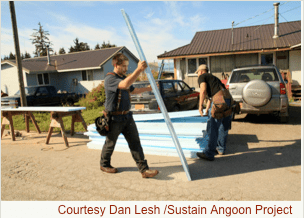
The Williams’ house was fitted out with new insulation and siding, caulking and sealing and duct repair. Improved high-efficiency lighting and Energy Star appliances were installed, monitored by The Energy Detective, or TED 5000, system. Solar panels were put up, including a solar hot water system.

Solar power is not the first thing one might think of when talking about energy in Southeast Alaska, but Lesh said that the system appears to be operational and effective.

“When you’re talking about a place that pays five times as much for energy, it doesn’t matter if you get one sixth of the sun,” he said.

The meter actually does run backwards on sunny days, Lesh said, though of course in the winter there are few hours of daylight, so at least during this time of year the new equipment doesn’t cancel out all energy usage.

There have been a few issues working out all the details of monitoring the solar hot water system, though there is anecdotal evidence from the Williams family who noticed that their boiler doesn’t kick on during sunny days.

They also put up a wind tower and hooked it up to the local school, which charges batteries that can run the washing machines. They have yet to set up a monitoring system for that, but so far it seems to be working.

Lesh said that the problem of high energy bills can’t be solved by just turning the lights out before leaving a room. On average citizens in places like Angoon, served by the Inside Passage Electrical Cooperative, use far less energy than residents of places like Juneau.

“So they turn the lights off, they use everything sparingly, but they may have something that’s on that’s draining power or leaky windows,” he said. “But they are head and shoulders above us [who live in cities] in terms of a lot of types of behavior in terms of energy efficiency.”

Renewable energy systems and weatherization are expensive, and Lesh said it will take time to work out how cost effective their implementations are.

“Not to say that our project should be replicated, but the kinds of discussions we’ve been generating should lead to more action along those lines,” he said. “Energy efficiency is low-hanging fruit that would make big differences in the villages.”

Newer to the project is Carrie Sykes, who started her position as the Business & Economic Development manager at Central Council in October. Sykes said she has worked with the THRHA on a joint application to expand similar ideas being explored in Angoon for other communities in Southeast with high energy costs like Kake and Hoonah.

Another project on the drawing board is a training program for local people in weatherization, which could help cut energy costs and provide jobs.

“When you put in this kind of stuff, you’ll need people who will be familiar in case something goes wrong,” she said.

Teaching and learning are the most important things to take away from the project as it progresses, Sykes said. The documentary will hopefully be a good tool to spark interest, especially with the younger generation.

“You really have to start educating, and start educating young,” she said. “We’re going to be getting the documentary to the schools, science teachers and all the tribes. We want to get it out there about all that can be done.”

Robert Gongwer, co-founder of the Iowa-based socially and environmentally conscious consulting firm Tidal Wave Group, said that there some in Angoon who doubted that the project would get pulled off, who were later “blown away when the electric meter started running backwards.”

“It was a big turning point, when it became real,” he said.

Gongwer co-directed the documentary, working on pre-production in Angoon in September of last year when the project was building up steam, and has recently put the final polish on the film. Coming from the outside, he was nervous about being able to give the best description of what was going on in Angoon. The goal was to be totally honest about the people, the community, and the energy providers.

He and his team wanted to make sure that the community was receptive to the project before getting involved. He was taken aback by the amount of hospitality shown to them by the residents of Angoon, regardless of any reservations they had about the potential of the project.

“We went to the [ANB Hall], and everyone was just so, so happy,” he said.

There is a respect for older people in Angoon, Gongwer said, and they are not only cared for, they are looked to for answers.

“It just really struck me as something that is really broken in the culture I’m from,” he said.

The concerns voiced by the elders of Angoon were first and foremost on Gongwer’s mind while working on the project.

“[An elder] told us her worst fear is to fly over Angoon with her grandchildren and tell them, ‘that’s where we used to live,'” he said.

The Sustain Angoon Project has shown the kinds of things that can be accomplished, Gongwer said, though there is still a lot more exploration to be done. The project isn’t the solution, but rather a demonstration of one take on a larger set of solutions. Maharishi University of Management Professor Lonnie Gamble, who also worked on the project, explained the situation as, “We don’t need a silver bullet, we need silver buckshot.”

“We’ve made some progress, that’s great,” Gongwer said, “but really the issue is how can we sustain progress? We just need to keep after it…maybe this [project] will help to change some laws, change some policies.”

“Sustain Angoon” will be shown at the Silverbow (120 Second Street) back room Thursday, Feb. 24 at 5:30 p.m. There will also be a discussion with members of the project. For more information or to follow new developments of the project, go online at www.sustainangoon.org.

Richard Radford may be reached at richard.radford@capweek.com

There are additional photos for viewing at the top right of the article. Go to: Click Thumbnails to View. Click on a photo, then click on it again for a larger view.  Here are the descriptions to go with some of those photos: Work on the house got underway in early fall of 2010. During sunny days, the electric meter actually runs backwards now. The community of Angoon came together to work on the energy project. The Williams’ house was fitted out with new insulation and siding, caulking and sealing and duct repair. Improved high-efficiency lighting and Energy Star appliances were installed, monitored by The Energy Detective, or TED 5000, system. Solar panels were put up, including a solar hot water system.

This article was also published in The Washington Examiner
Film looks at energy-saving efforts in Angoon

In this September 2010 photo provided by Tlingit and Haida Central Council, workers with the Sustain Angoon Project talk in the southeast Alaska village of Angoon. The Sustain Angoon Project tackled the problem of energy usage in the village from several angles, involving a combination of weatherization, energy efficiency and renewable energy systems. The efforts of the project have culminated in a film.

Detours: Vedic City Rises Above

January 19, 2011

Vedic City Rises Above

Winter 2010 Destinations
Written by Jessica Rapp

Rush hour in Vedic City, Iowa, is an understatement. Every day, just minutes before 7 a.m. and 5 p.m., its main street transforms from a desolate country road into a gently moving caravan carrying approximately 1,900 passengers intent upon achieving world peace. This common objective attracts visitors from all over the world to the heart of the Hawkeye State, many of them followers of the Transcendental Meditation (TM) movement and believers of the tranquil lifestyle. They eat organically-grown foods, live in housing built according to natural principles and make sustainability a priority in the 2,200 acres of land bordering Fairfield, Iowa, that they call home. Twice a day, they make the pilgrimage to two shimmering gold-domed complexes to cross their legs in the lotus position, close their eyes and meditate, to improve not only their own health but to better the society surrounding them.

The TM organization cites numerous studies that it says proves its method works and distinguishes the program from other common forms of meditation or yoga. Jeffrey Cohen, director of the Invincible America Assembly at accredited Maharishi University of Management (MUM), said TMers demonstrated their method in Washington, and even as far away as Lebanon. Cohen said that in Lebanon, statistics showed a “direct correlation” between the size of the groups meditating and the amount of crime and violence in the area.

“In Washington, D.C., large groups of TM meditators convened to show that [their technique] would lower the crime rate in D.C.,” Cohen said. “And in fact, statistical analysis showed that it lowered violent crime by… a very significant amount. And again, it was reviewed by experts and sociologists.”

Since the 1950s, six million people worldwide reached a consensus that the program developed by the late Maharishi Mahesh Yogi, famed guru to the Beatles, is worth following. (more…)

The Iowa Source: MUM Sustainable Living Center

November 21, 2010

The Iowa Source cover story on MUM’s SLC written by Linda Egenes

Building the Future: MUM’s Sustainable Living Center
New Zero-carbon Classroom Showcases Green Living
http://www.iowasource.com/fairfield/2010_11_slc.html

Sustainable Living Center: It Takes a Team to Go Green
http://www.iowasource.com/fairfield/2010_11_slc_team.html

For more information and videos of the phases of construction plus a TV news report visit Sustainable Living Center. Also see YouTube videos at mumslc from Earth Day 2010, a Sustainable Living Center Tour Dec 2010, and Building Progress Reports 1, 2, 3, & 4. To find out more about a degree program in Sustainable Living, visit: http://sustainableliving.mum.edu.

BUILDINGS Magazine Sept/Oct 2011: A Zero Utility Bill Building

Workshop Makes Case for Meeting Architecture 2030 Challenge Today

September 27, 2010

COSC hosts “2030 Now: Case Study of MUM’s Sustainable Living Center” on Sept. 28 in Des Moines.

West Des Moines, IA (September 24, 2010) –With buildings consuming more energy than any other sector, Architecture 2030 issued The 2030 Challenge to the global architecture and building community, asking them to meet sustainability standards of a zero carbon footprint by year 2030. As of July 2010 40% of all U.S. architecture firms have adopted the Challenge.

Center on Sustainable Communities (COSC) hosts a dynamic green building workshop that illustrates how to attain The 2030 Challenge right now, using readily available building technology and products. Fairfield’s Maharishi University of Management (MUM) Sustainable Living Center is the first of its kind and is the subject of “2030 Now: Case Study of MUM’s Sustainable Living Center” happening on Tuesday, Sept. 28 from 5:00-7:00pm at the John & Mary Pappajohn Education Center located at 1200 Grand Avenue in Des Moines. The workshop is free and those interested in attending are asked to register by contacting COSC’s Leslie Berckes at 515-707-2787 or Leslie@icosc.com.

Presenters of the program include Masaki Furukawa, architect of the Sustainable Living Center, and Dal Loiselle, developer and general contractor. Together, they will review how the Sustainable Living Center surpasses LEED platinum standards, complies with the Living Building Challenge and has already achieved The 2030 Challenge by using methods and materials readily available in Iowa now.

“2030 Now: Case Study of MUM’s Sustainable Living Center” is an extension of COSC’s Re-Building a Sustainable Iowa statewide training program. COSC is able to temporarily offer its Re-Building a Sustainable Iowa sessions for free through funding from the Iowa Department of Economic Development and the U.S. Department of Housing and Urban Development.

About COSC

Center on Sustainable Communities (COSC) is a non-profit membership organization founded in 2005 that serves as Iowa’s trusted educational resource for sustainable building. As the recognized leader in providing education and connecting resources, COSC empowers individuals and communities to make everyday decisions that promote sustainability, resulting in a better quality of life for all Iowans. COSC’s schedule of residential, commercial and energy-specific workshops can be found at www.icosc.com.

###

Contacts:

Lynnae Hentzen, Co-Founder/Executive Director
COSC – Center on Sustainable Communities
515-707-0732, Lynnae@icosc.com

Siobhan Spain, Communications Specialist
COSC – Center on Sustainable Communities
515-707-2783, Siobhan@icosc.com

KTVO News: Solar power at Maharishi University

July 22, 2010

Solar power at Maharishi University

by Matt Buhrman

With a flip of the switch, solar power is taking over one construction site in the Heartland.

FAIRFIELD, IOWA — Fairfield Mayor Ed Malloy and State Representative Curt Hanson (D-Fairfield), officially started the solar electricity of the Utility Cottage at Maharishi University on Thursday afternoon.

The renewable energy will be used to power all the equipment needed to complete construction on the university’s new Sustainable Living Center (SLC).

The SLC will set a new standard for green building in America by being completely off the grid with respect to electricity, heating and cooling, water, and waste…and it is the first of its kind on any campus in the world.

“As much as we are very excited about what we mark today, we know that in the very near future this will be commonplace. But let this building be a great demonstration model in the meantime to show others how this is done,” Mayor Malloy said.

“Use this as a learning tool and learn from the experiments that are taking place in this building, and perhaps get more of us off the power grid, more of us off foreign oil, more of us energy efficient,” Representative Hanson said.

The SLC will serve students in the university’s Sustainable Living major. Among its features, the building will have classrooms and workshops.

“I know that our future leaders that will really influence education, politics, and society at large are going to be studying and training in this building, at this university. And for that we are very fortunate, and I am very proud,” Mayor Malloy said.

“Hopefully it’s going to be studied by a lot of engineers all over the United States and maybe we can export some of these ideas to the whole nation. So I’m very happy to be here and learn more about this cutting-edge technology,” Representative Hanson added.

Also recognized on Thursday afternoon were students and other community leaders who played a major role in this green initiative.

Video is courtesy of KTVO Television and heartlandconnection.com

Solar Energy to Power Completion of MUM’s Sustainable Living Center