Archive for the ‘Education’ Category

BUILDINGS Magazine: A Zero Utility Bill Building

October 8, 2011

BUILDINGS Magazine
September 2011

You can read this article below, but there are two other ways to better see what it looks like online, in a digital version of the magazine: click here to browse the enhanced, rich media version from cover to cover: article is on pages 24-26, includes pop-out video, or click here to just see the article.

A Zero Utility Bill Building

One zero utility bill university is boldly pursuing off-grid for electricity, water, and sewer

By Jennie Morton

You wouldn’t expect to find a building of the future nestled in the hills of Iowa, but the Sustainable Living Center (SLC) is all about breaking the mold.

Commissioned by the Maharishi University of Management, the facility is a forward-looking project that draws from an “East Meets West” approach to sustainability. It is the first to integrate four separate building challenges: LEED Platinum, the Living Building Challenge, Building Biology, and Maharishi Vedic Architecture.

The result of combining ancient philosophies with the latest green technologies? A 6,900-square-foot building that’s off-grid for electricity, water, and sewer.

An Ambitious Plan
Since its inception, the Sustainable Living Center has evolved from an environmentally conscious project to one that minimizes its impact right down to the paint on the walls. Unlike other new buildings on campus, the design requirements were voiced by the faculty, students, and community members. While their first visions of the center were less far-reaching, the future occupants insisted on a building that teaches.

“Why off-grid? It’s never been done for a campus building as far as we know, and we wanted to demonstrate that it can be done,” explains David Fisher, director of the SLC and a university professor. “This is where the industry needs to go next, but they won’t do it unless they see it first. This will help to expand their vision of what is possible.”

One also doesn’t think of the Midwest as a hotbed for sustainable architecture, but it’s for this very reason that Maharishi University wasn’t thwarted. “Contrary to popular opinion, the Midwest is ideal for an off-grid building. It’s hard to imagine a place with more extremes with temperature, weather, and humidity. But if you can do it here, then you can do it anywhere,” Fisher says.

Overcoming Challenges
An intricately planned building of this magnitude requires an element of patience to temper unexpected complications. The first challenge was funding. Because the university was focused on another large project at the time, the SLC needed to secure funds from the onset. Once some excitement had been generated, the recession hit and stalled progress. Consequently, the center is being built in stages.

This economic reality may mean the building will go online without all the features required to be fully off-grid. However, the university remains optimistic. “Even short of the full goal, the building will compare favorably with, and even go further, than most green buildings,” says Fisher.

Conflicting opinions on green strategies were also a factor that had to be addressed to find consensus in the design. “People often have very sharp differences for the best way to go green,” Fisher says.

For instance, how does one determine whether in-floor radiant heating or a forced air system is the most suitable option when both reduce energy consumption? Fisher says many conversations like these were necessary to achieve the most optimal version of the building.

While the four challenges provided many options for sustainability, some produced a conflict of interest. For example, LEED honors recycled content, while Vedic Architecture supports the use of virgin materials only. The Living Building Challenge requires the protection or restoration of natural habits on the site, but only LEED specifies light pollution reduction.

“However, one reason for doing all four certifications is to try to be as inclusive as possible of different people’s ideas of what should be in a green building,” Fisher explains.

Another stumbling block came in the form of climate change, which impacted the center’s renewable energy output. “We discovered that the number of cloudy, wintery days with low temperatures and wind has increased more in the past 5 years than it has the last 20 years,” says Fisher. “We also found out that rainfall has gone up by 4 to 5 inches a year. We had to do some redesigning when we learned this.”

Creativity Yields Results
If you’ve assumed this progressive building is using cutting-edge or proprietary systems to get to its goal, you’d be mistaken. The university prides itself on using “state-of-the-shelf” technologies to prove that its goal can be achieved in the here and now with well-proven equipment and supplies, says Fisher.

This led to some out-of-the-box strategies to find solutions to common problems:

• “One strategy was instead of trying to make a building have a comfortable temperature at any humidity, we lowered the humidity. We know high humidity, whether cold or warm, makes people uncomfortable,” explains Fisher. “So we keep the humidity controlled with desiccant cooling, which actually provides a wider temperature range as a buffer.”

• Students drove innovation by insisting the amount of concrete in the building be reduced, so an alternative to cinder blocks had to be found. A nearby construction project excavated a ridge and the students saw the displaced soil as a resource. They ran a compressed earth block machine to compact the dirt into blocks. These became the thermal mass to help insulate the building and were also used for interior walls in classrooms and hallways.

• To negate any VOCs, even the paint on the walls has a biological origin. Earth plasters are mixed with sand and cow manure, paints have a powder milk base, and most pigments are derived from clays, minerals, or spices. “People today have a heightened awareness of what kinds of building materials are toxic or produce off-gassing,” says David Todt, vice president of expansion. “It’s important to demonstrate the kinds of techniques that will result in a more healthy building for people to work in.”

• To achieve zero-water status, extensive rainwater harvesting will be used and filtered with UV light for drinking water and toilets. All black and grey water will be processed in a septic tank and then by a peat moss system for irrigation needs.

Justifying the Cost
Though construction is still underway and anticipated to be completed within the next year, the final costs per square foot are projected to be $450. Fischer is quick to point out that while sizeable, the costs aren’t much higher than a typical LEED project.

Some have criticized the project as being twice as expensive as LEED, but those numbers are based on a certified project only, he says. Average costs for LEED Platinum projects are typically around $350 a square foot. The extra $100 for the SLC is balanced by the additional three certifications and the elimination of grid ties.

Given the high costs, Todt recognizes that the university’s commitment to sustainability won’t be easy for everyone to duplicate. “We know it’s not commercially feasible for everyone to do an off-grid building like we have,” Todt admits. “But this is a demonstration project – it makes a statement that this is the way we need to go in the future. If that means someone is doing a normal building and decides to go the extra mile with efficiency in one system, that’s what we want to help motivate.”

Fisher also stresses the benefits of grid independence. Calling the SLC a zero utility bill building, he hopes the building’s example will prompt others to think about a future that makes an off-grid facility a savvy move.

“We encourage others to keep in mind the effects of peak oil, climate change, and energy descent as you design your green building,” recommends Fisher. “You can have it all, and you can have it now. It’s just a matter of deciding if it’s worth it to you.”

Jennie Morton (jennie.morton@buildings.com) is assistant editor of BUILDINGS.

Combating Stress in Police Work and Preventing Crime, Terrorism, and War

September 28, 2011

Combating Stress in Police Work

By: John Theobald, M.S.
Former N.Y.P.D. Officer and Former Professor of Criminal Justice at the New York Institute of Technology

With: David Leffler, Ph.D.
Executive Director, Center for Advanced Military Science (CAMS)

Introduction

In 1965 I was a member of the New York City Police Department, assigned to a specialized anti-crime unit. In this capacity, I saw firsthand the types of stressors police officers were subject to, and the maladaptive ways in which many dealt with them. I subsequently left the department and returned to college and then graduate school. I eventually started a criminal justice program through the continuing education department of the New York Institute of Technology. The program grew, and in the 1970s reached an enrollment of 12,000 police officers from various police agencies across the New York metropolitan area.

At that time it was becoming increasingly clear that the stress factor in police work was manifesting in high rates of divorce, alcohol abuse, suicides, and other acting-out behaviors. Having experienced it firsthand, I was determined to seek some method that could help ameliorate this situation.

I began to research the various stress-reduction methods available. The Transcendental Meditation® program appeared to be the best approach because it was widely available, could be practiced anywhere at any time, and had unparalleled success at addressing these personal problems faced by police. Research indicated that Transcendental Meditation (TM®) practice could help alleviate the negative effects of stress. It was clear that the TM technique would also increase awareness of potentially dangerous situations, preparing anyone for any possible outcome.

Shortly after learning the TM technique, I noticed the marked reduction in my own stress levels, and decided to make this opportunity available to the students in the college program. It was only later, when many police officers were practicing the TM technique, that I fully realized how beneficial it truly was.

I arranged through centers in the ten metropolitan counties to teach any police officers who wanted to learn. At this time, college courses were offered in various police precincts and other locations throughout the New York Metropolitan area. Introductory TM lectures were offered at some of these locations, with interested officers going to their individual TM centers to learn the practice. Word spread to their associates and about 6,000 police officers learned to meditate.

Feedback from students was received for many years, both in the college program and, in some cases, years later, by individual police officers who said they were “still TM-ing.” Comments from students consistently indicated overwhelmingly positive results. One of the most common reports was an increase in their shooting scores. Others reported feeling more aware, especially in life-threatening situations. This is important because in an effort to protect and save lives, law enforcement officers may sometimes resort to using deadly force.

For example, there was a story of an officer and his partner who were called to a situation in a very dangerous part of New York City. While walking in an alley, they were ambushed. A shot rang out, and his partner fell wounded to the ground. This officer drew his revolver and quickly shot five assassins, killing four and disabling the fifth. He later reported if it were not for his regular TM practice, he would have been killed. Despite the overwhelming odds against him, the policeman said he was able to maintain his composure under fire. He skillfully and accurately shot his weapon during this dangerous and highly stressful situation. (The revolvers used by New York area police at that time could only fire six rounds, so the situation was much more critical than it would be in modern times where weapons can fire fifteen or more rounds.)

Read the entire article at: http://www.police-writers.com/articles/combating_stress_in_police_work.html

This article was published in India, USA, Somalia, Ethiopia, South Korea and Australia in The World News: The International News Magazine, The Mangalorean, Mareeg, The Seoul Times, Ethiomedia.

SIERRA: AMERICA’S COOLEST SCHOOLS: Maharishi University of Management

August 22, 2011

The Nonconformist Class | AMERICA’S COOLEST SCHOOLS

Going green may finally be “normal,” but some schools with eco-agendas remain miles from mainstream

By Tim McDonnell

Maharishi University of Management

Courtesy of Shane Ernest

The Beatles’ onetime spiritual adviser, the late Maharishi Mahesh Yogi (sometimes called the “giggling guru”), founded Maharishi University of Management, in Fairfield, Iowa, as a place for “consciousness-based education.” The school’s buildings face east and have a central nucleus, and rooms are aligned with the sun’s movement according to the strictures of an ancient Indian architectural style. The first U.S. university to offer a four-year degree in sustainable living, MUM balances modern clean technology and 5,000-year-old Vedic philosophy based on Sanskrit texts.

The dining hall serves food that’s entirely vegetarian and organic. To graduate, each student is required to have maintained a plot on the campus’s farm. Above, students celebrate the completion of their permaculture class with a feast made of ingredients harvested from their gardens.

Attending to the earth is hardwired into the school’s signature (and trademarked!) practice, Transcendental Meditation. From it, says Robbie Gongwer, the program developer for MUM’s Sustainable Living Center, “students get this subjective experience of an interconnectedness to life.”

Maharishi University MBA Students Win National Business Simulation Competition

August 19, 2011

Maharishi University of Management MBA Students Place First in National Business Simulation Competition

Also see: Students Place 1st in National Business Simulation and MBA Students Win National Business Competition and this video: CAPSIM winners: MBA teams at Maharishi University of Management

L-R: Peng Wang (China), Ganesh Baniya (Nepal), Abdul Sheikh (Pakistan), Chittaranjan Sahu (India)

Competing against 137 other MBA teams from universities nationwide, a team of four MBA students from Maharishi University of Management recently placed first in a business simulation competition.

Taking place over a six-month period, the simulation had students guide a fictitious company through eight rounds of decision-making, with each round representing a year of business activity.

According to professor Andy Bargerstock, who teaches the simulation in his course titled “U.S. and International Accounting Practices,” the students had to analyze and assess a variety of reports about the industry, competitors, and its own past performance results.

For their simulated company to perform well, the students must decide on research and development strategies, marketing tactics, sales and production forecasts, financing requirements, human resource management tactics, and total quality management initiatives.

The simulation, created by the CAPSIM Foundation, evaluates students on the growth of their company, based on financial results, customer perspectives, internal business development, and learning and growth initiatives.

“Strong analytical skills and informed intuition are valuable for simulation decision-making,” Dr. Bargerstock said. “When our MBA students perform so well against some of the best business schools in the U.S., it validates the quality of their decision-making skills and builds confidence that they can compete in the international business environment.”

The four-member winning MUM team consisted of students from around the world: Nepal, Pakistan, India, and China. In addition, a second team from MUM finished among the top 20%, comprising students from Iran, Cameroon, and Barbados.

Universities who participate regularly in this simulation include Harvard, Cornell, UC-Berkeley, Northwestern, Vanderbilt, the University of North Carolina, Pittsburgh, Boston College, the University of Iowa, and Iowa State, among others.

The game scenario took place in the sensor products industry and began with the premise that the Securities Exchange Commission had broken a monopoly into smaller companies. Each team assumed the role of a company and began with an equal market share and financial resources.

Bargerstock said that the winning team attributed their success to a combination of good decisions about product pricing, building customer awareness, product innovation, automation of production facilities, controlled expansion of capacity, cost control, training and development of personnel, and sound financing strategies.

The simulation creator, Capsim Management Simulations, Inc. of Northfield, Illinois, is the largest business game provider in the U.S.

Also listen to the Sept 8 KMCD MUM Spotlight Show as MUM Professor Andy Bargerstock and MBA student Ganesh Baniya discuss the Accounting MBA program at MUM and their team’s recent win, placing first in the nation, in a national business simulation competition created by the CAPSIM Foundation.

For more information on MUM’s Accounting MBA program visit: http://www.mum.edu/accountingmba

Also see Iowa and Nepal Rotary Clubs Provide Well for City in Nepal, and Maharishi University’s Rao and Bargerstock published in Management Accounting Quarterly.

Inspiring results from the TM-Quiet Time Program in the San Francisco Unified School District

August 12, 2011

Click on these links and you’ll be inspired as I was by the amazing results of the TM-Quiet Time Program in some San Francisco schools:

Schools Students and teachers speak about their experiences with TM-Quiet Time Program in San Francisco schools. http://t.co/D0QJtvf

Laurent Valosek, director of the Center for Wellness and Educational Achievement, discusses the implementation and results of the TM-Quiet Time Program in the San Francisco Unified School District. http://t.co/dAfYdTw

James Dierke, Principal of Visitacion Valley Middle School in San Francisco, presents research findings on the TM-Quiet Time Program. http://t.co/m4INjFT

David Lynch, founder of the David Lynch Foundation, gives an inspiring address to educators about experiences with the Transcendental Meditation program. (Q & A with Bob Roth). http://t.co/6IZOggu

See the complete presentation of Meditation for Students: Results of the David Lynch Foundation’s Quiet Time/TM Program in San Francisco Schools

Bob Roth Speaks at Maharishi School Graduation

August 6, 2011

Bob Roth, Vice President of the David Lynch Foundation, addresses students, parents, faculty and staff at the Maharishi School of Age of Enlightenment graduation on June 12, 2011 in Fairfield, Iowa. In his Commencement Address, Bobby shares a list of 10 ideas, or guidelines to live by to become a great person: 1) Meditate, 2) Be true to yourself. Think for yourself, 3) Energy is everything (fatigue is your enemy), 4) Live with conviction. Be persistent, 5) Be powerful. Be gentle (“It’s polite to apologize”), 6) Thank your teachers (Wisdom is priceless), 7) Love your parents (No one loves you more), 8) Truth triumphs, 9) You are the Master of your own destiny (Don’t complain), 10) Be happy. Enjoy your life! Bobby concludes his very inspiring talk, filled with wonderful stories, by reading a beautiful passage from the Talmud, given to him by Jane Pitt, who asked him to share it with the graduates. (Bobby is my hero!)

TM improves brain function in ADHD students

July 26, 2011

New study shows Transcendental Meditation improves brain functioning in ADHD students

A non-drug approach to enhance students’ ability to learn

A random-assignment controlled study published today in Mind & Brain, The Journal of Psychiatry (Vol 2, No 1, pp. 73–81) found improved brain functioning and decreased symptoms of attention-deficit/hyperactivity disorder, ADHD, in students practicing the Transcendental Meditation® (TM) technique. The paper, ADHD, Brain Functioning, and Transcendental Meditation Practice, is the second published study demonstrating TM’s ability to help students with attention-related difficulties.

The first exploratory study, published in Current Issues in Education, followed a group of middle school students diagnosed with ADHD who meditated twice a day in school. After 3 months, researchers found over 50% reductions in stress, anxiety, and ADHD symptoms. During the study, a video was made of some students discussing what it felt like to have ADHD, and how those experiences changed after 3 months of regular TM practice.

In this second study, lead author, neuroscientist Fred Travis, PhD, director of the Center for Brain, Consciousness and Cognition, joined principal investigator Sarina J. Grosswald, EdD, a George Washington University-trained cognitive learning specialist, and co-researcher William Stixrud, PhD, a prominent Silver Spring, Maryland, clinical neuropsychologist, to investigate the effects of Transcendental Meditation practice on task performance and brain functioning in 18 ADHD students, ages 11-14 years.

The study was conducted over a period of 6 months in an independent school for children with language-based learning disabilities in Washington, DC. The study showed improved brain functioning, increased brain processing, and improved language-based skills among ADHD students practicing the Transcendental Meditation technique.

A local TV news station reported on the study in-progress during the first 3 months.

What was Measured

Students were pretested, randomly assigned to TM or delayed-start comparison groups, and post-tested at 3- and 6-months. Delayed-start students learned TM after the 3-month post-test.

EEG measurements of brain functioning were taken while students were performing a demanding computer-based visual-motor task. Successful performance on the task requires attention, focus, memory, and impulse control.

In addition, students were administered a verbal fluency test. This test measured higher-order executive functions, including initiation, simultaneous processing, and systematic retrieval of knowledge. Performance on this task depends on several fundamental cognitive components, including vocabulary knowledge, spelling, and attention.

Theta/Beta Power Ratios and ADHD

Using EEG measurements, the relationship of theta brain waves to beta brain waves can be diagnostic of ADHD. Dr. Joel Lubar of the University of Tennessee has demonstrated that the theta/beta ratio can very accurately identify students with ADHD from those without it.

While theta EEG around 4-5 Hz is commonly associated with daydreaming, drowsiness, and unfocused mental states, theta EEG around 6-8 Hz is seen when one focuses on inner mental tasks, such as memory processing, identifying, and associating.

“In normal individuals, theta activity in the brain during tasks suggests that the brain is blocking out irrelevant information so the person can focus on the task,” said Dr. Travis. “But, in individuals with ADHD, the theta activity is even higher, suggesting that the brain is also blocking out relevant information.”

“And when beta activity, which is associated with focus, is lower than normal,” Travis added, “it affects the ability to concentrate on task for extended periods of time.”

“Prior research shows ADHD children have slower brain development and a reduced ability to cope with stress,” said Dr. Stixrud. “Virtually everyone finds it difficult to pay attention, organize themselves and get things done when they’re under stress,” he explained. “Stress interferes with the ability to learn—it shuts down the brain. Functions such as attention, memory, organization, and integration are compromised.”

Why the TM Technique

“We chose the TM technique for this study because studies show that it increases brain function. We wanted to know if it would have a similar effect in the case of ADHD, and if it did, would that also improve the symptoms of ADHD,” said Dr. Grosswald.

Dr. Stixrud added, “Because stress significantly compromises attention and all of the key executive functions such as inhibition, working memory, organization, and mental flexibility, it made sense that a technique that can reduce a child’s level of stress should also improve his or her cognitive functioning.”

The Transcendental Meditation technique is an effortless, easy-to-learn practice, unique among categories of meditation. “TM does not require concentration, controlling the mind or disciplined focus—challenges for anyone with ADHD,” Grosswald added.

There is substantial research showing the effectiveness of the TM technique for reducing stress and anxiety, and improving cognitive functioning among the general population. “What’s significant about these new findings,” Grosswald said, “is that among children who have difficulty with focus and attention, we see the same results. The fact that these children are able to do TM, and do it easily, shows us that this technique may be particularly well-suited for children with ADHD.”

Transcendental Meditation produces an experience of restful alertness, which is associated with higher metabolic activity in the frontal and parietal parts of the brain, indicating alertness, along with decreased metabolic activity in the thalamus, which is involved in regulating arousal, and hyperactivity.

With regular practice, this restfully alert brain state, characteristic of the TM technique, becomes more present outside of meditation, allowing ADHD students to attend to tasks. “In a sense,” Dr. Travis said, “the repeated experience of the Transcendental Meditation technique trains the brain to function in a style opposite to that of ADHD.”

Improved Brain Functioning

During the practice of the Transcendental Meditation technique, coherence is found across different EEG frequencies. After meditation, the brain utilizes this increased functioning ability to support the performance of a task in an integrated manner.

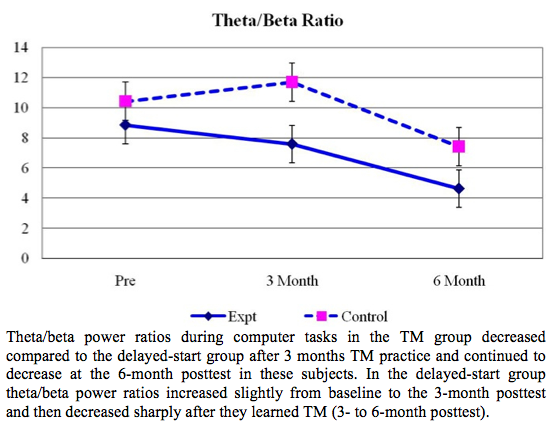
Three months of TM practice resulted in significant decreases in theta/beta ratios and increased verbal fluency.  This translates into improved executive function and more efficient cognitive processing.

During the first 3 months of the study, the theta/beta ratios of the control group (delayed start) actually increased. After learning, and practicing TM for 3 months, this group experienced dramatic decreases in theta/beta ratios and increased verbal fluency as well.

Student and Parent Surveys

Students reported that the TM technique was enjoyable and easy to do. They felt calmer, less stressed, and better able to concentrate on their schoolwork. They also said they were happier since they started TM. This correlated with reports from the parents.

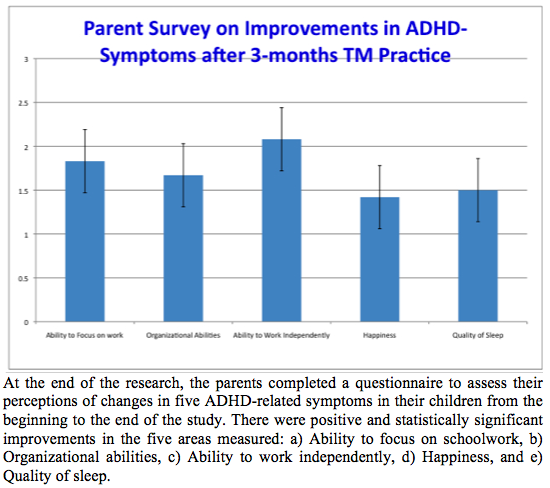
At the end of the research, the parents completed a questionnaire to assess their perceptions of changes in five ADHD-related symptoms in their children from the beginning to the end of the study. There were positive and statistically significant improvements in the five areas measured: a) Ability to focus on schoolwork, b) Organizational abilities, c) Ability to work independently, d) Happiness, and e) Quality of sleep.

Promising Results

The combined results were significant. There was a 48% reduction in the theta/beta power ratios and a 30% increase in brain coherence after the 6-month period. Studies have shown that pharmaceuticals decrease theta/beta power ratios by 3%, and neurofeedback by 25%.

“These are very encouraging findings,” said Dr. Stixrud. “Significant improvement in the theta/beta ratio without medication and without having to use any expensive equipment is a big deal, as is significant improvement in student happiness and student academic functioning reported by the parents.”

“While stimulant medication is very beneficial for some of my clients with ADHD,” Stixrud added, “the number of children who receive great benefit from medicine with minimal side-effects is relatively small. The fact that TM appears to improve attention and executive functions, and significantly reduces stress with no negative side-effects, is clearly very promising.” Stixrud said he hoped these findings would lead to more research on the use of TM with children and adolescents.

In conclusion, these findings warrant additional research to assess the impact of Transcendental Meditation practice as a non-drug treatment for ADHD, and to track meditating students’ improved academic achievements.

The study was funded by a grant from the David Lynch Foundation.

###

FACT SHEET

Attention-Deficit/Hyperactivity Disorder (ADHD)

  • Attention-deficit/hyperactivity disorder (ADHD)—characterized by inattentiveness, impulsivity, and hyperactivity—is diagnosed in almost 10% of children ages 4-17 years, representing 5.4 million children.
  • The Center for Disease Control and Prevention reported among children with current ADHD, 66.3% were taking medication for the disorder. In total, 4.8% of all children ages 4-17 years (2.7 million) were taking medication for ADHD. The majority of them stay on it into adulthood.
  • The rate of prescriptions for Attention-Deficit/Hyperactivity Disorder in the U.S. has increased by a factor of five since 1991—with production of ADHD medicines up 2,000 percent in 9 years.
  • The commonly used drugs for ADHD are stimulants (amphetamines). These drugs can cause persistent and negative side-effects, including sleep disturbances, reduced appetite, weight loss, suppressed growth, and mood disorders. The side-effects are frequently treated with additional medications to manage insomnia or mood swings. Almost none of the medications prescribed for insomnia or mood disturbances are approved by the Food and Drug Administration (FDA) for use with children.
  • The long-term health effects of ADHD medications are not fully known, but evidence suggests risks of cardiac disorders and sudden death, liver damage and psychiatric events. It has also been found that children on long-term medication have significantly higher rates of delinquency, substance use, and stunted physical growth.
  • A new study, Study raises questions about long-term effects of ADHD medication, the first of its kind, released February 17, 2010 by the Government of Western Australia’s Department of Health, found that “long-term use of drugs such as Ritalin and dexamphetamine may not improve a child’s social and emotional well-being or academic performance.” The chair of the Ministerial Implementation Committee for Attention Deficit Hyperactivity Disorder in Western Australia said in the Department’s press release, “We found that stimulant medication did not significantly improve a child’s level of depression, self perception or social functioning and they were more likely to be performing below their age level at school by a factor of 10.5 times.”

The Transcendental Meditation Technique

  • The Transcendental Meditation technique is an effortless technique practiced 10-20 minutes twice a day sitting comfortably with the eyes closed.
  • TM is not a religion or philosophy and involves no new beliefs or change in lifestyle.
  • Over 350 peer-reviewed research studies on the TM technique confirm a range of benefits for mind, body and behavior.
  • Several studies have compared the effects of different meditation practices and found that Transcendental Meditation provides deeper relaxation and is more effective at reducing anxiety, depression and hypertension than other forms of meditation and relaxation. In addition, no other meditation practice shows the widespread coherence throughout all areas of the brain that is seen with Transcendental Meditation.
  • The Transcendental Meditation technique is taught in the United States by a non-profit, educational organization.

Source: EurekAlert!

Some Media Coverage: PhysOrg.com: New study shows Transcendental Meditation improves brain functioning in ADHD Students, PsychCentral.com: Transcendental Meditation Lessens Kids’ ADHD Symptoms, eMaxHealth: Transcendental Meditation Improves ADHD Symptoms, Academic SkillsADHD/ADD Natural Remedy Report: New study shows Transcendental Meditation improves brain functioning in ADHD students, GGN-Education News: New study shows Transcendental Meditation improves brain functioning in ADHD students, Part 2, Part 3, Part 4, Part 5; The Times of India: Transcendental meditation for the brain, Health24: Meditation boosts brain functioning, RedOrbit: New Study Shows Transcendental Meditation Improves Brain Functioning In ADHD Students, The Behavioral Medicine Report: Transcendental Meditation Improves Brain Functioning In Students With ADHD, Science News Line medicine, Science Codex, Transcendental Meditation Blog: New study finds TM boosts brain functioning and helps students with ADHD, GoodTherapy.org: Children with ADHD May Benefit from Transcendental Meditation, and many others.

Huffington Post: Transcendental Meditation: Topping The Bestseller List Since 1975

June 21, 2011
Philip Goldberg
Interfaith Minister, author of ‘American Veda:
How Indian Spirituality Changed the West’

Transcendental Meditation: Topping The Bestseller List Since 1975

Posted: 06/21/11 08:10 AM ET

When I saw a book about Transcendental Meditation (TM), written by a scientist, had landed on the New York Times bestseller list, my reaction was to quote the great Yogi of Berra: “It’s déjà vu all over again.”

In 1975, “TM: Discovering Inner Energy and Overcoming Stress” was propelled onto the list when its lead author, psychiatrist Harold Bloomfield, appeared on Merv Griffin’s syndicated TV talk show (the Oprah of its day) with TM founder Maharishi Mahesh Yogi. The book remained a bestseller for six months, and then had a solid run on the paperback list. During that period, Merv devoted a second show to Maharishi, and TM centers could barely keep up with the demand. By the end of 1976, over a million Americans had learned to meditate.

This was the culmination of a remarkable eight-year run that began when the Beatles famously learned the TM and sojourned at Maharishi’s ashram in India. Between that watershed moment and the two Merv programs, meditation moved from the counterculture to the mainstream, from weird to respectable, from youthful mind expansion to middle-age stress remedy. Now, the celebrity meditators were not rock stars but Clint Eastwood and Mary Tyler Moore, and you could not get more mainstream than the nation’s big screen hero and its TV sweetheart.

The route from esoteric mystical discipline to respectable relaxation technique was paved by science. It started in the late ’60s when a young meditator named Robert Keith Wallace was persuaded by his guru, Maharishi, to study the physiology of TM. The research became his Ph.D. dissertation, and then a Science magazine article in 1970. Wallace’s follow-up study, conducted with Harvard cardiologist Herbert Benson, was published in 1971 in The American Journal of Physiology and Scientific American. The data sparked an avalanche of research. By 1975, a substantial body of evidence had demonstrated the efficacy of meditation on various measures of physical and mental health.

Now comes another psychiatrist, Norman E. Rosenthal, with “Transcendence: Healing and Transformation through Transcendental Meditation.” Once again, celebrity endorsements add pizzazz, in this case Mehmet Oz, David Lynch, Martin Scorcese and Russell Simmons, with cameo appearances by the gray eminences, Ringo Starr and Paul McCartney. And once again science confers credibility. Whereas Bloomfield was fresh out of his Yale residency when Merv Griffin showcased his book, Rosenthal has 30 years of distinguished clinical research and more than 200 scholarly articles under his belt. And by now TM has been the subject of over 300 peer-reviewed articles. The book describes the most recent findings, many of them involving common maladies such as ADHD, PTSD and hypertension, but not limited to medical conditions.

That meditation is good for you is no longer an eye-opening news flash. But the new book’s bestsellerdom suggests that a new generation wants to hear the message. In this era of soaring anxiety, depression and health costs, perhaps the only people who don’t think that’s a good thing are the makers of pharmaceuticals.

As someone who has chronicled the transmission of Eastern spirituality to the West, I hope that this time around we can avoid some of the pitfalls of the past. As the title of Rosenthal’s book “Transcendence,” suggests, meditation is not just a medical intervention. The deeper purpose has always been the development of higher consciousness, as described in the Vedic tradition from which practices like TM derive. But when yogic methods become medicalized and their benefits quantified, they tend to get disconnected from their spiritual roots — a loss for all of us.

Another consequence of the popularization of meditation was the rise of imitation practices. Health experts, self-help mavens and entrepreneurs did everything they could to de-Hinduize and de-Indianize the practice. Recently, we’ve seen a similar tendency as practices derived from Buddhism were secularized as “mindfulness.” The advantage of this adaptation, of course, is that it makes such practices far more accessible. The downside is that something vital can be lost in translation, thereby diminishing their effectiveness. Modernizing the language is one thing, but tinkering with the ingredients of a meditation practice is not unlike changing a medical formula or a food recipe.

Finally, in the past, all forms of meditation were lumped together as if their differences were inconsequential. People who should have known better assumed that the initial TM data could be applied to just about anything that resembled meditation. That techniques practiced differently would produce identical outcomes defies logic, yet the premise was accepted on faith and promoted by both healthcare professionals and New Age promoters. Recent findings have corrected that mistake to a large extent, and current researchers are sorting out which practices produce which results under which circumstances.

The scientific investigation of ancient spiritual practices might be one of the most important advances of the modern era. But we have to proceed with care and discernment, assimilating the methods without obscuring or dishonoring their roots. If we get careless, we can dilute them, corrupt them and otherwise fail to harness their full potential. It’s happened to some extent already, and it’s happening as we speak in the trendy world of yoga studios, where complex and profound teachings are being reduced to fitness exercises. Rudyard Kipling’s assertion that “East is East and West is West and never the twain shall meet” turned out to be mistaken, to our everlasting benefit. But we have to make sure that East does not become West.

Link to article, comments, and this blogger’s books: http://www.huffingtonpost.com/philip-goldberg/transcendental-meditation_b_880098.html.

Here is the first TM bestseller, now out again: Transcendental Meditation: The Essential Teachings of Maharishi Mahesh Yogi. The classic text revised and updated by Jack Forem (Oct 8, 2012).

Listen to Philip Goldberg on KRUU FM: Cheryl Fusco Johnson interviews Philip Goldberg, author of American Veda: How Indian Spirituality Changed the West on October 12, 2012, and Dennis Raimondi interviews Philip Goldberg on Speaking Freely about his latest book American Veda on Nov 22, 2010.

Meditation Helps Homeless Children

June 7, 2011

Meditation Helps Homeless Children | NBC Los Angeles

By Beverly White and Julie Brayton  |  Tuesday, Jun 7, 2011

Transcendental Meditation is helping traumatized Kids at the Children Of The Night Shelter recover and heal

Click here to watch video:

Thousands of adults and children live on Southern California streets, and so did Kelsey.

She was cast out by her abusive Midwestern family.

“I been kicked out of my house since I was nine, on and off. This last time, my father was sexually abusing me,” said Kelsey, who is 17 years old.

Living on the streets in Los Angeles was so horrifying and dangerous, Kelsey sought shelter at Children Of The Night, where she was diagnosed with post-traumatic stress and introduced to Transcendental Meditation.

“When you take like twenty minutes sit down and do TM, and calm yourself and be peaceful you’re not crabby. The daily things that make your day more frustrating, just kind of go away,” Kelsey said.

Hollywood filmmaker David Lynch and his wife Emily were confident traumatized kids could benefit from Transcendental Meditation.

“I myself meditated, and I thought this would be a good tool for them. So we brought them the Transcendental Meditation program,” said Emily Lynch, a volunteer and philanthropist.

“My first meditation blew me away. It curled my hair,” said David Lynch.

The David Lynch Foundation works to demonstrate the benefits of Transcendental Meditation worldwide.

“Stress goes. Anxiety, sorrow, suffering, anger, fears start to lift away,” said David Lynch, “and in its place, because they dive into the bit treasury within, all this happiness comes.”

Transcendental Meditation is deeper than closed eyes and calmed minds, according to Children Of The Night founder Lois Lee.

“Sometimes they’ll burst into tears, and they’ll talk about their dad abusing them, or something that someone did to them on the streets, and they learn through the process of being able to bring it up, put it out, pause, think about it and be done with it,” said Lois Lee, founder of Children of the Night.

Also see: LA Daily News: Children of the Night, movie director David Lynch expand work and MSNBC: Meditation Helps Homeless Children.

Children of the Night, movie director David Lynch expand work

June 7, 2011
LA Daily News AWARENESS

Children of the Night, movie director David Lynch expand work

Posted: 06/03/2011 09:59:06 PM PDT
Updated: 06/03/2011 10:16:19 PM PDT

David Lynch talks about the benefits of meditating. Transcendental Meditation is being used by teen victims of prostitution to ease their traumas. Academy Award-nominated director, acclaimed writer and producer David Lynch and his wife Emily; Children of the Night founder and president Dr. Lois Lee, motion picture actor Ben Foster, and world-renowned psychiatrist and author Norman Rosenthal were all on hand to talk about the benefits of meditation. (John McCoy/Staff Photographer)

Movie director David Lynch has teamed up with Children of the Night, the teen prostitute rescue organization, to raise awareness on a nationwide scale.

That means an expansion of services the nonprofit has been providing for more than three decades, and also the Transcendental Meditation instruction the David Lynch Foundation for Consciousness-Based Education and World Peace has been bringing to the Van Nuys youth shelter for the past 14 months.

“Through our experience with the David Lynch Foundation and through our discovery that Children of the Night can operate without walls, we know we can take our award-winning programs to adolescents who are forced to live in out-of-home care throughout America,” founder and president Lois Lee said Friday during a news conference at the organization’s campus.

Lynch, who became involved after his wife, Emily, began volunteering at the shelter, explained what the practice of TM – which he’s done daily for 38 years – can do for troubled psyches.

“If you’re a stressed human being – and especially a traumatically stressed human being – once you transcend and experience this deepest level, it’s like somebody took a hammer and hit the bolt at the top of a boiler filled with stress, and it starts pouring out,” said the director of such psycho-surreal classics as “Blue Velvet” and “Mulholland Dr.”

“It’s such a a relief,” continued Lynch, whose six-year-old foundation has raised millions of dollars to teach TM techniques to some 150,000 people, mostly students, worldwide. “So, the girls got happier and less stressed and saw a brighter world outside, rather than a hell world.”

The adolescents Children of the Night tries to help bring an assortment of dire baggage to the facility’s doors. Abusive homes, brutal pimps, substance addictions, the very nature of what they’ve had to do to survive. Their reservoirs of self-esteem and emotional control can understandably be all but empty.

Click here to see photo gallery.

Lee said that all current residents – about 65 – are now in the TM program, which both she and Lynch pointed out is voluntary since, as he put it, “You can never force a person to meditate if they don’t want to.”

The peaceful, focusing effect of the practice aids the kids in concentrating on the educational efforts – which includes high school proficiency and GED preparation – at the core of the nonprofit’s life-improving plan.

“I’ve done the meditation for a year,” said a 17-year-old resident who asked not to be identified. “It helps me realize the goals that I actually want to achieve.

“If I get scared or nervous or frustrated, I don’t leave right off the bat now. It’s just brought me a well of calmness that nothing else has been able to provide.”

Lee said that meditating herself had a similar effect, enabling her to clarify strategies for her long-frustrated dream of expanding Children of the Night’s programs beyond L.A.

“When we went on the first meditation retreat with David’s people, I turned off my cellphone for the first time since 1984 and I left it off for the entire weekend,” laughed Lee, an intense, micro-managing type by nature. “In the early days of TM, I stopped screaming, my anger disappeared. And about five months later, it came to me how I could put my people on the road, hit every shelter in America and – with phones and the Internet – do everything we do here out there.

“I would have never been able to make that leap in my mind without the Transcendental Meditation,” Lee said.

(l-r) Norman Rosenthal, Ben Foster, Emily and David Lynch and Lois Lee. Transcendental Meditation is being used by teen victims of prostitution to ease their traums. Academy Award-nominated director, acclaimed writer and producer David Lynch and his wife Emily; Children of the Night founder and president Dr. Lois Lee, motion picture actor Ben Foster, and world-renowned psychiatrist and author Norman Rosenthal were all on hand to talk about the benefits of meditation. (John McCoy/Staff Photographer)

###

Also see: Meditation Helps Homeless Children