Archive for January, 2011

Seeing Is Being

January 14, 2011

“The sight occupies the seer, transforms seer into sight.”
Maharishi Mahesh Yogi (Life Magazine, November 1990)

Seeing Is Being

Seeing outside the Self
Forgetting the Inner Light
The Seer becomes the Sight
Transforming Day to Night

Living Night for Day
The Seer can’t find The Way
Mistaking Sight for Seer
Becoming what’s on the Mirror
Forsaking what’s truly Dear

When Self is finally Clear
We Remember How we’re Here
It’s the One Becoming the Three
The Way To See Is To Be
Since Seer Sight and Seeing
Are All Three Ways of Being
And Being Is Being Being Being*

© Ken Chawkin

————————————–

*From a Q & A session:
Course participant: Maharishi, What is Being?
Maharishi: (laughs) Being? Being is Being Being Being.
Then Maharishi and everyone laugh.

I read that poem at a World Peace Assembly in Maharishi University’s Golden Dome in the early 90’s. It was followed by The Enlightened Heart, a poem by Ken Chawkin.

Also relevant: Maharishi describes the nature of inner life: bondage and liberation, and gaining bliss consciousness through Transcendental Meditation.

Rick Hotton and Holy Molé make us laugh and learn “what is essential is invisible to the eye”

January 12, 2011

“And now here is my secret, a very simple secret; it is only with the heart that one can see rightly, what is essential is invisible to the eye.”
—Antoine de Saint-Exupery, The Little Prince
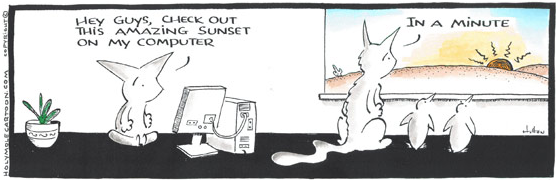
Copyright © 2011 Rick Hotton. All Rights Reserved.

Look familiar? Is this how you see reality—only what’s in front of you on your computer screen? Technology may be an extension of our senses to more effectively interact with the world, but it can also be what cuts us off from it. Sometimes we need a little humor to break this mistake of the intellect and make us see the light of day!

Rick Hotton, creator of the award-winning cartoon Holy Molé, opens our hearts and minds with insightful humor. His characters make us laugh and realize there’s more to life than meets the eye.

To find out how Holy Molé was born and to uncover the path of creator Rick Hotton, a dedicated martial artist turned math teacher and now cartoonist, read Behind Holy Molé’s Rick Hotton by Danielle Hope Hier.

Danielle describes the characteristics and spiritual significance of a mole as the main character in Rick’s cartoon and compares it to his outlook on life. She encapsulates his approach in this paragraph:

Through martial arts, math, and Molé, Hotton has captured the essences of working the body, the mind, and the spirit. The quest for knowledge is the thread that ties all three of these forms together, in what might otherwise appear as three completely separate entities.

Danielle asked Rick why he chose a cartoon as a way of expressing elements of his own spiritual journey. I love his answer.

He replied, “But for me, if I could get people to laugh, even if just for a moment…” He paused before rephrasing his next thought: “Being joyful is a state of grace.”

The January 2011 issue of Edge Magazine published an article by Randy Moore on Rick Hotton and the Mindful Art of Holy Molé. It’s interesting to note that both Danielle and Randy are also martial artists and writers.

If you like Rick’s sense of humor, visit www.holymolecartoon.com to sign up and have cartoons delivered to your Inbox. Also follow him on Facebook, Holy Molé Cartoon, to see his photo stream.

Speaking of a common thread that’s invisible to the eye, see William Stafford—The Way It Is. Twenty-five years ago I wrote Seeing Is Being, a poem about a more enlightened way of seeing the world.

This post is very relevant to the theme of how social media cuts us off from the world shown in the Holy Molé cartoon: Two innovative creative videos remind us how social media can destroy not build relationships.

Years later: this cartoon by Bill Bliss (@blisscartoons) of two cats looking at a sunset evokes a similar reaction as the cats in Rick Hutton’s characters above, only it’s what I ask myself after spending hours on my computer scrolling the internet and watching YouTube videos!

Years later I saw a similar quote to The Little Prince from Helen Keller: “The best and most beautiful things in the world cannot be seen or even touched. They must be felt with the heart.”

An animated film with an all-star cast was made of that wonderful book. A little girl lives in a very grown-up world with her mother, who tries to prepare her for it. Her neighbor, the Aviator, introduces the girl to an extraordinary world where anything is possible, the world of the Little Prince. See The Little Prince (2015); original title: Le petit prince (1h 48m), available to rent or buy on Amazon.

— Written and compiled (citing sources) by Ken Chawkin for The Uncarved Blog.

This Enduring Gift-A Flowering of Fairfield Poetry

January 6, 2011

This Enduring Gift

A Flowering of Fairfield Poetry

76 Poets Who Found Common Ground in One Small Prairie Town

Compiled and selected with introductions by Freddy Niagara Fonseca and a foreword by Donovan. Endorsed by two US Poets Laureate. Paperback and Hardcover versions with 300 poems, 16 chapters and 796 pages. Publisher: 1st World Publishing. Links to TEG‘s Website and Facebook.

Pictured below, Freddy invites Roger Pelizzari to read his poem, The Beginning of Real Time, during the book launch at Revelations Cafe and Bookstore in Fairfield, Iowa, September 24, 2010.

The room was filled with poets and guests that night. I’m sitting in the front row, and was also invited to read a poem. Since we were running out of time, I read the short tanka. Here are my poems, selected from the ones submitted, published in This Enduring Gift: Five Haiku, the tanka, Cold Wet Night, and Poetry—The Art of the Voice, which was later selected as the POEM OF THE DAY: Poetry – The Art of the Voice, by Ken Chawkin.

Poetry—The Art of the Voice

January 6, 2011

Poetry—The Art of the Voice is another one of my poems published in This Enduring Gift – A Flowering of Fairfield Poetry, 2010. Editor Freddy Niagara Fonseca posted this poem on his Amazon.com page: VISITING POET Ken Chawkin: Poetry – The Art of the Voice, which links to the complete version on his Live Journal.

Poetry—The Art of the Voice

How fine will your breath become
from listening to these words?
How soft will they seem to be
as they settle through the mind
like silent snowflakes falling
from a windless winter sky?

I often marvel at the mystery—
how words can work
on a listener’s heart and mind,
upon hearing a poet’s thoughts,
a poet’s breath, flowing
from an inner voice—

a windless wind, speaking
through a voiceless voice.

© Ken Chawkin
Published in This Enduring Gift – A Flowering of Fairfield Poetry, 2010
http://www.thisenduringgift.com

This poem came out of the inspiration listening to the Diane Rhem Show: Bill Moyers on Poetry, when she invited him on to talk about his latest PBS special on the Poetry Festival he had attended and filmed, and his new book of it, “Fooling With Words: A Celebration of Poets and Their Craft” (William Morrow). They had invited 3 poets: Marge Piercy, former poet laureate Mark Strand, and Jane Hirschfield, to call in and discuss the inspiration for a poem they had written and share it with the listening audience. The effect on the Festival audiences was also discussed. See , with links to the program, book, and each poet reading their poem.

When the call went out for poems from Fairfield poets for This Enduring Gift-A Flowering of Fairfield Poetry, I sent it in along with some haiku and a tanka. It was published and later selected as the POEM OF THE DAY: Poetry – The Art of the Voice, by Ken Chawkin.

Cold Wet Night (a tanka)

January 6, 2011

Cold Wet Night
A Tanka

Rain on the trailer
Beating down its dismal song
Drop, by cold, wet, drop

A monotonous rhythm
Driving home … the loneliness

© Ken Chawkin
Fairfield, Iowa
Dec 20, 2006

Published in This Enduring Gift – A Flowering of Fairfield Poetry, 2010. See my other published poems in that book.

This poem was written in the presence of my muse, Sally Peden (Sali), as I was demonstrating to her how easy it was to write a haiku, which extended to this tanka. It tells the story of what was happening at the time. It was a very blissful process. Nothing depressing or lonely about it. I just selected the words that best conveyed such an image and accompanying mood.

Three years later things would change. On Jan 19, 2010, Sali would have to move into Parkview Care Center because of her dementia. Over 9 years later, I wrote this short, sad, 4-line Teapot Poem. In the 5th Response, I explain how it came to be written. Using the creative process described there brought relief from the grief I was feeling at the time.

Five Haiku

January 6, 2011

Five Haiku was published in This Enduring Gift — A Flowering of Fairfield Poetry, 2010. These 5 haiku were selected from 13 Ways to Write Haiku: A Poet’s Dozen, where they were originally published in The Dryland Fish, An Anthology of Contemporary Iowa Poets, 2003. The University of Iowa’s “Iowa Writes” program heard of This Enduring Gift and asked the Fairfield Poets to submit our poems to them. They published Five Haiku on The Daily Palette, January 5, 2011.

Five Haiku

Defined

3 lines, 2 spaces,
17 feet to walk thru;
then,  the unending

Translated
(Inspired by Australian artist Gareth Jones-Roberts’ painting
Egrets in Morning Light
)

on the edge of space
two egrets in morning light
woken from a dream

The Fall

sudden drop of leaves
a negligée to the floor
trees stand stark naked

Winter Memo

On seeing snowflakes
written on a piece of bark
I copied this down

Forest Flowers

tiny white flowers
a constellation of stars
so low yet so high

© Ken Chawkin

Also see Another Fall Haiku