David Lynch offers music for meditation

March 9, 2011

David Lynch offers music for meditation

Relaxnews
Wednesday, 9 March 2011

Acclaimed film director David Lynch (Blue Velvet, Wild at Heart, Mulholland Drive) released a 17-track charity compilation on March 8 to support his foundation, which encourages healing through meditation. The album features exclusive tracks by Tom Waits, Iggy Pop, Peter Gabriel, Moby, Ben Folds, and others.

In exchange for a pledge of $18 (€13), the David Lynch Foundation, founded in 2005, will provide all of the tracks in digital format over the course of the next six weeks. Proceeds go to the organization’s global effort to teach meditation to 1 million at-risk youth and 10,000 veterans of war with post-traumatic stress disorder.

A supporter of transcendental meditation, dubbed TM for short, Lynch believes that it is the cheapest, most effective, and medication-free way of healing people who have suffered severe stress in war and any other extreme experience.

Waits’ track is a live recording of “Briar & the Rose,” composed in 1993 for the play The Black Rider, cowritten by William S. Burroughs. On the website Pledge Music, you can hear a 90-second preview of the track alongside four more cuts from the compilation. Other artists included are Arrested Development, Au Revoir Simone, Mary Hopkin, Maroon 5, Neon Trees, Ozomatli, Heather Nova, and Slightly Stoopid.

Make a pledge and each week you will receive two or three of the comp’s featured tracks, along with videos, photos, and blog updates, “giving you an insider’s view into the artists’ lives and experiences,” states the website.

Last December, Lynch organized a Hollywood A-list fundraising event at the Metropolitan Museum of Art in New York for his foundation, which aims to train people in need the art of finding inner peace, said Lynch at the event.

In another one of Lynch’s musical endeavors, he recently released a pair of digital songs on iTunes: “Good Day Today,” with a melancholy electro-pop sound, and the more trance-like, rock-oriented “I Know.”

Inspired by working with his composer Angelo Badalamenti on Inland Empire, his last film in 2006, the director began experimenting with music, he told the Los Angeles Times. “One thing led to another, and I started making music even though I’m not a musician.”

In 2009, the director launched an artistic visual and musical project with Danger Mouse and the late Mark Linkous aka Sparklehorse called Dark Night of the Soul.

Listen to track samples, see a video of Lynch describing the project, or make a pledge: http://www.pledgemusic.com/projects/davidlynchfoundationmusic

http://davidlynch.com/

Exciting video promo for Stephen Hopson’s book “Obstacle Illusions”

March 7, 2011

Uploaded by on Mar 6, 2011

March 17, 2011 will be the Official Nationwide Release Date
for Obstacle Illusions: Transforming Adversity into Success

Special message from author Stephen Hopson:

Here’s the long-awaited video promo for “Obstacle Illusions” by the very talented Wade Travis Koch. BUT DON’T BUY THE BOOK JUST YET!!! Wait until Mar 17th. Will you guys help me make this a #1 Amazon bestseller on that day? There will be something special just for you if you decide to help me out. Email me at sjhopson@yahoo.com for more details!

Go to the actual You Tube video and post a comment! If you’ve read the book, go to Amazon and B&N and write a short review. If you want to buy the book for yourself and a friend, please order “Obstacle Illusions” on March 17, 2011 at Amazon. You can also visit the landing page on my website for more details: ObstacleIllusionsbook.com.

Links to the book http://amzn.to/Obstacle_Illusions and video http://bit.ly/ObstacleIllusionsVideo.

Thank you!
Stephen

Also Listen to Stephen Hopson on Speaking Freely and KMCD Spotlights Stephen Hopson and his book “Obstacle Illusions”. See Stephen Hopson holds book signing at Revelations for “Obstacle Illusions” and Obstacle Illusions: Transforming Adversity into Success by Stephen J. Hopson.

Imagine Peace: “Operation Warrior Wellness” is helping Veterans with PTSD

March 6, 2011

Visit Yoko Ono’s impressive blog, IMAGINE PEACE, and see this comprehensive post on the David Lynch Foundation’s OPERATION WARRIOR WELLNESS, Overcoming PTSD and Promoting Mental Resilience through Transcendental Meditation: Change Begins Within: “Operation Warrior Wellness” is helping Veterans with PTSD.

WW II veteran publishes The Resilient Warrior: Healing the Hidden Wounds of War

March 6, 2011

The Resilient Warrior: Healing the Hidden Wounds of War

On the occasion of Veterans’ Day and the first anniversary of Veterans’ Children, we are honored to feature a guest post by World War II veteran, Jerry Yellin, author of Of War and Weddings, The Blackened Canteen, The Letter, and The Resilient Warrior.  Jerry is working hard to make possible veterans having the opportunity to learn Transcendental Meditation as a means of healing from PTSD.

I was one of the 16 million people who served our country in World War Two. I was 18 when I enlisted, 19 when I graduated Luke Field in Phoenix, Arizona and three weeks into my 21st year when I landed on Iwo Jima, an eight-square mile island 650 miles from Japan. I quickly became familiar with death.

On March 7, 1945 our squadron landed on Iwo Jima on a dirt runway at the foot of Mount Suribachi. I looked out at the landscape as I taxied my Mustang to our parking area and saw huge piles of dead Japanese soldiers being pushed into mass graves, the sight and smell indelibly imprinted on my mind. It was a shocking sight for a young man just entering his 21st year to see.    Our squadron area was next to a Marine mortuary where hundreds of dead Marines were being readied for burial, a sight that continued until the remains of nearly 7000 American Marines were buried in the cemetery.

The fighting was fierce on this eight square mile Island 650 miles from Japan. Twenty one thousand Japanese soldiers lost their lives there and nearly 7000 Marines were killed.

I flew ninteen very long range missions over Japan from Iwo Jima and flew with eleven young pilots, all of them friends, who did not return home. All in all I flew with sixteen pilots who did not come back.

On one mission Al Sherren, my classmate from flying school called in “I’m hit and can’t see,” and he was gone. Robert “Pudgy” Carr also disappeared on that day. He was my tent mate.  Three of those killed were my wingmen. Danny Mathis in a mid-air collision with 26 other fighters when my wisdom teeth were pulled and I was grounded, Dick Schroeppel who was following me on a strafing run over Chichi Jima and Phil Schlamberg who disappeared from my wing in clouds on August 14, 1945 the day the war ended.

All of us knew who were fighting and why. Then it was over, one day a fighter pilot the next a civilian, no buddies, no airplane, nothing to hold on to, and no one to talk to. Life, as it was for me from 1945 to 1975 was empty. The highs I had experienced in combat became the lows of daily living. I had absolutely no connection to my parents, my sister, my relatives or my friends. I listened to some of the guys I knew talk about their experiences in combat and I knew they had never been in a battle let alone a war zone. No one that I knew who had seen their friends die could talk about it. The Army Air Corps had trained me and prepared me to fly combat missions but there was no training on how to fit into society when the war was over and I stopped flying.

I was not able to find any contentment, any reason to succeed, any connection to anyone that had meaning or value. I was depressed, unhappy and lonely even though I was surrounded by a loving wife and four sons. That feeling of disconnect, lack of emotions, restlessness, empty feeling of hopelessness lasted until 1975.

In 1975 I learned to meditate—I learned a technique called Transcendental Meditation. In just a few months life became meaningful to me and now, at 86.8 years of living, I can say that this meditation has brought me peace and contentment.

What makes the current wars in Iraq and Afghanistan so difficult for our troops? War is always difficult for those on the front lines, but these wars are being fought in the countries of our enemies, on their territory, their homeland, their cities, and there are no established front lines or objectives to capture. Every citizen can be looked at as “the enemy,” every road as a dangerous road to travel, every pile of garbage might contain an IED ready to explode.

As I write this today, in October 2010, there have been 5745 of our servicemen and women killed and 86,175 evacuated from wounds or illness, 21.7% of the approximately two million who have seen active duty.

It has been estimated that 35-40% of those who have served since 2003 are victims of Post-Traumatic Stress Disorder. Since the average age of the current military is 21, these veterans will require care for 50 or 60 years. The cost to care for our veterans as estimated by Stiglitz and Bilmes in their book The Three Trillion Dollar War will be  $5,765.00 per veteran per year; a total that could reach 717 Billion Dollars just to service the estimated 2.1 million veterans of Iraq and Afghanistan. This does not take into account additional costs to the Government for benefits to the families of the wounded and mentally ill veterans. Every veteran, either wounded or mentally ill affects everyone in his household adversely. The entire family suffers and has needs.

If I am an example of a recovered PTSD veteran, Transcendental Meditation should be offered to all veterans as an option. The cost per veteran for a lifetime of health is just one-fourth of the annual projected cost to the VA for one year of treatment. Why aren’t we pursuing this 5000 year old modality to help our young veterans and their families recover from the profound affect Iraq and Afghanistan has had on our military?

Jerry Yellin, member The Military Writers Society of America, CO-Chair Operation Warrior Wellness, a division of the David Lynch Foundation

Author: Of War and Weddings, The Blackened Canteen, The Letter, The Resilient Warrior.

1 Comments

  1. Amy Adams, November 11, 2010:

    Your story is so heart breaking. I kept reading hoping to see that you had found some reason to live, knowing you must have, to write this – and it’s meditation. It is ridiculous for us as a society not to take advantage of this very old and tested, inexpensive, idea. Thank you for sharing. Is the army listening?

Also see Jerry Yellin: Healing the Hidden Wounds of War, PTSD and Transcendental Meditation mentioned in Military Times publications, and Jerry Yellin discusses Operation Warrior Wellness.

Listen to Stephen Hopson on Speaking Freely

March 4, 2011

Speaking Freely

This week, Dennis Raimondi interviewed Stephen J. Hopson for his show, Speaking Freely, on KRUU 100.1 FM, in Fairfield, Iowa. The show aired March 1, 2001, and is now archived. You can listen online to the 26:40 minute interview here: http://www.kruufm.com/node/9951.

Despite being deaf since birth, Stephen J. Hopson enjoyed fifteen years of extraordinary success in the turbulent world of Wall Street before switching gears in 1996 and becoming a transformational speaker, author and eventually a pilot.  His latest book is Obstacle Illusions: Transforming Adversity Into Success.

Speaking Freely airs weekly on Tuesdays, 1-2 pm, and again on Thursdays, 8-9 am. Listen online at: KRUU-LP 100.1 FM. Dennis interviews prominent people from business, politics, sports, entertainment, and non-profits. His angle is to ask intelligent and thought-provoking questions and allow guests to speak in detail about their area of expertise and interest. He tries to have people come on who represent diverse points of view.

Homepage: http://www.speakingfreelywithdennis.com

See Exciting video promo for Stephen Hopson’s book Obstacle Illusions”, Stephen Hopson holds book signing at Revelations for “Obstacle Illusions” and Obstacle Illusions: Transforming Adversity into Success by Stephen J. Hopson. KMCD Spotlights Stephen Hopson and his book “Obstacle Illusions”.

Stephen Hopson holds book signing at Revelations for “Obstacle Illusions”

March 3, 2011

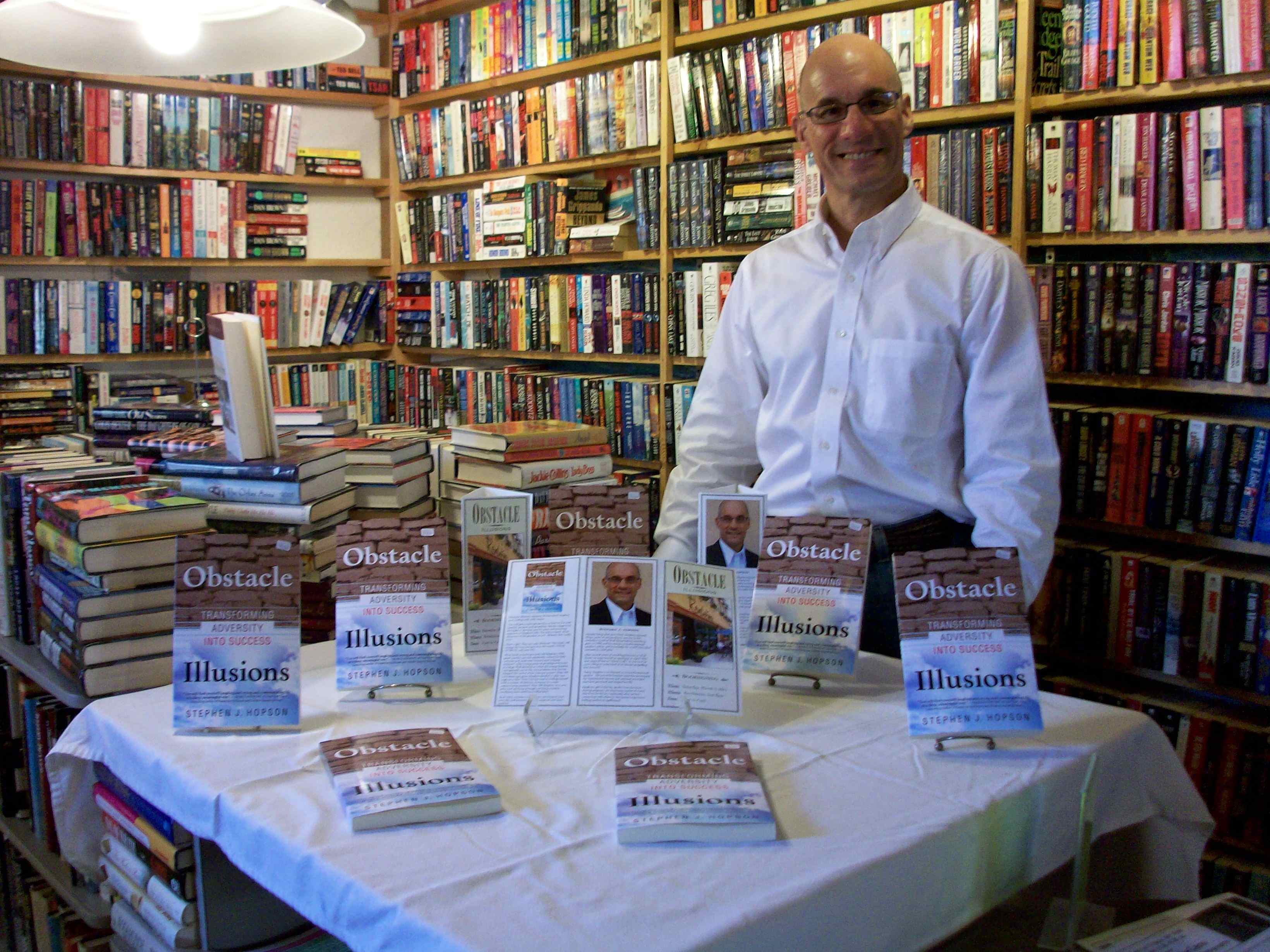
Author Stephen J. Hopson will sign copies of his book, Obstacle Illusions: Transforming Adversity into Success, upstairs at Revelations Café, Saturday, March 5, 2-4 pm, in downtown Fairfield, Iowa.

Other recent posts:
Exciting video promo for Stephen Hopson’s book Obstacle Illusions”
Listen to Stephen Hopson on Speaking Freely
KMCD Spotlights Stephen Hopson and his book Obstacle Illusions”
Obstacle Illusions: Transforming Adversity into Success by Stephen J. Hopson

Storytelling—a poem on the storytelling process

February 27, 2011

Storytelling

Telling a story is speaking out anew
what you always knew you knew
but didn’t know you knew it
until you heard yourself saying it
and in the telling of it, you,
the teller, become the listener too.

The teller and the listener
together both discover
the process of finding out
what the story is all about
as one draws the story out of the other
and the story tells itself from cover to cover.

© Ken Chawkin

Read the rest of this entry »

Documentary shines a new light on rural energy

February 24, 2011

‘Sustain Angoon’ documentary shines a new light on rural energy

By Richard Radford | Capital City Weekly
Wednesday, February 23, 2011

“December and the Meter’s Spinning Backwards,” Southeast Alaska Conservation Council Energy Coordinator Dan Lesh wrote on the Sustain Angoon blog. He included photographs of the frozen landscape surrounding the demonstration house – the home of Angoon elders Peggy and Kelly Williams – and a video that indeed showed the electric meter rotating counterclockwise.

This is no small feat for a community which has energy costs that can add up to as high as $1,200 a household a month, about 6 to 8 times more expensive than in the Lower 48. Angoon is heavily dependent on non-renewable resources, and combined with a shrinking population and high unemployment, keeping up with the bills can prove to be a challenge.

What sent the wheel of progress spinning forward and the meter backwards? The Sustain Angoon Project, which tackled the problem of energy usage from several angles, involving a combination of weatherization, energy efficiency and renewable energy systems. The efforts of the project have culminated in a film, which will be shown this week at a special screening in Juneau.

The project has combined the collective efforts of several organizations including the Central Council of Tlingit and Haida Indian Tribes of Alaska, SEACC, the Tlingit-Haida Regional Housing Authority (THRHA), Angoon Business Center, and the Maharishi University of Management of Iowa.
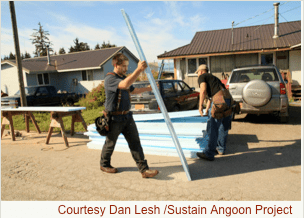
The Williams’ house was fitted out with new insulation and siding, caulking and sealing and duct repair. Improved high-efficiency lighting and Energy Star appliances were installed, monitored by The Energy Detective, or TED 5000, system. Solar panels were put up, including a solar hot water system.

Solar power is not the first thing one might think of when talking about energy in Southeast Alaska, but Lesh said that the system appears to be operational and effective.

“When you’re talking about a place that pays five times as much for energy, it doesn’t matter if you get one sixth of the sun,” he said.

The meter actually does run backwards on sunny days, Lesh said, though of course in the winter there are few hours of daylight, so at least during this time of year the new equipment doesn’t cancel out all energy usage.

There have been a few issues working out all the details of monitoring the solar hot water system, though there is anecdotal evidence from the Williams family who noticed that their boiler doesn’t kick on during sunny days.

They also put up a wind tower and hooked it up to the local school, which charges batteries that can run the washing machines. They have yet to set up a monitoring system for that, but so far it seems to be working.

Lesh said that the problem of high energy bills can’t be solved by just turning the lights out before leaving a room. On average citizens in places like Angoon, served by the Inside Passage Electrical Cooperative, use far less energy than residents of places like Juneau.

“So they turn the lights off, they use everything sparingly, but they may have something that’s on that’s draining power or leaky windows,” he said. “But they are head and shoulders above us [who live in cities] in terms of a lot of types of behavior in terms of energy efficiency.”

Renewable energy systems and weatherization are expensive, and Lesh said it will take time to work out how cost effective their implementations are.

“Not to say that our project should be replicated, but the kinds of discussions we’ve been generating should lead to more action along those lines,” he said. “Energy efficiency is low-hanging fruit that would make big differences in the villages.”

Newer to the project is Carrie Sykes, who started her position as the Business & Economic Development manager at Central Council in October. Sykes said she has worked with the THRHA on a joint application to expand similar ideas being explored in Angoon for other communities in Southeast with high energy costs like Kake and Hoonah.

Another project on the drawing board is a training program for local people in weatherization, which could help cut energy costs and provide jobs.

“When you put in this kind of stuff, you’ll need people who will be familiar in case something goes wrong,” she said.

Teaching and learning are the most important things to take away from the project as it progresses, Sykes said. The documentary will hopefully be a good tool to spark interest, especially with the younger generation.

“You really have to start educating, and start educating young,” she said. “We’re going to be getting the documentary to the schools, science teachers and all the tribes. We want to get it out there about all that can be done.”

Robert Gongwer, co-founder of the Iowa-based socially and environmentally conscious consulting firm Tidal Wave Group, said that there some in Angoon who doubted that the project would get pulled off, who were later “blown away when the electric meter started running backwards.”

“It was a big turning point, when it became real,” he said.

Gongwer co-directed the documentary, working on pre-production in Angoon in September of last year when the project was building up steam, and has recently put the final polish on the film. Coming from the outside, he was nervous about being able to give the best description of what was going on in Angoon. The goal was to be totally honest about the people, the community, and the energy providers.

He and his team wanted to make sure that the community was receptive to the project before getting involved. He was taken aback by the amount of hospitality shown to them by the residents of Angoon, regardless of any reservations they had about the potential of the project.

“We went to the [ANB Hall], and everyone was just so, so happy,” he said.

There is a respect for older people in Angoon, Gongwer said, and they are not only cared for, they are looked to for answers.

“It just really struck me as something that is really broken in the culture I’m from,” he said.

The concerns voiced by the elders of Angoon were first and foremost on Gongwer’s mind while working on the project.

“[An elder] told us her worst fear is to fly over Angoon with her grandchildren and tell them, ‘that’s where we used to live,'” he said.

The Sustain Angoon Project has shown the kinds of things that can be accomplished, Gongwer said, though there is still a lot more exploration to be done. The project isn’t the solution, but rather a demonstration of one take on a larger set of solutions. Maharishi University of Management Professor Lonnie Gamble, who also worked on the project, explained the situation as, “We don’t need a silver bullet, we need silver buckshot.”

“We’ve made some progress, that’s great,” Gongwer said, “but really the issue is how can we sustain progress? We just need to keep after it…maybe this [project] will help to change some laws, change some policies.”

“Sustain Angoon” will be shown at the Silverbow (120 Second Street) back room Thursday, Feb. 24 at 5:30 p.m. There will also be a discussion with members of the project. For more information or to follow new developments of the project, go online at www.sustainangoon.org.

Richard Radford may be reached at richard.radford@capweek.com

There are additional photos for viewing at the top right of the article. Go to: Click Thumbnails to View. Click on a photo, then click on it again for a larger view.  Here are the descriptions to go with some of those photos: Work on the house got underway in early fall of 2010. During sunny days, the electric meter actually runs backwards now. The community of Angoon came together to work on the energy project. The Williams’ house was fitted out with new insulation and siding, caulking and sealing and duct repair. Improved high-efficiency lighting and Energy Star appliances were installed, monitored by The Energy Detective, or TED 5000, system. Solar panels were put up, including a solar hot water system.

This article was also published in The Washington Examiner
Film looks at energy-saving efforts in Angoon
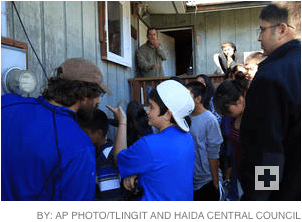
In this September 2010 photo provided by Tlingit and Haida Central Council, workers with the Sustain Angoon Project talk in the southeast Alaska village of Angoon. The Sustain Angoon Project tackled the problem of energy usage in the village from several angles, involving a combination of weatherization, energy efficiency and renewable energy systems. The efforts of the project have culminated in a film.


Writers on Writing–What Writing Means To Writers

February 24, 2011

Writers on Writing

Below are a few of many quotes by famous writers on writing found in Learning by Teaching, Selected Articles on Writing and Teaching, by Donald M. Murray. When I volunteered to become a writing facilitator at MIU in the mid-80s, this was our bible. It had a huge transformational effect on me. I used these writing principles when I helped young students write at the Sylvan Learning Center in North Vancouver, BC, Canada. I also learned writing techniques from Writing Down the Bones: Freeing the Writer Within, by Natalie Goldberg, and shared them with my students, and later in other writing workshops with older animation students, and friends.

The whole idea is to facilitate the writing process, to see what it would reveal to the writer, rather than focus on producing a specific piece of writing. I remember reading what Donald Graves had to say about teaching writing, something like: “If you take care of the writer, the writing will take care of itself.” Donald Graves studied with Donald Murray, and went on to conduct research in the classroom on how to teach children to becoming writers. His seminal book, Writing: Teachers & Children at Work, has become a classic and revolutionized the teaching of writing in schools.

For Donald Murray, “Writing is the process of using language to discover meaning in experience and to communicate it.”

Here’s what some famous writers, poets, and playwrights have to say about writing and their process.

Edward Albee: Writing has got to be an act of discovery. . . .I write to find out what I’m thinking about.

C. Day Lewis: First, I do not sit down at my desk to put into verse something that is already clear in my mind. If it were clear in my mind, I should have no incentive or need to write about it….we do not write in order to be understood; we write in order to understand.

William Faulkner: It begins with a character, usually, and once he stands up on his feet and begins to move, all I do is trot along behind him with a paper and pencil trying to keep up long enough to put down what he says and does.

E. M. Forster: Think before you speak, is criticism’s motto; speak before you think is creation’s.

Donald Hall: A good writer uses words to discover, and to bring that discovery to other people. He rewrites so that his prose is a pleasure that carries knowledge with it. That pleasure-carrying knowledge comes from self-understanding, and creates understanding in the minds of other people.

William Stafford: I don’t see writing as a communication of something already discovered, as “truths” already known. Rather, I see writing as a job of experiment. It’s like any discovery job; you don’t know what’s going to happen until you try it.

Speaking of William Stafford, you’ll enjoy this poem, William Stafford—A Course in Creative Writing, and others posted on my blog. Also see one of my first poems, Writing—a poem on the writing process.

And you’ll especially enjoy reading New York Times best-selling author (Eat, Pray, Love) Elizabeth Gilbert—Some Thoughts On Writing, as well as What Rainer Maria Rilke inscribed on the copy of The Duino Elegies he gave his Polish translator, mentioned in Nine Gates: Entering the Mind of Poetry, Essays by Jane Hirshfield. Also check out: Words of Wisdom on Writing from Literary Lights.

Here’s a good resource of timeless advice on writing from famous authors posted on The Marginalian by Maria Popova @themarginalian. I liked what Andrea R Huelsenbeck posted: 14 Authors Share Their Writing Wisdom…by the staff of Writer’s Relief. You may also enjoy Burghild Nina Holzer inspires us to write and discover who we are and what we have to say. Later added: The perils of praise or blame for young writers. New ways to help students find their own voice. Much later added: Writing can become a process of self-discovery & self-empowerment, especially for young students.

— Written and compiled (citing sources) by Ken Chawkin for The Uncarved Blog.

Elizabeth Gilbert—Some Thoughts On Writing

February 24, 2011

SOME THOUGHTS ON WRITING
by Elizabeth Gilbert
New York Times bestselling author, Eat Pray Love and Committed

Sometimes people ask me for help or suggestions about how to write, or how to get published. Keeping in mind that this is all very ephemeral and personal, I will try to explain here everything that I believe about writing. I hope it is useful. It’s all I know.

I believe that – if you are serious about a life of writing, or indeed about any creative form of expression – that you should take on this work like a holy calling. I became a writer the way other people become monks or nuns. I made a vow to writing, very young. I became Bride-of-Writing. I was writing’s most devotional handmaiden. I built my entire life around writing. I didn’t know how else to do this. I didn’t know anyone who had ever become a writer. I had no, as they say, connections. I had no clues. I just began.

I took a few writing classes when I was at NYU, but, aside from an excellent workshop taught by Helen Schulman, I found that I didn’t really want to be practicing this work in a classroom. I wasn’t convinced that a workshop full of 13 other young writers trying to find their voices was the best place for me to find my voice. So I wrote on my own, as well. I showed my work to friends and family whose opinions I trusted. I was always writing, always showing. After I graduated from NYU, I decided not to pursue an MFA in creative writing. Instead, I created my own post-graduate writing program, which entailed several years spent traveling around the country and world, taking jobs at bars and restaurants and ranches, listening to how people spoke, collecting experiences and writing constantly. My life probably looked disordered to observers (not that anyone was observing it that closely) but my travels were a very deliberate effort to learn as much as I could about life, expressly so that I could write about it.

Back around the age of 19, I had started sending my short stories out for publication. My goal was to publish something (anything, anywhere) before I died. I collected only massive piles of rejection notes for years. I cannot explain exactly why I had the confidence to be sending off my short stories at the age of 19 to, say, The New Yorker, or why it did not destroy me when I was inevitably rejected. I sort of figured I’d be rejected. But I also thought: “Hey – somebody has to write all those stories: why not me?” I didn’t love being rejected, but my expectations were low and my patience was high. (Again – the goal was to get published before death. And I was young and healthy.) It has never been easy for me to understand why people work so hard to create something beautiful, but then refuse to share it with anyone, for fear of criticism. Wasn’t that the point of the creation – to communicate something to the world? So PUT IT OUT THERE. Send your work off to editors and agents as much as possible, show it to your neighbors, plaster it on the walls of the bus stops – just don’t sit on your work and suffocate it. At least try. And when the powers-that-be send you back your manuscript (and they will), take a deep breath and try again. I often hear people say, “I’m not good enough yet to be published.” That’s quite possible. Probable, even. All I’m saying is: Let someone else decide that. Magazines, editors, agents – they all employ young people making $22,000 a year whose job it is to read through piles of manuscripts and send you back letters telling you that you aren’t good enough yet: LET THEM DO IT. Don’t pre-reject yourself. That’s their job, not yours. Your job is only to write your heart out, and let destiny take care of the rest.

As for discipline – it’s important, but sort of over-rated. The more important virtue for a writer, I believe, is self-forgiveness. Because your writing will always disappoint you. Your laziness will always disappoint you. You will make vows: “I’m going to write for an hour every day,” and then you won’t do it. You will think: “I suck, I’m such a failure. I’m washed-up.” Continuing to write after that heartache of disappointment doesn’t take only discipline, but also self-forgiveness (which comes from a place of kind and encouraging and motherly love). The other thing to realize is that all writers think they suck. When I was writing “Eat, Pray, Love”, I had just as a strong a mantra of THIS SUCKS ringing through my head as anyone does when they write anything. But I had a clarion moment of truth during the process of that book. One day, when I was agonizing over how utterly bad my writing felt, I realized: “That’s actually not my problem.” The point I realized was this – I never promised the universe that I would write brilliantly; I only promised the universe that I would write. So I put my head down and sweated through it, as per my vows.

I have a friend who’s an Italian filmmaker of great artistic sensibility. After years of struggling to get his films made, he sent an anguished letter to his hero, the brilliant (and perhaps half-insane) German filmmaker Werner Herzog. My friend complained about how difficult it is these days to be an independent filmmaker, how hard it is to find government arts grants, how the audiences have all been ruined by Hollywood and how the world has lost its taste…etc, etc. Herzog wrote back a personal letter to my friend that essentially ran along these lines: “Quit your complaining. It’s not the world’s fault that you wanted to be an artist. It’s not the world’s job to enjoy the films you make, and it’s certainly not the world’s obligation to pay for your dreams. Nobody wants to hear it. Steal a camera if you have to, but stop whining and get back to work.” I repeat those words back to myself whenever I start to feel resentful, entitled, competitive or unappreciated with regard to my writing: “It’s not the world’s fault that you want to be an artist…now get back to work.”  Always, at the end of the day, the important thing is only and always that: Get back to work. This is a path for the courageous and the faithful. You must find another reason to work, other than the desire for success or recognition. It must come from another place.

Here’s another thing to consider. If you always wanted to write, and now you are A Certain Age, and you never got around to it, and you think it’s too late…do please think again. I watched Julia Glass win the National Book Award for her first novel, “The Three Junes”, which she began writing in her late 30’s. I listened to her give her moving acceptance speech, in which she told how she used to lie awake at night, tormented as she worked on her book, asking herself, “Who do you think you are, trying to write a first novel at your age?” But she wrote it. And as she held up her National Book Award, she said, “This is for all the late-bloomers in the world.” Writing is not like dancing or modeling; it’s not something where – if you missed it by age 19 – you’re finished. It’s never too late. Your writing will only get better as you get older and wiser. If you write something beautiful and important, and the right person somehow discovers it, they will clear room for you on the bookshelves of the world – at any age. At least try.

There are heaps of books out there on How To Get Published. Often people find the information in these books contradictory. My feeling is — of COURSE the information is contradictory. Because, frankly, nobody knows anything. Nobody can tell you how to succeed at writing (even if they write a book called “How To Succeed At Writing”) because there is no WAY; there are, instead, many ways. Everyone I know who managed to become a writer did it differently – sometimes radically differently. Try all the ways, I guess. Becoming a published writer is sort of like trying to find a cheap apartment in New York City: it’s impossible. And yet…every single day, somebody manages to find a cheap apartment in New York City. I can’t tell you how to do it. I’m still not even entirely sure how I did it. I can only tell you – through my own example – that it can be done. I once found a cheap apartment in Manhattan. And I also became a writer.

In the end, I love this work. I have always loved this work. My suggestion is that you start with the love and then work very hard and try to let go of the results. Cast out your will, and then cut the line. Please try, also, not to go totally freaking insane in the process. Insanity is a very tempting path for artists, but we don’t need any more of that in the world at the moment, so please resist your call to insanity. We need more creation, not more destruction. We need our artists more than ever, and we need them to be stable, steadfast, honorable and brave – they are our soldiers, our hope. If you decide to write, then you must do it, as Balzac said, “like a miner buried under a fallen roof.” Become a knight, a force of diligence and faith. I don’t know how else to do it except that way. As the great poet Jack Gilbert said once to young writer, when she asked him for advice about her own poems: “Do you have the courage to bring forth this work? The treasures that are hidden inside you are hoping you will say YES.”

Good luck.

You may also enjoy reading A Conversation with Elizabeth Gilbert.

Watch this great TED Talk by Elizabeth Gilbert: Your elusive creative genius as she muses on the impossible things we expect from artists and geniuses — and shares the radical idea that, instead of the rare person “being” a genius, all of us “have” a genius. It’s a funny, personal and surprisingly moving talk.

Related entries you may also enjoy: Writers on Writing—What Writing Means To WritersWords of Wisdom on Writing from Literary Lights, and one of my first poems, Writing—a poem on the writing process. And, What Rainer Maria Rilke inscribed on the copy of The Duino Elegies he gave his Polish translator, where I also link to an excellent interview with Jane Hirshfield on poetic craft.

Here’s a good resource of Writers on writing – an updated reading list of 70 notable meditations by Bradbury, Didion, Sontag, Hemingway & more http://j.mp/1huxG1S posted by Maria Popova @brainpicker.

You may also enjoy Burghild Nina Holzer inspires us to write and discover who we are and what we have to say.