Archive for the ‘Peace’ Category

Jerry Yellin: Healing the Hidden Wounds of War

October 27, 2010

On Patrol | Until every one comes home | The Magazine of the US

October 27, 2010

Healing the Hidden Wounds of War

by

I was one of the 16 million people who served our country in World War II.

Just 18 when I enlisted, I was 19 when I graduated from flight school at Luke Field in Phoenix, Arizona, and three weeks into my 21st year when I landed on Iwo Jima. I quickly became familiar with death.

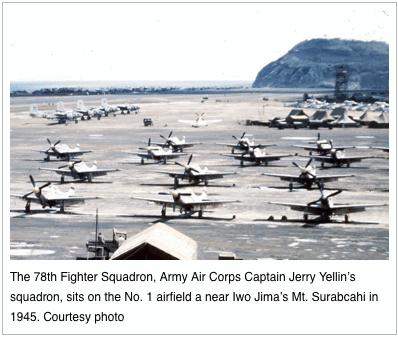
On March 7, 1945, our squadron landed on a dirt runway at the foot of Iwo Jima’s Mount Suribachi. I looked out at the landscape as I taxied my P-51 Mustang to our parking area and saw huge piles of dead Japanese soldiers being pushed into mass graves, the sight and smell indelibly imprinted on my mind. It was a shocking sight for such a young man to see.

Our squadron area was next to a Marine mortuary where hundreds of dead Marines were being readied for burial.

The fighting was fierce on the eight-square-mile island situated 650 miles off Japan’s southern coast. Nearly 7,000 Marines and 21,000 Japanese soldiers lost their lives there.

I flew 19 long-range missions over Japan from Iwo Jima with 11 young pilots; all of them friends, who did not return home. Over the course of the war, I flew with 16 pilots who did not come back.

On one mission, Al Sherren, my classmate from flying school called in, “I’m hit and can’t see,” and he was gone. Robert “Pudgy” Carr also disappeared that day. He was my tent-mate.

Three of those killed were my wingmen. Danny Mathis was lost in a mid-air collision along with 26 other fighters the day my wisdom teeth were pulled and I was grounded. Dick Schroeppel died following me on a strafing run over Chichi Jima, and Phil Schlamberg disappeared from my wing in the clouds on August 14, 1945 – the day the war ended.

All of us knew who we were fighting and why.

Then it was over. One day a fighter pilot, the next a civilian.

No buddies, no airplane, nothing to hold on to, and no one to talk to. Life, as it was for me from 1945 to 1975 was empty.

The highs I had experienced in combat became the lows of daily living. I had absolutely no connection to my parents, my sister, my relatives, or my friends. I listened to some of the guys I knew talk about their experiences in combat and I knew they had never been in a battle let alone a war zone. No one that I knew who had seen their friends die could talk about it. The Army Air Corps had trained me and prepared me to fly combat missions, but there was no training on how to fit into society when the war was over and I stopped flying.

I was not able to find any contentment, any reason to succeed, any connection to anyone that had meaning or value. I was depressed, unhappy, and lonely even though I was surrounded by a loving wife and four sons. That feeling of disconnect, lack of emotions, restlessness, empty feeling of hopelessness lasted until 1975.
In 1975, I learned a technique called Transcendental Meditation (TM). In just a few months life became meaningful to me and now, at 86 years of living, I can say that this meditation has brought me peace and contentment.

War is always difficult for those on the front lines, but today’s wars are being fought in the countries of our enemies, on their territory, their homeland, and their cities, with no distinguishing uniform. There are no established front lines or objectives to capture. Every citizen can be looked at as “the enemy,” every road dangerous to travel and every pile of garbage might explode from a hidden IED.

As I write this today, in October 2010, there have been 5,745 of our servicemen and women killed and 86,175 evacuated because of wounds or illness. That’s 21.7 percent of the approximately two million who have seen combat duty.

It has been estimated by some private organizations that up to 25% of those who have served since 2001 may seek treatment for post traumatic stress.

I am a recovered PTSD veteran. Meditation made a difference in my life. Maybe it can work for others as well.

To learn more about Operation Warrior Wellness, please visit www.davidlynchfoundation.org.

This is an excerpt from Jerry Yellin’s book The Resilient Warrior.

Army Air Corps Captain Jerry Yellin (Ret.) flew P-51 Mustangs during World War II. He currently co-chairs Operation Warrior Wellness and is the award-winning author of four books, including Of War and Weddings.

Copyright ©2010 USO. All Rights Reserved

(more…)
Conscious TV: John Hagelin – The Core of Nature

July 30, 2010

Science – Dr John Hagelin – ‘The Core Of Nature’ – Interview by Iain McNay (watch this programme) Author of “Manual for a Perfect Government“, John Hagelin, Ph.D. is a quantum physicist and leading proponent of peace. Stood for President of the US in 1990 and received over 2 million votes. Conducted pioneering research at CERN (the European Centre for Particle Physics) and SLAC (the Stanford Linear Accelerator Centre). His scientific contributions in the fields of electroweak unification, grand unification, super-symmetry and cosmology include some of the most cited references in the physical sciences. He is also responsible for the development of a highly successful Grand Unified Field Theory based on the Superstring. Dr Hagelin is therefore at the pinnacle of achievement among the elite cadre of physicists who have fulfilled Einstein’s dream of a “theory of everything” through their mathematical formulation of the Unified Field, the most advanced scientific knowledge of our time. Dr Hagelin is currently Director of the Institute of Science, Technology and Public Policy, a leading science and technology think tank, and International Director of the Global Union of Scientists for Peace, an organization of leading scientists throughout the world dedicated to ending nuclear proliferation and establishing lasting world peace. John talks about his life, his work and the benefits of meditation. Visit Dr John Hagelin’s website: http://www.hagelin.org. Watch John Hagelin on Conscious TV.

Other videos worth watching: John Hagelin, Ph.D., Speaks on the Nature of Consciousness and the Universe | Dr. John Hagelin: Look Within to Understand the Universe | John Hagelin — “Only Higher Consciousness Can Transform Our World” — Beyond Awakening Blog.

GURU PURNIMA 2010

July 25, 2010

Jai Guru Dev
Guru Purnima, July 25, 2010

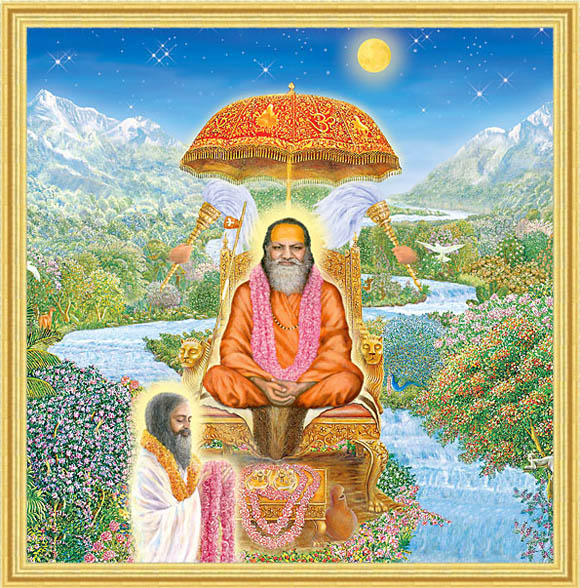
Guru Purnima is the day of infinite correlation. It is a day of supreme knowledge; it is a day of Brahman; it is the day of Guru; Guru Purnima, the fullness of Guru Dev, the fullness of the element of Guru, the fullness of pure knowledge. Guru is the expression of Enlightenment, pure knowledge, the field of all possibilities, the field of infinite correlation. In that supreme awakening, in that supreme awareness, in the state of supreme knowledge we have wholeness of life, absolute value of Being, pure infinity, pure eternity, pure immortality. Guru Purnima day is structured in pure knowledge. It comes year after year to bring the awakening of totality of life. It unfolds the full potential of knowledge and brings to fulfillment the master-disciple relationship. It is the master-disciple relationship, and that expresses itself in its totality: Full potential of all possibilities. It is a very special day; it’s a very special day for us. — Maharishi

The Vedic Tradition, upheld in its purity by a long history of custodians, enshrines the supreme knowledge of the integration of life. From time to time a revival of man’s understanding of the eternal wisdom of this Holy Tradition arises to rescue him from suffering, restoring him to the speedy path of evolution, and … awakening him to a meaningful life in fulfillment. The Masters of this Tradition have been exponents of reality from earliest ages. In each new epoch, they have propounded the enduring truths of practical living and have set out those standards by which men’s lives may attain the highest achievements and fulfillment, generation after generation. — Maharishi

Wishing you the fullness of Guru Dev on this very special day,

Jai Guru Dev

Group Meditations Reduce Crime, As Predicted

July 23, 2010

INVINCIBLE AMERICA ASSEMBLY
Communications: 1000 North Fourth Street • Fairfield, Iowa 52557

PRESS RELEASE

Fourth Anniversary of the Invincible America Assembly, July 23, 2010

Large Group Meditations Produce Dramatic Decrease
in Violent Crime, Rise in “Peacefulness,” as Predicted

Murder Rates Inexplicably at 40-Year Lows in Many U.S. Cities

“We predict that America will rise to become a true powerhouse of peace when the number of group meditation experts in Iowa rises from its current average of 1850 to the desired level of 2500, which is predicted to cause a more profound and comprehensive shift in these positive trends away from violence towards peace.”

— Dr. John Hagelin, Executive Director, International Center for Invincible Defense.

An unexpected drop in crime last year, with homicide rates in some major U.S. cities plunging to levels not seen in four decades, and a rise in “peacefulness” in the nation are among the findings of the first-ever scientific demonstration project, now entering its fifth year, documenting the long-term peace-promoting effects of large group meditations on national trends in America.

The “Invincible America Assembly” was launched on July 23, 2006, at Maharishi University of Management in Fairfield, Iowa.

Dr. John Hagelin, executive director of the International Center for Invincible Defense and director of the Invincible America Assembly, predicted in advance of the start of the Assembly a significant drop in violent crime nationwide, and improved U.S. relations overseas. Dr. Hagelin’s predictions have been borne out by FBI Uniform Crime Reports and by an independent analysis of U.S. domestic and foreign policy trends.

As the Washington Post reported on May 25, 2010:

“The national violent crime rate had risen in 2005 and 2006 …. But crimes of violence began going down in 2007, falling 0.7 percent that year and then an additional 1.9 percent in 2008. The trend accelerated [in 2009] with a 5.5 percent reduction in overall violent crime and a decrease of 8.1 percent in robberies, 4.2 percent in aggravated assaults and 3.1 percent in rapes.”

Reuters highlighted the dramatic and unexpected reductions in crime rates in 2009:

“Year-end statistics from the largest U.S. cities defy the predictions of many police commanders who braced for a crime wave they expected to be unleashed by the recession, rising home foreclosures and social despair.

“Last year turned out to be the safest on record in New York City, with the murder rate in the nation’s biggest metropolis plunging to its lowest level since the city began gathering comparable data in the early 1960s.

“Crime overall was down about 11 percent in New York and off 12 percent Chicago. The number of murders in Dallas fell for a second straight year in 2009 to its lowest mark since 1967.

“Los Angeles, the second-most populous U.S. city, posted its lowest crime rate in about 50 years, with violent crimes including homicide dropping nearly 11 percent from 2008 levels and property crimes down 8 percent for the same period. Homicides alone in Los Angeles dropped by 18 percent.”

Global Peace Index shows rise in U.S. “peacefulness”

At the same time, according to the “Global Peace Index” (GPI) of the Institute for Economics and Peace, the U.S. experienced the biggest year-on-year improvement in peacefulness since 2007. (The GPI is composed of 23 qualitative and quantitative indicators, which combine internal and external factors ranging from military expenditure to relations with neighboring countries and levels of violent crime.)

“It is possible that reductions in homicide rates, armed robbery, assaults, and rapes—as well as an improvement in ‘peacefulness’—might have occurred, individually, on their own. But the fact that all this good news began when we launched our Assembly in July 2006—exactly as we predicted four years ago—is well beyond chance. It is the direct result of the coherence created by the Invincible America Assembly,” Dr. Hagelin said.

Positive influence of group meditations is immediate and profound

Extensive published research shows that coherence and positivity are created in collective consciousness when a small number of people practice Transcendental Meditation and its advanced Yogic Flying technique together in a group. This rise of positivity in collective consciousness reduces negative trends, including crime and violence, and improves economic trends.

“Rigorous statistical analysis shows that the upsurge of positive trends started on the month the Assembly began—July 2006—when an initial group of 1200 experts assembled from across the U.S. and around the world to practice these technologies in a group,” said Dr. Hagelin, who added that when the number of group meditation experts rises from its current average of 1850 to the desired level of 2500, America will rise to become a true powerhouse of peace.

“Twenty-five hundred is the number required to create a far more profound and comprehensive shift in these positive trends away from violence towards peace,” Dr. Hagelin said.

The Invincible America Assembly has been funded by a grant from the Howard and Alice Settle Foundation for an Invincible America.

###

See: Explanation to Steady Decline in Major Crime
And The Power of The Collective, by John Hagelin

Meditation Techniques Have Different Effects

July 21, 2010

Meditation Techniques Have Different Effects

By Rick Nauert PhD Senior News Editor
Reviewed by John M. Grohol, Psy.D. on July 21, 2010

Meditation is an alternative medicine modality prescribed by physicians to help individuals relieve stress and, at times, reduce pain.

However, as Western medicine turns to meditation, doctors are learning that meditation incorporates a variety of techniques including methods that originated from Buddhist, Chinese, and Vedic traditions.

And, just as the techniques vary in delivery, the clinical effects of meditation may also have a variety of outcomes.

A new paper published in Consciousness and Cognition discusses three categories to organize and better understand meditation:

Focused attention—concentrating on an object or emotion;
Open monitoring—being mindful of one’s breath or thoughts;
Automatic self-transcending—meditations that transcend their own activity—a new category introduced by the authors.

Each category was assigned electroencephalogram bands, based on reported brain patterns during mental tasks. Meditations were then categorized based on their reported EEG.

“The idea is that meditation is, in a sense, a ‘cognitive task,’ and EEG frequencies are known for different tasks,” said Fred Travis, Ph.D., co-author, and director of the Center for Brain, Consciousness, and Cognition at Maharishi University of Management.

Focused attention, characterized by beta/gamma activity, included meditations from Tibetan Buddhist (loving kindness and compassion), Buddhist (Zen and Diamond Way), and Chinese (Qigong) traditions.
Open monitoring, characterized by theta activity, included meditations from Buddhist (Mindfulness, and ZaZen), Chinese (Qigong), and Vedic (Sahaja Yoga) traditions.

Automatic self-transcending, characterized by alpha1 activity, included meditations from Vedic (Transcendental Meditation) and Chinese (Qigong) traditions.

Between categories, the included meditations differed in focus, subject/object relation, and procedures. These findings shed light on the common mistake of averaging meditations together to determine mechanisms or clinical effects.

“Meditations differ in both their ingredients and their effects, just as medicines do. Lumping them all together as “essentially the same” is simply a mistake,” said Jonathan Shear, Ph.D., co-author, professor of philosophy at Virginia Commonwealth University in Richmond, and the author of several books and publications on meditation.

“Explicit differences between meditation techniques need to be respected when researching physiological patterns or clinical outcomes of meditation practices,” said Dr. Travis.

“If they are averaged together, then the resulting phenomenological, physiological, and clinical profiles cannot be meaningfully interpreted.”

Source: Maharishi University of Management

ABC News/Nightline: Transcendental Meditation in Vedic City, Iowa

July 6, 2010

Transcendental Meditation Thrives in Iowa

Adherents of Transcendental Meditation Have Called Hawkeye State Home Since ’70s

By JOHN BERMAN and MAGGIE BURBANK

July 5, 2010 —

Travel to an Iowa cornfield to find an entire town that meditates en masse. More Photos

When you think of Iowa, you think of cornfields, you think of caucuses, you think of old-fashioned country-living.

Chances are, you don’t think of meditation and communal living.

Welcome to Maharishi Vedic City, Iowa — the only city in the country built on the tenets of transcendental meditation, for meditators, by meditators.

Meg and Erik Vigmostad moved here from St. Louis in 1982.

“We wanted to come to a meditating community,” said Meg Vigmostad. “We had two children at the time, one of them was an infant, and we felt like it was the best place to bring up our children.”

Watch the full story tonight on “Nightline” at 11:35 p.m. ET

Vigmostad acknowledged that the couple’s families thought they were “crazy” for making the move. Crazy, because those words, “transcendental meditation,” sound, well, different. Many people first heard of transcendental meditation, or TM, in the 1960s, when the Beatles started following Maharishi Mahesh Yogi, the official founder of TM.

“Transcendental meditation is a simple technique practiced for about 15-20 minutes sitting comfortably in a chair with the eyes closed,” said Bob Roth, national director of the TM program. “It allows the body to get a profound state of rest while the mind just settles down and experiences a state of inner wakefulness, inner calm, inner coherence.”

The followers of Mahesh Yogi — mostly from East and West Coast universities — moved to Iowa en masse in 1974 to set up their own college, the Maharishi University of Management. The group chose Iowa because that is where they could find the land.

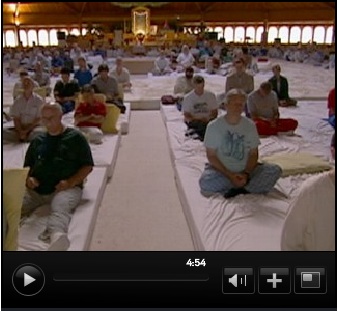
Now the settlement features two huge domes, one for men and one for women, with residents streaming in to meditate together twice a day.

But at the university and in the city, the commitment to Vedic principles of natural law and balance, derived from ancient Sanskrit texts, goes far beyond meditation. The community has banned the sale of nonorganic food within its boundaries. And that’s not all.

“The primary characteristics of Vedic architecture, the most obvious one, is that ideally, buildings face east, the direction of the rising sun,” said Jon Lipman, the country’s leading Vedic architect.

‘Greater Happiness’

Lipman says the buildings at the university and most new houses in town are constructed in line with ancient precepts.

“Just like the organs in the human body, there is a right place for different kinds of functions within a building,” Lipman said.

“And so, a kitchen is typically in one location. A living room in a house is typically in another location.”

Every Vedic building has a silent core known as a Bramastan, which is lit by a skylight and is never walked on. Lipman claims miraculous effects.

“The results are that, families find that their lives are improved, that there’s greater family harmony, that there is greater financial success, there’s greater happiness,” said Lipman. “There are many many cases where members of a family had disharmony between them, and it dissolved when they moved into a Vedic home. There are many cases where even such things as chronic diseases were abated by moving into a Vedic home.”

Lipman said “it’s a real challenge” to be poor, unhappy or unhealthy if you live in a Vedic building.

The Vigmostads live in a Vedic house, and seem like happy customers.

“It feels harmonious, it feels orderly, there’s a lot of silence here that was definitely not in our other house that we owned,” said Meg Vigmostad.

The talk of order and inner peace might sound unbelievable. But it is also the work of Vedic City to make it all … believable. Fred Travis, director of a university facility called the Center for Brain Consciousness and Cognition, demonstrated an EEG monitor of neurological electrical activity that he said shows that TM makes the brain more organized.

“What this is measuring is the electrical activity of the brain,” Travis explained as a member of the community hooked up to the machine sat and meditated.

“You see this one going up and down?” Travis said, pointed to a gauge. “Look at the one next to it. It goes up and down in a similar way. This is called coherence. When the similarity of two signatures are very close, it suggests those two parts of the brain are working together.

Neurologist Gary Kaplan, a proponent of TM, said such “coherence” will bring happiness, success — even world peace.

“What we notice is that this electrical activity becomes more harmonious or coherent between left and right hemispheres,” Kaplan said. “There have been studies that have documented that the TM technique, when practiced in large groups, seems to have some effect on society in general, whether it’s in war-torn areas where people are sitting to meditate together, or in high-crime areas that the trends reverse when you have larger groups meditating together.”

David Lynch and TM

It is a lot to digest — but then you don’t really have to. The TM followers insist they are not a cult. They all have normal jobs, for the middle of Iowa, and they are not out to recruit you. They just want you to know the option is there.

Famed filmmaker David Lynch spends a lot of time in Vedic City. He started the David Lynch Foundation, which, in the last four years, has provided scholarships for over 100,000 kids to learn to meditate for free in schools across the country.

“It’s not a religion. It’s not against any religion, it’s not mumbo-jumbo. It truly does transform life,” Lynch told ABC News. “Kids come to school and they meditate together for 15 minutes in the morning. And before they go home they meditate for 15 minutes. A lot of them come from, you know, bad situations, and so this gives them this thing you know, at the beginning and the end of the day, the rest of the time you just watch the violence stop. Watch relationships improve. Watch happiness in the hallways, in the classroom, watch creativity flow more and more, watch that heavy weight that we are living under gently lift away.”

“Nightline” was told there wasn’t enough time to properly learn transcendental meditation on a short trip to Vedic City. But to get a feeling of the Vedic way of life, we did visit the Ayurveda Health Spa in Vedic City — the leading spa of its kind in the country. Ayurveda is a system of health and healing involving food and behavior that originated in India thousands of years ago.

“We take your pulse, we put three fingers on the right hand,” explained Mark Toomey, an Ayurvedic health expert at the spa. “And it’s what I would say is like plugging into the inner intelligence of the body.”

Toomey said he can learn a lot from feeling a person’s pulse. He demonstrated on our correspondent.

“It’s a strong pulse,” Toomey said. “That means that, good expression of intelligence. It’s clear. Your pulse has a little bit of tension there, so maybe you’re working a little too hard, too many deadlines.”

Next up was the Shirodhara treatment.

“So what we’re going to be doing is pouring this oil for about 20 minutes on your forehead, in a continuous stream,” said Toomey. “Your job is just to relax and enjoy.”

And what’s so wrong with that? In Vedic City, they have made that their way of life … in the middle of Iowa.

“We really have all we need here,” said Meg Vigmostad. “You can go to a city anytime. But this is sort of a haven, you know? And it’s a place of comfort, and community.”

Copyright © 2010 ABC News Internet Ventures

This edited version finally aired: http://bit.ly/cDxWqj and was posted earlier this year: http://wp.me/pD0BA-Gp

Ending Tensions with North Korea: What South Korea Could Learn from Latin America

June 22, 2010

Social tensions between South and North Korea have escalated once again due to the sinking of the Cheonan. The two Koreas have remained technically at war with each other ever since the 1953 ceasefire ended the Korean War. If one considers the premise that their long-term struggle is a cold civil war with periodic hot flashes, then it could be argued that the protracted civil wars in Latin American countries like Colombia, Bolivia, etc. have followed similar patterns. However, the latter situation is now changing, and perhaps both Koreas could learn something from new developments regarding the implementation of Invincible Defense Technology IDT in Latin America.

The Latin American Military Prevention Wing

Read the whole article here, or click on any of the publications below.

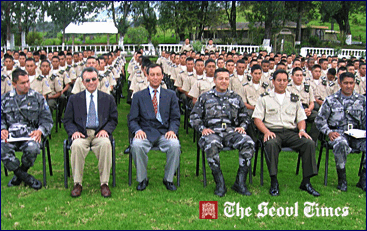
Published in China Today, The Seoul Times, Pattaya Dailynews (Thailand), Kashmir Watch, ReviewNepal, The Seoul Times, Cyprus News, Business Ghana, OpEd News, and Australia.to

Radical Peace: People Refusing War, by William T. Hathaway

June 10, 2010

Radical Peace: People Refusing War

World peace depends on our collective consciousness. – William T. Hathaway

William T. Hathaway’s latest literary work, is a return to journalism. Radical Peace: People Refusing War, presents the first-person experiences of war resisters, deserters, and peace activists in the USA, Europe, Iraq, and Afghanistan. Just released by Trine Day, it’s a journey along diverse paths of nonviolence, the true stories of people working for peace in unconventional ways. The first, Chapter 1: The Real War Heroes, and last, Chapter 15: Conscious Peace, are both posted on OpEdNews.com.

William T. Hathaway is a political journalist and a former Special Forces soldier turned peace activist whose articles have appeared in more than 40 publications, including Humanist, the Los Angeles Times, Midstream Magazine, and Synthesis/Regeneration. He won a Fullbright grant to teach at universities in Germany, where he continues to reside. He is an adjunct professor of American studies at the University of Oldenburg. William and his wife also run a small TM center there.

Hathaway is the author of A World of Hurt (Rinehart Foundation Award), CD-Ring, and Summer Snow. He is currently working on WELLSPRINGS: A Fable of Consciousness, which focuses on applying Vedic knowledge to ecology. A selection of his writing is available at www.peacewriter.org.

William also spent 7 years, from 1987-1993, as an assistant professor in the Master’s in Professional Writing at MIU, now MUM. The last chapter of Radical Peace, Conscious Peace, discusses his TM practice, and the vision of possibilities it holds for world peace. You can click on the Chapter 15 link above or read it here:

I was sitting in full lotus, body wrapped in a blanket, mind rapt in deep stillness, breathing lightly, wisps of air curling into the infinite space behind my closed eyes. My mantra had gone beyond sound to become a pulse of light in an emptiness that contained everything.

An electric shock flashed down my spine and through my body. My head snapped back, limbs jerked, a cry burst from my throat. Every muscle in my body contracted — neck rigid, jaws clenched, forehead tight. Bolts of pain shot through me in all directions, then drew together in my chest. Heart attack! I thought. I managed to lie down, then noticed I wasn’t breathing — maybe I was already dead. I groaned and gulped a huge breath, which stirred a whirl of thoughts and images.

Vietnam again: Rotor wind from a hovering helicopter flails the water of a rice paddy while farmers run frantically for cover. Points of fire spark out from a bamboo grove to become dopplered whines past my ears. A plane dives on the grove to release a bomb which tumbles end over end and bursts into an orange globe of napalm. A man in my arms shakes in spasms as his chest gushes blood.

I held my head and tried to force the images out, but the montage of scenes flowed on, needing release. I could only lie there under a torrent of grief, regret, terror, and guilt. My chest felt like it was caving in under the pressure. I clung to my mantra like a lifeline to sanity. I was breathing in short, shallow gasps, but gradually my breath slowed and deepened, the feelings became less gripping, and I reoriented back into the here and now: my small room in Spain on a Transcendental Meditation teacher training course.

I lay on my narrow bed stunned by this flashback from four years ago when I’d been a Green Beret in Vietnam. I had thought I’d left all that behind, but here it was again.

I sat up and was able to do some yoga exercises but couldn’t meditate. Instead I took a walk on the beach. For the rest of that day and the next I was confused and irritable and could hardly meditate or sleep. But the following day I felt lightened and relieved, purged of a load of trauma, and my meditations were clear. My anxiety about the war was much less; the violence was in the past, not raging right now in my head.

Gradually I became aware of a delicate joy permeating not just me but also my surroundings. I knew somehow it had always been there, inhering deep in everything, but my stress had been blocking my perception of it. I felt closer to the other people on the course, connected by a shared consciousness. Then I started feeling closer to everything around me; birds and grass, even rocks and water were basically the same as me. Our surface separations were an illusion; essentially we were all one consciousness expressing itself in different forms. Rather than being just an isolated individual, I knew I was united with the universe, joined in a field of felicity. This perception faded after a few days, but it gave me a glimpse of what enlightenment must be like.

The whole experience was a dramatic example of what Maharishi Mahesh Yogi called “unstressing,” the nervous system’s purging itself of blockages caused by our past actions. Since my past actions had been extreme, the healing process was also extreme.

I had begun meditating in 1968, several months after returning from the war. I’d come back laden with fear and anger, but I had denied those emotions, burying them under an “I’m all right, Jack,” attitude. I was tough, I could take it, I was a survivor. Within certain parameters I could function well, but when my superficial control broke down, I would fall into self-destructive depressions. I finally had to admit I was carrying a huge burden of stress, and I knew I had to get rid of that before I could live at peace with myself or anyone else.

(more…)

The Bat Segundo Show #100: David Lynch

May 31, 2010

The Bat Segundo Show #100 with special guest David Lynch discussing TM
BSS #100: David Lynch

CLICK TO LISTEN: 33:43
Author: David Lynch

Condition of Mr. Segundo: In absentia, terrified of meditation.

Subjects Discussed: Transcendental Meditation, true happiness, contending with stress, fear and anxiety, anger, the relationship between filmmaking and TM, inner happiness, walking vs. TM, Knut Hamsun, Einstein’s Theory of Everything, Dostoevsky’s 1866 publishing deal, on coming up with ideas, the art life vs. the business life, Frank Silva’s unexpected casting as Bob in Twin Peaks, and whether Lynch understands his own films.

EXCERPT FROM SHOW:

Lynch: Let’s talk about suffering. Like in movies, people die. Well, you say, you don’t have to die to show a death. And there’s all kind of suffering and torment and all these things in a story. And, for me, those things come from ideas. Now when you catch an idea, you see the thing. You hear the thing. You feel and see and hear the mood of it. And you see the character. You almost see what the character wears. And you see what the character says and how they say it. That it’s an idea that comes all at once. And you know that idea.

Podcast: Play in new window | Download

Maharishi describes the nature of inner life: bondage and liberation, and gaining bliss consciousness through Transcendental Meditation

May 9, 2010

Maharishi at Lake Louise

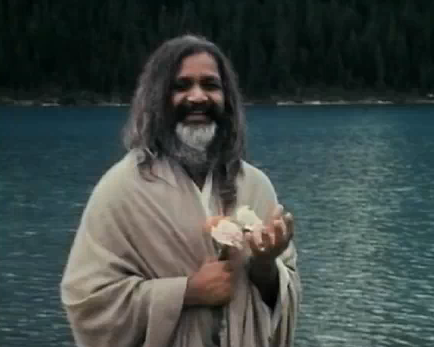
The Canadian Broadcasting Corporation produced this beautiful documentary on Maharishi Mahesh Yogi, founder of the Transcendental Meditation technique, during his visit to Canada’s premier hotel Chateau Lake Louise,  June 10-14, 1968, the course location for Canadian meditators. I was very lucky to have been on that course and met Maharishi for the first time. All of the course participants lined up to present Maharishi with flowers for the CBC to film. It was used to open and close that documentary profile, which was made for the CBC program series called Telescope.

This CBC documentary remains one of the best films ever made on Maharishi. Filmed inside the hotel’s main lecture hall and outside with the backdrop of the majestic Canadian Rocky Mountains, it respectfully portrays Maharishi as a great spiritual teacher. They filmed him walking in front of the glacier lake, the image of which he used to describe the nature of inner life, bondage and liberation, and contacting and integrating bliss consciousness into daily life through the regular practice of Transcendental Meditation.

Posted here is an edited version of that documentary, minus the opening introduction, segues, and commercials, which was aired on Canadian national television during the Fall of 1968. Here is a partial transcription of that segment of the video. To view the whole video click on the title, Maharishi at Lake Louise. It can also be viewed on the Maharishi Channel on You Tube: Transcendental Meditation – Maharishi Mahesh Yogi at Lake Louise, Canada, 1968. Also, the Transcendental Meditation blog has a well-written comprehensive, historical, contextual description about this video by Bob Roth: Maharishi: A rare glimpse into the message of meditation from 40 years ago. It’s also embed here for you to enjoy.

The depth of the lake, and the ripples, and the beautiful reflection of the glacier, reminds me of the story of inner life. The mind is deep like a lake. The ripples on the surface represent the conscious mind, the activity of the mind on the surface. And the whole depth of the lake is silent. And that is the subconscious mind, which is not used by the wave. But if, the wave could deepen, and incorporate more silent levels of the water, the waves could become the waves of the ocean, the mighty waves.

This is what happens in Transcendental Meditation. The surface activity of the conscious mind deepens and incorporates within its fold the depth of the subconscious. And with practice, nothing remains subconscious. The whole subconscious becomes conscious, and a man starts using full potential of the mind.

And the reflection of the glacier on the water is like the impression of the objects that the mind perceives. And as long as the mind is not capable of maintaining its essential nature, which is bliss consciousness, so long the mind gets imprinted by the perceptions of the objects. And this is called the bondage of the mind. The mind loses bliss consciousness and gains the joy of the reflections of the world, the joy of the relative order, losing the bliss of the absolute eternal Being.

When the mind is not capable of maintaining its essential nature, bliss consciousness, and is overshadowed by the reflections of the object of perception, then only the object remains, and the subject, as if, becomes annihilated. This annihilation of the subjective nature within is a great loss. It’s a loss of eternal bliss at the cost of temporary joys. Such a life where the value of the matter dominates is called material life, and the spirit gets annihilated.

But, when through the practice of Transcendental Meditation, the mind goes deep within to the source of thought, transcends the thought, and gains bliss consciousness, and is capable of maintaining that even when it comes out into the worldly experience of objective nature, then it is called spiritual life—that the spirit is not capable of being overshadowed anymore by the objective experience. And this is spiritual life. This is life in eternal liberation. And without this, life is in bondage. A great loss. As if loss of a billion pounds, and gain of a million. Loss of eternal bliss consciousness and gain of a worldly fleeting joy.

The vision, the vision of the lake, brings about a great teaching of spiritual life. …

New Post: Watch the 1968 film of Maharishi at Lake Louise.

On September 30, 2014 I had posted how I learned #TMmeditation 47 years ago today. In there I share more information about the making of the CBC Telescope film, The Guru, of Maharishi at Lake Louise. Richard Day shared a story he had heard many years later about the director of the film who told Maharishi that he wanted to film him saying something that would encapsulate all his teachings. Maharishi said, “I’ll walk by the lake, you walk with me, and I’ll tell you everything about spiritual development.” He did it in one take!