Archive for the ‘Art’ Category

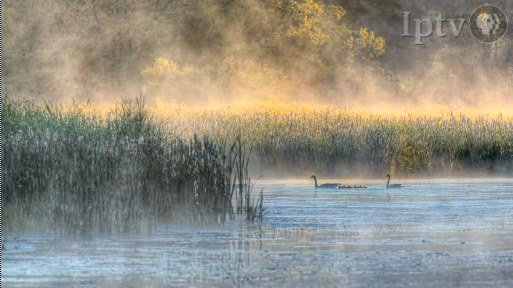
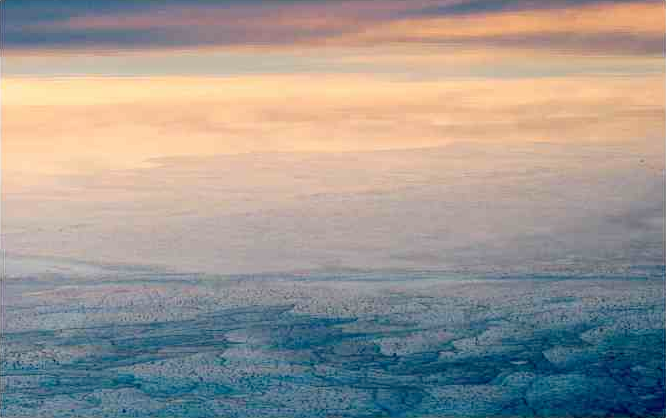
Ken West and his unique landscape photographs are featured on IPTV show Iowa Outdoors

November 14, 2011

How The Uncarved Blog got its name

November 7, 2011

How The Uncarved Blog got its name by Ken Chawkin

Some readers have asked me about the name of my blog, what it means, and how I came up with it. When I explain it to them they say I should write it down for others to see. So I just added it to the About section, and have also decided to include is as its own post. Here it is:

Heather Hartnett at the David Lynch Foundation, encouraged me to set up my own blog and post all the TM-related articles I was sending around. So, when I thought of the word, blog, it reminded me of the word, block, the uncarved block specifically, a term from Taoism that means the uncreated pure potentiality from which all things are created, the Tao, the source of the 10,000 things. It also reminded me of the unmanifest pure Creative Intelligence Maharishi talks about in his Science of Creative Intelligence, the field of pure potentiality; also the Unified Field of all the Laws of Nature, the Veda within Atma, Sutratma, the Self. And since ‘block’ and ‘blog’ sounded so similar, I thought it was a clever poetic way of coming up with a name.

I first read about the uncarved block in a wonderful book, Creativity and Taoism, by Chang Chung-Yuan. In it he described how the Taoist artist, a sculptor in this case, used to meditate, fast, purify himself first, and then go into the forest to find the right tree that for him contained the vision of what he was called to create. He would take that block of wood back to his studio and carve it out. Think Michelangelo freeing the statue from the marble he was carving.

Same message in the Bhagavad Gita translated and commented on by Maharishi Mahesh Yogi, the founder of the Transcendental Meditation program and Maharishi University of Management: Transcend, Be, then act; and, established in Being perform action. Established in the Self, act in tune with Natural Law. Then you’ll be more successful in actualizing whatever inspired vision, or idea, you had that motivated you to create, whether it’s a poem, a painting, a piece of sculpture, or a blog post.

I certainly enjoy blogging, and glad I started. It’s a fun creative process using digital words, images, and sounds, to carve out something meaningful for myself and hopefully my readers. Of course, there’s so much more one can do in terms of the look and functionality of a blog. That takes up even more time, so I’ll leave that up to the good folks at WordPress.com to keep coming up with more ways to improve the experience, both for bloggers and readers. Enjoy exploring The Uncarved Blog, and thank you for visiting!

And in case you were wondering what the small colored abstract square you see next to the link in your finder at the top left, or on the right next to my comments, is all about, it’s one of Ken West’s photos, used as the blog picture, or icon, for The Uncarved Blog. Here is the complete photo © 2008 Kenneth G. West Jr.. Click on it and it will open up in a larger format. I chose it for its beauty and abstract quality; it can mean different things. For more information and links to a video and photo gallery, check out this blog post: Ken West and his unique landscape photographs are featured on IPTV show Iowa Outdoors.

Indonesian Mystery Poem honoring Nyi Roro Kidul

April 12, 2011

Indonesian Mystery Poem
Honoring Nyi Roro Kidul
Queen of the Southern Seas

He hides within the rock
of three dimensions
and cannot be found
in this world

When night comes
she rises like a moon
to shine her light
upon the mountain

The sea dances
rising and falling
like a lover
in her arms

What pull does she have
on his life
as she looks for a partner
to dance with

The moon bows
before the rising sun
and he is left
breathless

© Ken Chawkin
June 2000
Jakarta, Indonesia

(more…)

Rick Hotton and Holy Molé make us laugh and learn “what is essential is invisible to the eye”

January 12, 2011

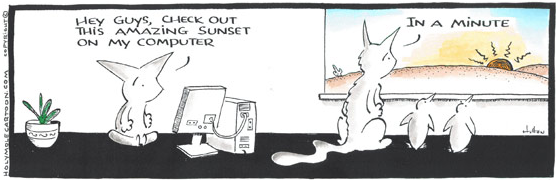
“And now here is my secret, a very simple secret; it is only with the heart that one can see rightly, what is essential is invisible to the eye.”
—Antoine de Saint-Exupery, The Little Prince

Copyright © 2011 Rick Hotton. All Rights Reserved.

Look familiar? Is this how you see reality—only what’s in front of you on your computer screen? Technology may be an extension of our senses to more effectively interact with the world, but it can also be what cuts us off from it. Sometimes we need a little humor to break this mistake of the intellect and make us see the light of day!

Rick Hotton, creator of the award-winning cartoon Holy Molé, opens our hearts and minds with insightful humor. His characters make us laugh and realize there’s more to life than meets the eye.

To find out how Holy Molé was born and to uncover the path of creator Rick Hotton, a dedicated martial artist turned math teacher and now cartoonist, read Behind Holy Molé’s Rick Hotton by Danielle Hope Hier.

Danielle describes the characteristics and spiritual significance of a mole as the main character in Rick’s cartoon and compares it to his outlook on life. She encapsulates his approach in this paragraph:

Through martial arts, math, and Molé, Hotton has captured the essences of working the body, the mind, and the spirit. The quest for knowledge is the thread that ties all three of these forms together, in what might otherwise appear as three completely separate entities.

Danielle asked Rick why he chose a cartoon as a way of expressing elements of his own spiritual journey. I love his answer.

He replied, “But for me, if I could get people to laugh, even if just for a moment…” He paused before rephrasing his next thought: “Being joyful is a state of grace.”

The January 2011 issue of Edge Magazine published an article by Randy Moore on Rick Hotton and the Mindful Art of Holy Molé. It’s interesting to note that both Danielle and Randy are also martial artists and writers.

If you like Rick’s sense of humor, visit www.holymolecartoon.com to sign up and have cartoons delivered to your Inbox. Also follow him on Facebook, Holy Molé Cartoon, to see his photo stream.

Speaking of a common thread that’s invisible to the eye, see William Stafford—The Way It Is. Twenty-five years ago I wrote Seeing Is Being, a poem about a more enlightened way of seeing the world.

This post is very relevant to the theme of how social media cuts us off from the world shown in the Holy Molé cartoon: Two innovative creative videos remind us how social media can destroy not build relationships.

Years later: this cartoon by Bill Bliss (@blisscartoons) of two cats looking at a sunset evokes a similar reaction as the cats in Rick Hutton’s characters above, only it’s what I ask myself after spending hours on my computer scrolling the internet and watching YouTube videos!

Years later I saw a similar quote to The Little Prince from Helen Keller: “The best and most beautiful things in the world cannot be seen or even touched. They must be felt with the heart.”

An animated film with an all-star cast was made of that wonderful book. A little girl lives in a very grown-up world with her mother, who tries to prepare her for it. Her neighbor, the Aviator, introduces the girl to an extraordinary world where anything is possible, the world of the Little Prince. See The Little Prince (2015); original title: Le petit prince (1h 48m), available to rent or buy on Amazon.

— Written and compiled (citing sources) by Ken Chawkin for The Uncarved Blog.

The Iowan features Fairfield artist Stacey Hurlin’s photos of light and love in The Halo Project

October 28, 2010

A Fairfield artist focuses on unifying humanity

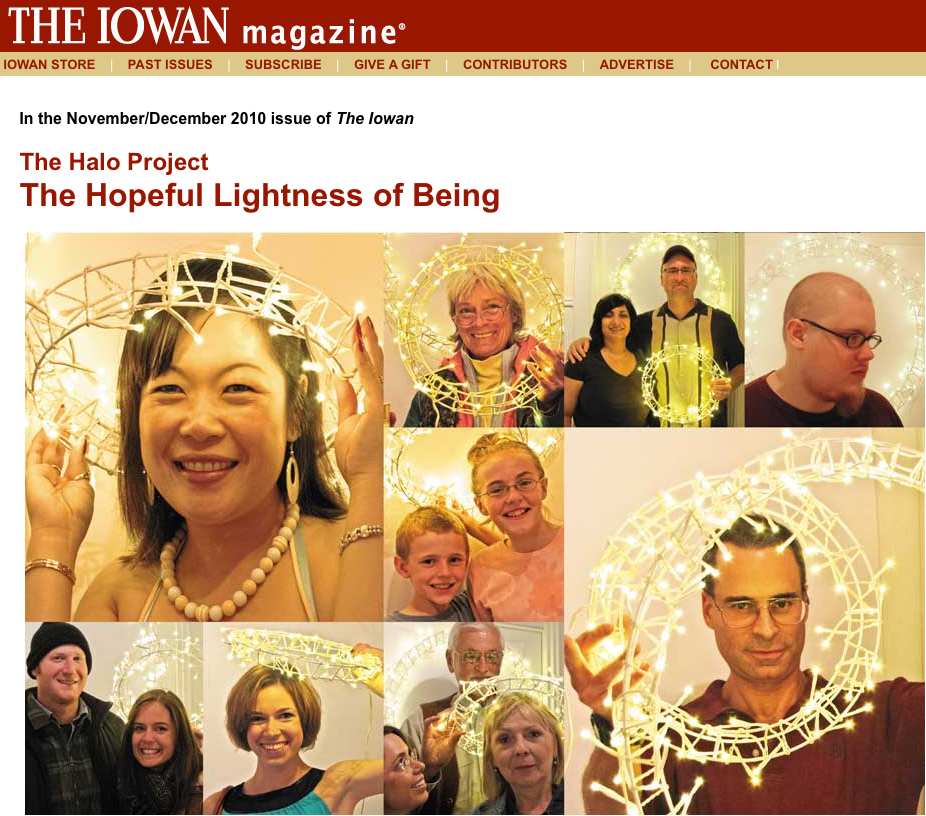
Click on The Halo Project: The Hopeful Lightness of Being, to see all of the photographs taken by Stacey Hurlin featured in the November/December 2010 issue of The Iowan.

Stacey Hurlin’s 2009 art installation — Angels on High — included several circular light fixtures. When the setup was complete, one extra light fixture remained. Voila! The Halo Project was born. Hurlin invited visitors to her Fairfield gallery to pose for the camera in an aura of light.

“I did not expect what happened next. People became playful. Bonds were formed — among family members, between friends, or between the sole subject interacting with the photographer,” remembers Hurlin.

After shooting a thousand photographs, Hurlin began to see something new as she peered through the lens. As people unassumingly held a circle of light as a prop, she noticed that their faces were themselves holding light for just that instant.

Hurlin says the photography project has revealed and been propelled by the strength of human commonality. Her images, she explains, accentuate our unity. “No medium compares with photography to tell the truth. You can show an image of hate and suffering, and the viewer can make a whole story around that photo, that suffering is a truth about humanity. Exhibit a photo of light and love, and that too will mirror for us a truth, our highest goodness, our true nature as a human race, peace.”

She is currently photographing in Iowa, but Hurlin plans to expand the scope of the project, sometimes using a portable “Halo Booth.”  She’s researching options for a solar panel that would enable her to photograph in remote locations sans electricity.

Hurlin envisions a wide application for The Halo Project images, perhaps one day seen along roadways and on the information superhighway. “Wherever these photo collages are exhibited — be it billboards, magazines, airports, or city halls — I want the viewer to take pause and to somewhere inside have a voice say, ‘Yes, there is light and, yes, I could be one of those people, and, yes, let it begin with me.’ It is a tiny awakening, but it is huge.” — B.W. [Beth Wilson, Editor]

Anastasia “Stacey” Hurlin retains the rights to The Halo Project concept, including the use of lights as a backdrop for individual and group photos that are then collaged in large groupings, the working title The Halo Project, and the application of “halos” as part of a local, national, or international image project.

After raising five sons, Stacey Hurlin and her  husband now live in a solar- and wind-powered Fairfield home. Hurlin, who signs her artwork simply “Anastasia,”  is both painter — with women as her primary subject — and photographer. She approaches any photography project — local or global — as an endeavor that mirrors the light and energy of life’s force itself. Nothing more, nothing less. (anastasiafineart.com)

READ MORE IN THIS ISSUE OF THE IOWAN   subscribe now

ORDER PAST ISSUES OR BULK QUANTITIES OF THE IOWAN 800-352-8039

BECOME A FAN OF THE IOWAN

David Lynch receives Cologne Film Award

October 3, 2010

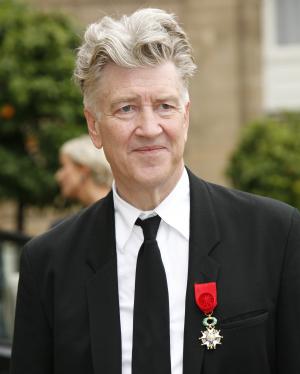
COLOGNE, Germany — David Lynch hasn’t turned his back on Hollywood entirely, but the four-time Oscar nominee is focusing more on the art of painting and photography than film as his non-cinematic work begins to receive worldwide attention.

“I’m trying to catch ideas for a film but I don’t have the ideas yet,” the director of “Blue Velvet” and “Mulholland Dr.” told an audience in Cologne Friday, where he received the city’s Film Prize for his life’s work.

The award ceremony was the climax of the 20th media festival and confab the Cologne Conference.

While the idiosyncratic director has been linked to a CGI project called “Snootworld,” Lynch said the only film he is working on at the moment is his documentary on the Maharishi Mahesh Yogi, founder of Transcendental Meditation. Lynch has been a practitioner and proselytizer of TM for decades. The director was recently in India shooting interviews for the project.

“I’m not a documentary film maker, but I’ll give it a try,” Lynch said.

Lynch’s last feature, “Inland Empire” (2006) received mixed reviews and grossed just $4 million worldwide.

But his painting, photography and sculpture, work he has continued to produce between film projects, is reaching an ever-larger audience. Since a major exhibit of his paintings and photography in Paris three years ago, Lynch has held exhibitions around the world. He recently held a joint exhibit together with shock-rocker Marilyn Manson at the Vienna Kunsthalle this summer. A new exhibit of his work opens this month in Osaka, Japan.

On October 9, Lynch will receive the Goslar Kaiserring, one of Germany’s highest artistic honors. Previous winners include painter Willem de Kooning, “wrap artist” Christo and sculptor and art film director Matthew Barney.

Source: The Hollywood Reporter

Press-Citizen Editorial on Borderlines: Drawing Border Lives

August 2, 2010

Our View – Humanity behind immigration debate

Press-Citizen Editorial Board • July 21, 2010

One of the oft-cited limitations of contemporary American poetry — including the poetry produced by graduates of the Iowa Writers’ Workshop — is its inaccessibility. Readers often have to be as well-trained and academically astute as the poets themselves to appreciate all the nuances, sly allusions and small linguistic experiments. And the poets seldom offer a helpful hand to readers struggling to find meaning or purpose in the words.

That’s definitely not the case with the “Borderlines: Drawing Border Lives/Fronteras: Dibujando las vidas fronterizas” (Wings Press), a recent book project by poet Steven P. Schneider and artist Reefka Schneider. Not only have the husband and wife team paired every poem with the drawing that initially inspired it, but the book stage of the Schneiders’ broader project evolved from exhibits that the couple took on the road to schools and other educational settings throughout south Texas.

Steven Schneider, a 1977 graduate of the Iowa Writers’ Workshop who now teaches at the University of Texas-Pan American, said the couple has long had an educational purpose in mind for the project. They describe “Borderlines/Fronteras” as a text — appropriate for use in high school and college classes as well as for everyday reading — that demonstrates how to cross the borders between:

• Art and poetry.

• Academically aware poetry and a broader, popular audience.

• English and Spanish.

• The physical border between the U.S. and Mexico and the different ways that imaginary line echoes symbolically throughout both nations.

The “Borderlines/Fronteras” project began in 2001, when Steven Schneider came to teach in Texas, and Reefka Schneider began to draw portraits of people on both sides of the border. Once Reefka had amassed more than 100 drawings, Steven chose the 25 most engaging and began a four-year process of writing poems in response to the visual images. He then worked with bilingual poet José Antonio Rodriguez to translate the poetry so that reading through “Borderlines/Fronteras” would be a dual-language, integrated-arts experience.

With readings scheduled in New York, Rhode Island, Florida, New Mexico and Iowa City (7 p.m. today at Prairie Lights), the Schneiders now are hoping to attract a broader, national audience for the book stage of their project. (Interested readers can follow the couple’s progress at http://poetry-art.com.)

“The border has moved north,” Steven Schneider said. “There is still the Rio Grande, of course. But (through farm labor and working in meatpacking plants) the influx of immigrants from Mexico and Latin America has come as far north as states like Iowa, Nebraska and Minnesota.”

At the very least, “Borderlines/Fronteras” is a helpful primer for anyone looking to improve their Spanish or English reading skills. At its best, however, “Borderlines/Fronteras” is a model for the type of cross cultural understanding and communication that needs to take place to ensure a healthy and comprehensive national debate on immigration issues.

Sandra Cisneros, a workshop graduate and MacArthur fellow who has spent decades urging writers to be more culturally relevant, describes the Schneiders’ poetic/artistic portraits as, “Ordinary folks rendered with love, compassion and intimacy at a time in which love, compassion, and intimacy are in short supply on borders, especially when it comes to the Tex/Mex border.”

Thus “Borderlines/Fronteras” also is welcome reminder that legacy of the Iowa Writers’ Workshop is not just the linguistically and formally challenging work of poets such as Pulitzer Prize-winner Jorie Graham. The workshop’s legacy also includes the poets and writers such as Cisneros and former U.S. Poet Laureate Rita Dove who continually call on literary artists to be more actively, socially and politically engaged in the world around them.

“Our View” represents the consensus opinion of the Press-Citizen Editorial Board — which includes General Manager Daniel W. Brown, Executive Editor Jim Lewers, Opinion Editor Jeff Charis-Carlson, Specialty Publications Editor Tricia DeWall and community members Shams Ghoneim, Angie Blanchard-Manning and Amy Sundermann.

Artist’s short video on Fairfield Puzzle Mural

July 26, 2010

E.E. Yates ~ Public Murals

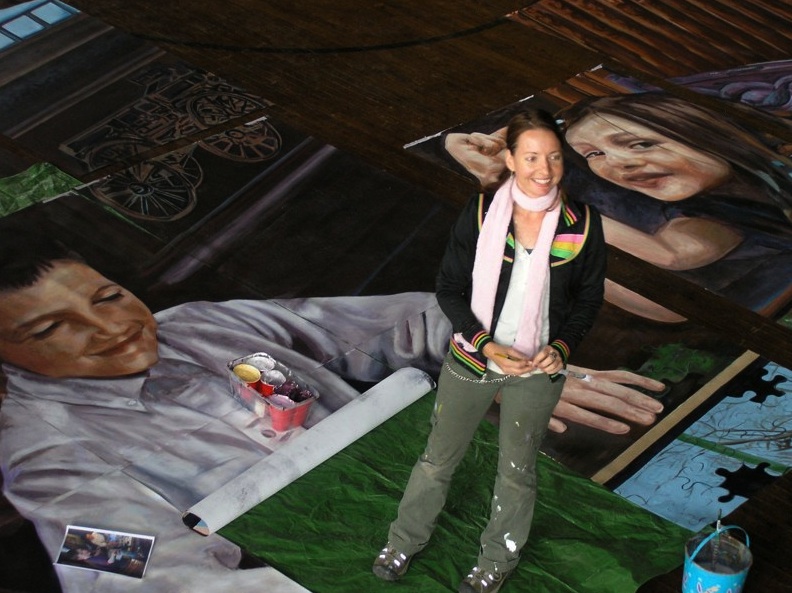
At long last, I have put some final touches on the Fairfield Mural Video. Watch it here for the first time! Fairfield, Iowa is one of my very favorite places in the world—well worth a visit! Next time you are driving across the United States, make sure to plan a day in Fairfield.

Ella Yates


Besides the Lovely Fairfield video, watch the Fairfield Slideshow.

Thanks to Stacey Hurlin for this, in more ways than just this link to the mural artist she helped bring to Fairfield on behalf of the ArtLife Society. Just another reason to come and visit Fairfield, Iowa!

Here’s another great video: A town like no other—Fairfield, Iowa

See NPR: Fairfield, Iowa: Where ‘Art Belongs To Everyone’

The Connexion, France’s English-Language Newspaper, interviews David Lynch

June 27, 2010

David Lynch’s French connections

Connexion edition: May 2010

FRANCE has been kind to David Lynch; he’s an officier of the Légion d’honneur (a rare thing for a foreigner); French production companies have supported his last three films and he has twice won best foreign director from the French-based César cinema awards. The feeling is mutual he tells Connexion.

You’re quite a frequent visitor to France

This is one of my favourite places in the world. I’ve had a lot of support in France for my films and I love Paris. I’m doing a lot of work here now. I’m here on average maybe twice a year.

Do you see much of the rest of the country at all?

Well, when I go to the Cannes Film festival I see the south of France but mainly I’m coming to Paris. I stay in a hotel here.

Would you like to live here?

For sure, if I have the money I’d like to get a place here. It would be in Paris. I’m doing a lot of lithographs here. I’m working in a place called Idem Print Studio. It’s incredible – a 150 year old printing shop. It’s the real thing. It’s got a mood you can’t believe.

You’ve had exhibitions here as well

Yes I had a big exhibition at the Fondation Cartier and a big exhibition of lithographs in the north of France.

When did you first visit France?

My first trip was 1965. I came here with my friend Jack Fisk. I was kind of lost and just travelling around.

What were your first impressions?

Paris is I think the most beautiful city in the world. It’s inspiring to me. It’s a place that’s just packed with all the arts. It’s a great, great celebration of all the arts. It’s just got the feel.

Has it ever inspired any scenes in your films?

(pauses) Let’s see. I don’t know. I don’t think so…but it’s still inspiring.

You made The Cowboy and the Frenchman in 1988 for a project with Le Figaro (The French as seen by…) Have your opinions changed much since then?

We live in a world of change. Everything is always changing but that film was kind of a cliché – both an American and French cliché film and there’s probably still truth to that.

What would you say about the French away from the clichés then?

Well as I said, they’re lovers of art. They champion the arts more than any other country in the world, they support the arts more than any other country I think, and this is very important to me. Plus they’ve got great food, great wine, incredible knowledge of materials and design. It’s a really high-end life.

Do you have any particular things that you like to do when you’re in France?

I like to work.

Is it always work or do you get to relax here?

I usually come to work and that’s the most enjoyable thing. I don’t really like vacations. I like to work here a lot.

Who are your influential French figures?

I like so many of the artists that work in France. When you come here and connect the place to the work, you see that it must have been so inspiring for them to be here. It sort of feeds the work this place. It’s a great country to live the artlife.

Would you ever make a film here?

For sure, if the ideas came. You don’t just arbitrarily say ‘I’m going to make a film in Paris.’ The ideas have to come and then if the ideas came and Paris was the setting, then absolutely, it would be a joy.

There’s some bits of French that makes their way into your films. Do you have any affinity for the French language?

No I don’t speak French. I just murder the language.

Why choose to use French?

Things appear from ideas. You don’t just say I want some French here. Ideas come along and who knows exactly how that happens but they come along and then there it is.

So it’s like there’s a little bit of France swimming around out there?

There’s everything swimming around and sometimes that will conjure an idea, that’s how it all goes. Ideas, ideas, ideas.

Do you have any particular favourite foods in France?

Oh yes, I like the foie gras. I like vin rouge Bordeaux. I like all the French pastries and I like the galettes. It’s hard to get a bad meal in France.

What’s brought you and your meditation project to France?

The David Lynch Foundation for Consciousness-Based Education and World Peace has helped start well over 100,000 students to meditate. It’s in several schools in US, both private and public. Some of these were the worst schools in their state and in one year the schools had been completely changed. It’s not just France it’s in so many countries now. There’s a project in the West Bank in Palestine, in Africa, many countries in Europe, Iceland, Canada.

What’s the connection that’s brought you to Lille?

The Maharishi Mahesh Yogi came over to Lille, 50 years ago this month. It’s a celebration of him coming to France.

How do you feel Transcendental Meditation (TM) is received in France as opposed to the US?

France and Germany will probably be among the last countries where the penny drops and they say ‘wait a minute this is a great thing’. I base that on many, many misunderstandings. The misunderstanding of this world ‘cult’ or ‘sect’ which is very unfortunate. This is absolutely not true. It’s not a religion or against any religion. It’s a technique, an ancient form of meditation for the human being that opens the door to the treasury within; unbounded, infinite eternal consciousness. Life improves almost over night when people experience ‘the big self’ – the unified field within. The lack of knowledge and misunderstandings are ridiculously huge here.

But little by little they’re saying there’s got to be something to this. In other places the misunderstandings have almost disappeared and it’s a normal thing for people to meditate in schools, in homes, wherever. It’s as normal as breathing and life improves rapidly. The world is full of stress and this is a stress buster beyond the beyond. All these stress related illnesses that people suffer, so much of the behaviour is dictated by stress – you practise this thing and it frees you from stress.

Grades go up, relationships improve, health improves. Everything gets better.

The main sticking point for France is not the meditation aspect but the money aspect – how would you respond to critics?

That’s another crazy thing. People will spend money on almost anything but when it comes to meditation they say it’s a scam. It’s because they haven’t yet had the experience or they don’t see the change in one of their friends who’s had this experience. Once they start seeing this transformation in other people they realise that this is nothing to spend for this life transforming thing. The money they save from the doctors is going to be huge. You want a legitimate teacher of Transcendental Meditation and it’s about 90 mins a day over four days to learn the technique. The teachers, they need to live and have a place to stay and a car to drive. It’s so well worth the money there’s nothing to talk about.

You’ve met President Sarkozy – how do you find him?

I love him. I think he’s filled with energy. He’s got a great energy and a great caring for France.

You’ve spoken with him about TM as well. Has he helped you with this project up in Lille?

No, because I think people are not quite ready to go out on a limb and say let’s do this thing because of these strange misunderstandings or lack of knowledge but the times are changing. To experience this is life transforming.

You put it in a school that’s in trouble, you put it into a school that’s in great shape it will just get better. It’s a human being thing.

Awards, art and films

Won the Cannes Film Festival’s Palme d’Or for Wild at Heart in 1990. In 2002 he presided over the festival jury.

Won two Cesar Awards (the French equivalent of Baftas) for Elephant Man in 1982 and for Mulholland Drive in 2002.

He was made a chevalier of the Légion d’honneur in 2002 and then made an officier by President Nicolas Sarkozy in 2007.

Sarkozy says he is a fan, declaring that Lynch’s Elephant Man convinced him that “cinema was a highly important matter”

An exhibition of 25 years of Lynch’s work as a painter, sculpture, photographer and musician entitled The Air Is On Fire went on show in Paris in 2007 at the Fondation Cartier.

From his 2006 book Catching the Big Fish:
“I love the French. They’re the biggest film bugs and protectors of cinema in the world. They really look out for the filmmaker and the rights of the filmmaker, and they believe in final cut. I’ve been very luck that I’ve been in with some French companies that have backed me.”

When American TV channel ABC dropped Mulholland Drive (originally conceived as a series) after seeing the pilot episode it was French production company StudioCanal that provided the funding to turn it into the award-winning film.

StudioCanal also provided funding for Lynch’s Inland Empire and The Straight Story.

Lynch is by no means guaranteed hits among audiences in France. At the Cannes festival in 1992 his film Twin Peaks: Fire Walk with Me was booed following its screening.

Transcendental Meditation – a way for peace that rarely passes quietly

Transcendental Meditation is never far from criticism, principally for its direct approach of charging money for courses instructing people how to carry out the technique. It was founded by the Maharishi Mahesh Yogi in the 1950s and spread around the world as famous faces such as The Beatles, The Rolling Stones, Clint Eastwood, Jane Fonda and Mia Farrow took it up.

In 2005 David Lynch announced that he had been practising the technique for 32 years.

That year he founded the David Lynch foundation to promote meditation in schools. The foundation’s latest project aims to reduce stress and violence at 10 schools in Lille by funding meditation courses for students and teachers.

Milvudes (Mission interministérielle de vigilance et de lutte contre les dérives sectaires) which monitors religions and possible cults in France says their main concern with TM is a “lack of transparency” within the group. Milvudes spokeswoman Claire Barbereau said: “It is presented as a technique for meditation but there is a strong spiritual movement in the background.” She said people could find themselves pushed to adhere to the movements beliefs which were not necessarily linked to meditation.

Ms Barbereau said they had received no complaints about the group for many years. Milvudes does not keep a list of ‘cults’ “because we are concerned with what they do, not what they are.” It was up to the Ministry of Education to see whether the David Lynch Foundation’s plan was an effective way of helping children improve performance at school, she added.
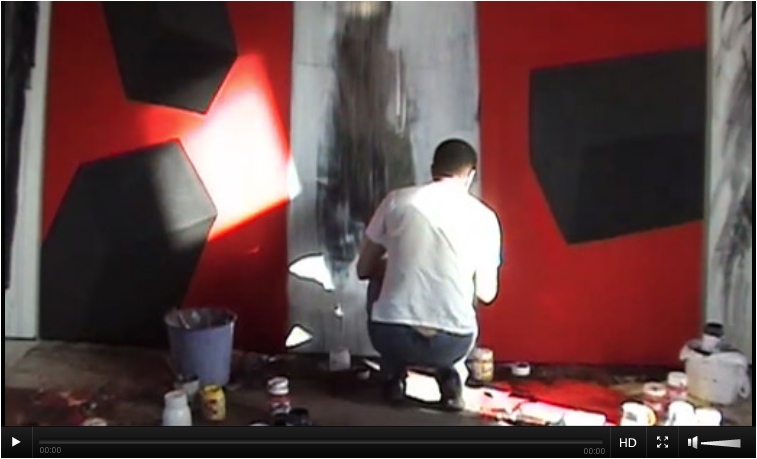
Beautiful film on Algerian artist Malek Salah by Amine Koudier

November 30, 2009

Malek Salah: Majnûn Laylâ – Artist

Enjoy this short film about the Algerian contemporary artist Malek Salah as he prepares for the inaugural exhibition titled ‘Majnûn Laylâ’ for the new Modern Art Museum of Algiers, the first of its kind in the Arab world. The film brings deep insight into Salah’s world—his creative process, the information contained within his work, his relationship to his art, and through it, with the Algerian society.

This beautiful film of a meditating Algerian artist, Malek Salah, is a fine example of a famous artist profiled by one of our MUM students, who later became a videographer for DLF.TV. The young filmmaker, Amine Koudier, a senior student at the time in MUM’s digital media class, was asked to make this film to accompany an opening exhibit of the new Modern Art Museum of Algiers (MaMa), the first of its kind in the Muslim world.

When Amine showed it to me I was really impressed and encouraged him to translate and add English sub-titles and enter it into competitions. I ended up helping him with the French to English translation, and he won first place wherever he entered it. He took the top 2008 Award of Excellence in the student category from the Iowa Motion Picture Association and Winner in the student film category of 2008 Landlocked Film Festival.

David Lynch visited the students when he was here last year and commented on this film. He said he loved the artist, his work, and what he had to say about it, and how Amine had portrayed it—high praise for a student. Amine was later hired to work at David Lynch Foundation Television upon graduating. Read an excellent article in the Iowa Source written by Mo Ellis about him and the film.

Watch the 13-minute film Malek Salah: ‘Majnun Layla’ on DLF.TV, on Vimeo, or on YouTube Part 1 and Part 2. Also see David Lynch Foundation Television to premiere David S. Ware: A World of Sound. The Ware and more profiles by Amine and other DLF.TV filmmakers are available here.

This blog post was published November 30, 2009. After working for the David Lynch Foundation, Amine would become a teacher of Transcendental Meditation and later taught TM and filmmaking at Maharishi University. He gave a wonderful interview to Nylon Magazine, and later invited a photographer from the Ottumwa Courier into his classroom as part of her profile on the university.