
Archive for the ‘Architecture’ Category

The Iowa Source: MUM Sustainable Living Center

November 21, 2010

The Iowa Source cover story on MUM’s SLC written by Linda Egenes

Building the Future: MUM’s Sustainable Living Center
New Zero-carbon Classroom Showcases Green Living
http://www.iowasource.com/fairfield/2010_11_slc.html

Sustainable Living Center: It Takes a Team to Go Green
http://www.iowasource.com/fairfield/2010_11_slc_team.html

For more information and videos of the phases of construction plus a TV news report visit Sustainable Living Center. Also see YouTube videos at mumslc from Earth Day 2010, a Sustainable Living Center Tour Dec 2010, and Building Progress Reports 1, 2, 3, & 4. To find out more about a degree program in Sustainable Living, visit: http://sustainableliving.mum.edu.

BUILDINGS Magazine Sept/Oct 2011: A Zero Utility Bill Building

Workshop Makes Case for Meeting Architecture 2030 Challenge Today

September 27, 2010

COSC hosts “2030 Now: Case Study of MUM’s Sustainable Living Center” on Sept. 28 in Des Moines.

West Des Moines, IA (September 24, 2010) –With buildings consuming more energy than any other sector, Architecture 2030 issued The 2030 Challenge to the global architecture and building community, asking them to meet sustainability standards of a zero carbon footprint by year 2030. As of July 2010 40% of all U.S. architecture firms have adopted the Challenge.

Center on Sustainable Communities (COSC) hosts a dynamic green building workshop that illustrates how to attain The 2030 Challenge right now, using readily available building technology and products. Fairfield’s Maharishi University of Management (MUM) Sustainable Living Center is the first of its kind and is the subject of “2030 Now: Case Study of MUM’s Sustainable Living Center” happening on Tuesday, Sept. 28 from 5:00-7:00pm at the John & Mary Pappajohn Education Center located at 1200 Grand Avenue in Des Moines. The workshop is free and those interested in attending are asked to register by contacting COSC’s Leslie Berckes at 515-707-2787 or Leslie@icosc.com.

Presenters of the program include Masaki Furukawa, architect of the Sustainable Living Center, and Dal Loiselle, developer and general contractor. Together, they will review how the Sustainable Living Center surpasses LEED platinum standards, complies with the Living Building Challenge and has already achieved The 2030 Challenge by using methods and materials readily available in Iowa now.

“2030 Now: Case Study of MUM’s Sustainable Living Center” is an extension of COSC’s Re-Building a Sustainable Iowa statewide training program. COSC is able to temporarily offer its Re-Building a Sustainable Iowa sessions for free through funding from the Iowa Department of Economic Development and the U.S. Department of Housing and Urban Development.

About COSC

Center on Sustainable Communities (COSC) is a non-profit membership organization founded in 2005 that serves as Iowa’s trusted educational resource for sustainable building. As the recognized leader in providing education and connecting resources, COSC empowers individuals and communities to make everyday decisions that promote sustainability, resulting in a better quality of life for all Iowans. COSC’s schedule of residential, commercial and energy-specific workshops can be found at www.icosc.com.

###

Contacts:

Lynnae Hentzen, Co-Founder/Executive Director
COSC – Center on Sustainable Communities
515-707-0732, Lynnae@icosc.com

Siobhan Spain, Communications Specialist
COSC – Center on Sustainable Communities
515-707-2783, Siobhan@icosc.com

KTVO News: Solar power at Maharishi University

July 22, 2010

Solar power at Maharishi University

by Matt Buhrman

With a flip of the switch, solar power is taking over one construction site in the Heartland.

FAIRFIELD, IOWA — Fairfield Mayor Ed Malloy and State Representative Curt Hanson (D-Fairfield), officially started the solar electricity of the Utility Cottage at Maharishi University on Thursday afternoon.

The renewable energy will be used to power all the equipment needed to complete construction on the university’s new Sustainable Living Center (SLC).

The SLC will set a new standard for green building in America by being completely off the grid with respect to electricity, heating and cooling, water, and waste…and it is the first of its kind on any campus in the world.

“As much as we are very excited about what we mark today, we know that in the very near future this will be commonplace. But let this building be a great demonstration model in the meantime to show others how this is done,” Mayor Malloy said.

“Use this as a learning tool and learn from the experiments that are taking place in this building, and perhaps get more of us off the power grid, more of us off foreign oil, more of us energy efficient,” Representative Hanson said.

The SLC will serve students in the university’s Sustainable Living major. Among its features, the building will have classrooms and workshops.

“I know that our future leaders that will really influence education, politics, and society at large are going to be studying and training in this building, at this university. And for that we are very fortunate, and I am very proud,” Mayor Malloy said.

“Hopefully it’s going to be studied by a lot of engineers all over the United States and maybe we can export some of these ideas to the whole nation. So I’m very happy to be here and learn more about this cutting-edge technology,” Representative Hanson added.

Also recognized on Thursday afternoon were students and other community leaders who played a major role in this green initiative.

Video is courtesy of KTVO Television and heartlandconnection.com

Solar Energy to Power Completion of MUM’s Sustainable Living Center

Solar Energy to Power Completion of MUM’s Sustainable Living Center

July 19, 2010

Maharishi University of Management

MUM to Launch Renewable Energy System

Solar panels provide power to complete construction of Sustainable Living Center


Photo credit: Robbie Gongwer

Fairfield, Ia, July 20, 2010 – On Thursday, July 22, at 2 pm, Fairfield’s ‘green’ mayor, Ed Malloy, will flip the switch on the solar electricity of the Utility Cottage to use only renewable energy to power all the equipment needed to complete construction of Maharishi University of Management’s (MUM) new Sustainable Living Center. (SLC)

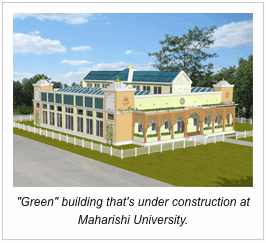
The Sustainable Living Center will set a new standard for green building in America by being completely off the grid with respect to electricity, heating and cooling, water, and waste, and will be the first of its kind on any campus anywhere in the world.

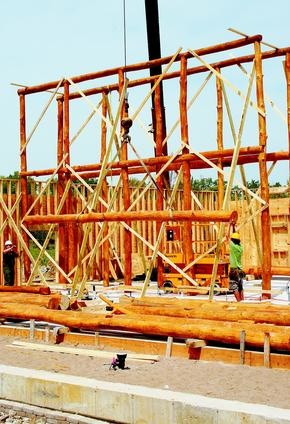
On Earth Day, Whole Tree Posts and Beams were put in place, walls were tilted up, and roof trusses were placed on top of them. The entire shell of the building is now complete and is expected to be ready for occupancy in late fall.

Four Building Philosophies

The Sustainable Living Center features four green building philosophies. It has been designed to meet the Living Building Challenge, the highest standard for sustainable design and green building in the world. It will be one of the first three to achieve this. And it will be unique because it will be the first to combine that standard with the standards of LEED Platinum certification, Building Biology, and Maharishi Vedic Architecture.

Architects talk about 2030 as the year when all buildings will be built this way, sustainable and without a carbon footprint. But MUM is doing it now, with existing technologies and materials. “There’s no other building like this going up in the nation, or in the world for that matter, that we know of,” said nationally known green building expert Mike Nicklas, FAIA, founder and president of Innovative Design, the building’s Project Architects.

To date, Innovative Design has designed over 4750 buildings and more than 100 schools that use renewable energy solutions. Mike Nicklas is the Technical Architect for this project, and Jon Lipman, AIA of Fortune-Creating Buildings, is the Design Architect. Mr. Lipman was responsible for the initial concept, and for the design and Vedic architecture throughout the project.

A Building That Teaches

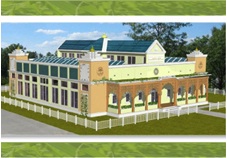
The Sustainable Living Center will serve students in the university’s Sustainable Living major. It will have classrooms, workshop, meeting room, greenhouse, kitchenette, research lab, recycling center, and offices, as well as east and west covered verandas and a porch on the north.

It has been designed as a building that teaches. In addition to embodying sustainability, it will allow students to monitor performance and energy efficiency and make adjustments.

“The Sustainable Living Center will be a living, evolving building,” said David Fisher, head of the MUM Sustainable Living Department, who helped plan the building. “The building itself is an educational tool, not just a passive one like most classroom buildings. It will provide participatory education where students will be continually adding to, or altering, the building and grounds as well as systematically checking its effectiveness.”

Off the Grid

The Sustainable Living Center will be completely off of the energy and utility grid. Every feature will exemplify healthy and sustainable green building — and will be geared to teaching those principles.

Construction uses all non-toxic materials from local sources, as defined by the Living Building Challenge requirements. All energy will be provided from solar panels on the building and from an outside wind turbine. Rainwater catchment will be the complete source of the building’s water, with purification of drinking water via ultraviolet technology. Wastewater will be treated onsite using a constructed wetland. Natural day lighting will illuminate the entire interior. Geothermal technology will assist with heating and cooling.

An Embodiment of Sustainability That’s Feasible and Practical

This achievement is remarkable because none of the systems in the building are new or experimental, according to developer and construction manager Dal Loiselle. “The Sustainable Living Center is being constructed using ‘state-of-the-shelf technologies,’” he said. “This building proves that we can meet our environmental goals for our built environment with the materials, technologies, and green building protocols we already possess.”

A Community Oriented Toward Sustainability

Sustainability has become a major focus at Maharishi University of Management, which has long used techniques for living in harmony with natural law, including the Transcendental Meditation technique and other Vedic technologies including Vedic Architecture. The University has filed a climate action plan to be 100% carbon neutral by 2020 as part of the American College and University Presidents Climate Commitment.

Fairfield, too, has taken a strong direction toward sustainability, hiring a sustainability coordinator and moving ahead with its Go Green Strategic Plan to become a sustainable city. In 2009, MSN.com named Fairfield Mayor Ed Malloy as one of the nation’s 15 greenest mayors — alongside the mayors of New York, Seattle, San Francisco, Chicago, and Salt Lake City.

“Our city will benefit enormously by having this building on the campus of MUM as a demonstration of a new standard of design and will reinforce our commitment in Fairfield to changing the culture towards a more sustainable future,” Mayor Malloy said.

Industry-Educational Partnerships Industry leaders in green technologies provide sponsorships

The Sustainable Living Center features four green building philosophies, is entirely off grid and has amassed an impressive list of leading corporate sponsors. These industry-educational partnerships showcase a new level of leadership, cooperation and sustainable capitalism unique to green building and sustainable development within the state, nation and world at large.

The Sustainable Living Center has benefited by in-kind donations from these nationally recognized leaders in green building materials: Serious Materials (high performance windows); Pittsburgh Corning (FoamGlas insulation); Gerdau AmeriSteel (rebar); United States Gypsum Corporation (Aqua Tough-paperless drywall); Green Building Supply; SpiderLath Inc (lath mesh to support exterior stucco); and GlobalWatt (PV panels).

GlobalWatt is excited about participating in this special project and is proud to be a Platinum Sponsor. MUM SLC will be one of the very first customers to receive PV panels off the line at their new Saginaw, Michigan manufacturing plant, a former automotive facility. “We are pleased to partner with MUM on this historic educational green building,” says GlobalWatt Director of Sales, Dave Slivinski.

Wege Foundation Grant

There seems to be a Michigan connection here. With GlobalWatt in Michigan, the Kresge Foundation is headquartered in metropolitan Detroit, in the suburb community of Troy, Michigan. They provided MUM with a Planning Grant, and possibly an upcoming Challenge Grant.

Another Michigan foundation, the Wege Foundation, provided a $100,000 grant to fund the Maharishi University of Management Sustainable Living Center to help it achieve the Living Building Challenge. Peter M. Wege, who built Steelcase, Inc. into the largest office-furniture manufacturer, is an environmentalist who founded the Wege Foundation to promote environmental activities primarily in Grand Rapids, Michigan, where Steelcase, Inc. is headquartered. The board of the Wege Foundation made an exception and funded the MUM SLC in Fairfield, Iowa because it is a nationally significant sustainable building. This is the largest Foundation grant the Maharishi University of Management Sustainable Living Center has received to date. In appreciation for this gift the University will name the largest classroom in the Sustainable Living Center, the Peter M. Wege Classroom and Event Center.

The Building will also be a showcase for the public, and will feature meeting rooms, a real-time energy and renewable systems monitor, and displays of materials and building systems featured in the building to showcase partnerships with leading technologies and materials manufacturers. For more information please contact: Marco Sunseri @ 641-472-7000 x2449.

Available for media interviews: Sustainable Living department head David Fisher, construction manager Dal Loiselle, Fairfield Mayor Ed Malloy, and design architect Jon Lipman, AIA. Contact Ken Chawkin, Director of Media Relations.

• • •

Also available here: http://www.mum.edu/sustain/slc and http://www.prweb.com/releases/2010/07/prweb4290894.htm

See KTVO News Report: Solar power at Maharishi University With a flip of the switch, solar power is taking over one construction site in the Heartland. http://www.youtube.com/watch?v=cU69q2P_R4c

ABC News/Nightline: Transcendental Meditation in Vedic City, Iowa

July 6, 2010

Transcendental Meditation Thrives in Iowa

Adherents of Transcendental Meditation Have Called Hawkeye State Home Since ’70s

By JOHN BERMAN and MAGGIE BURBANK

July 5, 2010 —
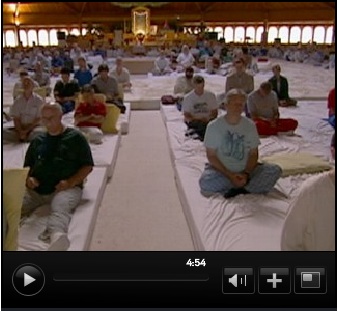
Travel to an Iowa cornfield to find an entire town that meditates en masse. More Photos

When you think of Iowa, you think of cornfields, you think of caucuses, you think of old-fashioned country-living.

Chances are, you don’t think of meditation and communal living.

Welcome to Maharishi Vedic City, Iowa — the only city in the country built on the tenets of transcendental meditation, for meditators, by meditators.

Meg and Erik Vigmostad moved here from St. Louis in 1982.

“We wanted to come to a meditating community,” said Meg Vigmostad. “We had two children at the time, one of them was an infant, and we felt like it was the best place to bring up our children.”

Watch the full story tonight on “Nightline” at 11:35 p.m. ET

Vigmostad acknowledged that the couple’s families thought they were “crazy” for making the move. Crazy, because those words, “transcendental meditation,” sound, well, different. Many people first heard of transcendental meditation, or TM, in the 1960s, when the Beatles started following Maharishi Mahesh Yogi, the official founder of TM.

“Transcendental meditation is a simple technique practiced for about 15-20 minutes sitting comfortably in a chair with the eyes closed,” said Bob Roth, national director of the TM program. “It allows the body to get a profound state of rest while the mind just settles down and experiences a state of inner wakefulness, inner calm, inner coherence.”

The followers of Mahesh Yogi — mostly from East and West Coast universities — moved to Iowa en masse in 1974 to set up their own college, the Maharishi University of Management. The group chose Iowa because that is where they could find the land.

Now the settlement features two huge domes, one for men and one for women, with residents streaming in to meditate together twice a day.

But at the university and in the city, the commitment to Vedic principles of natural law and balance, derived from ancient Sanskrit texts, goes far beyond meditation. The community has banned the sale of nonorganic food within its boundaries. And that’s not all.

“The primary characteristics of Vedic architecture, the most obvious one, is that ideally, buildings face east, the direction of the rising sun,” said Jon Lipman, the country’s leading Vedic architect.

‘Greater Happiness’

Lipman says the buildings at the university and most new houses in town are constructed in line with ancient precepts.

“Just like the organs in the human body, there is a right place for different kinds of functions within a building,” Lipman said.

“And so, a kitchen is typically in one location. A living room in a house is typically in another location.”

Every Vedic building has a silent core known as a Bramastan, which is lit by a skylight and is never walked on. Lipman claims miraculous effects.

“The results are that, families find that their lives are improved, that there’s greater family harmony, that there is greater financial success, there’s greater happiness,” said Lipman. “There are many many cases where members of a family had disharmony between them, and it dissolved when they moved into a Vedic home. There are many cases where even such things as chronic diseases were abated by moving into a Vedic home.”

Lipman said “it’s a real challenge” to be poor, unhappy or unhealthy if you live in a Vedic building.

The Vigmostads live in a Vedic house, and seem like happy customers.

“It feels harmonious, it feels orderly, there’s a lot of silence here that was definitely not in our other house that we owned,” said Meg Vigmostad.

The talk of order and inner peace might sound unbelievable. But it is also the work of Vedic City to make it all … believable. Fred Travis, director of a university facility called the Center for Brain Consciousness and Cognition, demonstrated an EEG monitor of neurological electrical activity that he said shows that TM makes the brain more organized.

“What this is measuring is the electrical activity of the brain,” Travis explained as a member of the community hooked up to the machine sat and meditated.

“You see this one going up and down?” Travis said, pointed to a gauge. “Look at the one next to it. It goes up and down in a similar way. This is called coherence. When the similarity of two signatures are very close, it suggests those two parts of the brain are working together.

Neurologist Gary Kaplan, a proponent of TM, said such “coherence” will bring happiness, success — even world peace.

“What we notice is that this electrical activity becomes more harmonious or coherent between left and right hemispheres,” Kaplan said. “There have been studies that have documented that the TM technique, when practiced in large groups, seems to have some effect on society in general, whether it’s in war-torn areas where people are sitting to meditate together, or in high-crime areas that the trends reverse when you have larger groups meditating together.”

David Lynch and TM

It is a lot to digest — but then you don’t really have to. The TM followers insist they are not a cult. They all have normal jobs, for the middle of Iowa, and they are not out to recruit you. They just want you to know the option is there.

Famed filmmaker David Lynch spends a lot of time in Vedic City. He started the David Lynch Foundation, which, in the last four years, has provided scholarships for over 100,000 kids to learn to meditate for free in schools across the country.

“It’s not a religion. It’s not against any religion, it’s not mumbo-jumbo. It truly does transform life,” Lynch told ABC News. “Kids come to school and they meditate together for 15 minutes in the morning. And before they go home they meditate for 15 minutes. A lot of them come from, you know, bad situations, and so this gives them this thing you know, at the beginning and the end of the day, the rest of the time you just watch the violence stop. Watch relationships improve. Watch happiness in the hallways, in the classroom, watch creativity flow more and more, watch that heavy weight that we are living under gently lift away.”

“Nightline” was told there wasn’t enough time to properly learn transcendental meditation on a short trip to Vedic City. But to get a feeling of the Vedic way of life, we did visit the Ayurveda Health Spa in Vedic City — the leading spa of its kind in the country. Ayurveda is a system of health and healing involving food and behavior that originated in India thousands of years ago.

“We take your pulse, we put three fingers on the right hand,” explained Mark Toomey, an Ayurvedic health expert at the spa. “And it’s what I would say is like plugging into the inner intelligence of the body.”

Toomey said he can learn a lot from feeling a person’s pulse. He demonstrated on our correspondent.

“It’s a strong pulse,” Toomey said. “That means that, good expression of intelligence. It’s clear. Your pulse has a little bit of tension there, so maybe you’re working a little too hard, too many deadlines.”

Next up was the Shirodhara treatment.

“So what we’re going to be doing is pouring this oil for about 20 minutes on your forehead, in a continuous stream,” said Toomey. “Your job is just to relax and enjoy.”

And what’s so wrong with that? In Vedic City, they have made that their way of life … in the middle of Iowa.

“We really have all we need here,” said Meg Vigmostad. “You can go to a city anytime. But this is sort of a haven, you know? And it’s a place of comfort, and community.”

Copyright © 2010 ABC News Internet Ventures

This edited version finally aired: http://bit.ly/cDxWqj and was posted earlier this year: http://wp.me/pD0BA-Gp

MHN Interview with Jeffrey S. Abramson: Vedic Architecture Changes Way People Feel, Work

May 6, 2010

MHN Interview with Jeffrey S. Abramson: Vedic Architecture Changes Way People Feel, Work

Headline News, National, News, Today’s Headlines May 5, 2010

By Anuradha Kher, Online News Editor

The Harvard Business School/Harvard University Graduate School of Design recently presented a case study: “Design Creates Fortune: 2000 Tower Oaks Boulevard,” on the 200,000 square foot LEED Platinum and Fortune Creating Architectural/Vedic-designed office building co-developed by The Tower Companies and Lerner Enterprises of Rockville, Md.

The presenters challenged students to consider the fact that human capital costs were higher than energy costs, and, perhaps it made more business sense to focus on improving the efficiency and productivity of the employees by employing ideas like Vedic Architecture.

Jeffrey S. Abramson, Partner, The Tower Companies’ talks to MHN about why he believes Vedic Architecture is the wave of the future and how it can also change people’s lives by being implemented in multifamily buildings.

MHN: What is Vedic Architecture?

Abramson: Vedic architecture is architecture in accord with natural law. Natural laws are those governing intelligence found in nature, which uphold life in perfect order. It is electrons and magnetic fields and all those impulses of nature that uphold everything in nature. Everything that happens in nature happens by the functioning of natural law. This architecture connects individual life with cosmic life using the same intelligence that governs nature. These expressions like you see in Vedic architecture are expressions you find in almost all cultures, in all systems of architecture, since the Greeks, Romans and Egyptians.

MHN: What are the principles of Vedic architecture?

Abramson: There are about 100 principles that make up Vedic architecture. Orientation—states that the front entrance should face east; how the building is sited on the land—which is called Vastu; determining the center point or nucleus of building; water placement etc. Taken in isolation these principles don’t have much of an impact, but taken together, they create the ideal building.

We incorporated all the 100 principles in the office building. We didn’t try to fool Mother Nature.

MHN: Why is this form of architecture important?

Abramson: Buildings affect people. And if buildings can affect people, they can affect their behavior, their outcomes and their success. Buildings can elevate life and if you can figure out those architectural principles that can uphold the life of the occupant, make them more successful, brighter and smarter, it can be very useful. The built environment can enhance productivity of the company and collectively this is going to have huge ramifications on the health and economic development of the U.S. Reduce pollution; create new jobs and new technologies. It’s not an intellectual concept, its not like there’s a sign that says you are about to experience something. But people come in and say they feel peaceful and energized. It has nothing to do with style, it can be any style the architect chooses.

MHN: Where does Vedic architecture come from?

Abramson: It is about 5000 years old and is associated with India but in its absolute essence, where we are not talking about interpretation etc, these are really just principles found in nature. It could be like saying physics is Austrian or German because we associate Einstein with it. So in that sense, it transcends culture. It was however, enlivened, and somewhat maintained in India.

MHN: How many building that incorporate Vedic architecture exist today?

Abramson: There is 500 million dollars worth of Vedic construction around the world. There are some very small multifamily buildings that incorporate it as well but it so happens that the office one is the largest right now. The next goal for us is to incorporate it in multi-housing. In fact, we now have the opportunity to build about 2,500 apartments at Metro station. This is the direction in which real estate is moving.

MHN: Are there any additional costs involved?

Abramson: There is a small cost—about 2-3 percent more, which is about 10 cents or so per sq ft. It is a minimal cost to make a massive contribution.

Maharishi University hopes to set the standard for “green” buildings

April 28, 2010

Maharishi University hopes to set the standard for “green” buildings

by Matt Kelley on April 26, 2010

in Education, Health & Medicine

A new classroom and research building is under construction on a college campus in southeast Iowa that aims to set a new global standard for green buildings.

David Fisher, director of the Sustainable Living program at Maharishi University in Fairfield, says the building promises to be unlike any other structure on the planet.

“It will be off the grid completely with respect to electricity, heating, cooling, water and waste disposal,” Fisher says. “In addition, the building will be day lit throughout the building.”

Banks of solar panels will provide the electricity for the Sustainable Living Center, Fisher says, and solar energy is being used by workers during the construction phase, as well. During the warm months, he says the building will be kept cool using a geothermal system.

“The heating will be done with solar water heaters on the roof,” Fisher says. “We will have insulation provided in part by very local materials, that is compacted earth blocks which came from some earth right across the street that was being cleared out for a parking lot.” That dirt was compacted into 26,000 bricks that will make up the building’s insulation. The building’s skeleton will use whole tree post and beam techniques.

“Water will be all rainwater,” Fisher says. “It will be collected on the roof and stored in a cistern and, of course, for drinking purposes, it’ll all be filtered with (an ultraviolet) filter.” Fisher says the system for handling waste is also accounted for as a green effort. Fisher says, “We have a constructed wetland and we’re planning to use a system that’s similar to what they use in submarines and on space capsules, purifying the water with a system that puts very, very finely-divided bubbles through the water to keep it aerobic and to completely degrade all of the organic matter so as to purify the water.”

Fisher says the building is designed to meet the Living Building Challenge, the highest standard for sustainable design and green building in the world. It will also be the first to combine that standard with the standards of LEED Platinum certification, Building Biology and Maharishi Vedic Architecture.

The building will serve as the base for the university’s Sustainable Living major. It will have classrooms, a workshop, a meeting room, a greenhouse, a kitchen, a research lab, a recycling center and offices. Fisher says it’ll be a building that teaches. The one-point-seven million dollar project is expected to be complete late this year.

Sustainable Living Center is unique in USA

April 26, 2010

Sustainable Living Center is unique in United States

Front page, Friday, April 23, 2010; published online: 4/26/2010

As ancient walls continue to crumble the world over, a few new ones went up yesterday in Iowa’s hippest farmtown.

The Sustainable Living Center at the Maharishi University of Management in Fairfield was the scene of a modern-day barnraising. Walls were tilted and roof trusses placed during the Earth Day event.

The structure uses “whole tree” post and beam techniques.

“It will set a new standard for green building in America by being completely off the grid with respect to electricity, heating and cooling, water and waste,” MUM director of media relations Ken Chawkin said.

Innovative Design of North Carolina conceived the building to meet the Living Building Challenge, a standard for sustainable design introduced at the 2006 Greenbuild Conference in Denver, Colo. The SLC is the first to combine that standard with those of LEED platinum certification, Building Biology standards, and Maharishi Vedic architecture guidelines.

The Leadership in Energy and Environmental Design system was created by the U.S. Green Building Council and is an internationally recognized third-party certification. Vedic architecture is based on Hindu traditions emphasizing the use of natural materials such as wood, bricks, adobe, stucco and marble.

“There’s no other building like this going up in the nation, or in the world for that matter, that we know of,” said Mike Nicklas, SLC co-designer and president of Innovative Design.

The company has created over 4000 structures that use renewable energy solutions. Nicklas participated in the first Earth Day in 1970.

The SLC building is slated for university occupation this fall.

“It’s a building that teaches,” Chawkin said. The SLC will provide students with classrooms, workshop, meeting room, greenhouse, kitchen, research lab, recycling center and offices.

In addition to embodying sustainability, the SLC will allow students to interactively monitor performance and energy efficiency.

MUM Sustainable Living Department head David Fisher, who helped plan the building, said the SLC will be a living, evolving project.

“The building itself is an educational tool, not just a passive one like most classroom buildings,” Fisher said. “It will provide participatory education where students will be continually adding to or altering the building and grounds, as well as systematically checking its effectiveness.”

The SLC is designed to be completely off-grid. Construction uses all non-toxic materials from local sources, as defined by the Living Building Challenge requirements.

All energy will be provided from solar panels on the building and from an outside wind turbine. Rainwater catchment will be the complete source of the building’s water, with purification of drinking water via ultraviolet technology.

Wastewater will be treated on-site using a constructed wetland. Natural daylighting will illuminate the entire interior. Geothermal technology will assist with heating and cooling.

None of the planned systems in the building are new or experimental, according to construction manager Dal Loiselle, who said the SLC uses “state-of-the-shelf” technologies.

“This building proves that we can meet our environmental goals for our built environment with the materials, technologies, and green building protocols we already possess,” Loiselle said.

Sustainability is a major focus at MUM, which has long promoted techniques for living in harmony with nature. The school was founded in 1974 by the Maharishi Mahesh Yogi as an international center for teaching Transcendental Meditation.

MUM filed a climate action plan to be 100 percent carbon-neutral by 2020 as part of the American College and University Presidents Climate Commitment.

Fairfield Mayor Ed Malloy, named in 2009 by MSN.com as one of the nation’s 15 greenest mayors — alongside those of New York, Seattle and San Francisco — said the SLC holds promise for a sustainable future.

“Our city will benefit enormously by having this building on the campus of MUM as a demonstration of a new standard of design,” Malloy said.

The Sustainable Living Center includes material donations from nationally recognized leaders in green building materials, including Gerdau AmeriSteel, Pittsburgh Corning and United States Gypsum Corporation, as well as Green Building Supply of Fairfield.

Yesterday’s event was part of MUM’s tenth annual EcoFair, which runs from April 30 to May 2 at the Argiro Student Center, 1000 N. Fourth St., Fairfield.

2 comment(s) found

Prgressive!: 4/27/2010

Fairfield,Iowa/Maharishi University of Management is a creative outpost ~ of a life worth living; healthy, in tune with nature, cutting edge and friendly. Thank you to all involved.

Small Town USA: 4/26/2010

Its great to see even the small towns and universities going full swing into this Green thing. Whoo Hoo!

‘Green’ learning in sustainable classrooms

April 23, 2010

Local News April 23, 2010

‘Green’ learning in sustainable classrooms

Maharishi University of Management constructs an off-the-grid academic building for sustainable living majors

MATT MILNER Courier Staff Writer

Matt Milner/The Courier Construction workers had to move carefully to avoid excessive damage to the tree trunks that will be a signature element in the new building for MUM’s sustainable living program. The school held a ceremony at the site on Thursday to mark Earth Day

FAIRFIELD — Builders and backers of the new home for sustainable living majors at Maharishi University of Management say nothing like it has been attempted anywhere.

It’s easy to believe them.

The construction brings together four basic philosophies. Three are focused on environmental impact and resource demands. The fourth is, as all new buildings at the college are, based on Vedic concepts. It’s a tough combination to pull off.

When complete, the building will be completely off the grid for electrical power, climate control and waste removal. The goal is creation of a building that meets the university’s needs for classroom and office space while demonstrating concepts the students learn inside.

Dr. David Fisher, director of the sustainable living department, thinks the building will help draw students. That has not been a problem for the program, which opened in 2003 with six students and now has 80 sustainable living majors. He called it an “incredible environmental building.”

It is not large as academic buildings go. That’s intentional.

“We didn’t want to make it too large because we’re trying to do so much,” Fisher said.

Right now the site doesn’t look markedly different from any other building under construction. Stud framed walls are the exterior on two sides. The other two are still open. The biggest clues that something different is going on are the nearly full-sized tree trunks that form part of one hallway. Others lay around the site, ready to be raised.

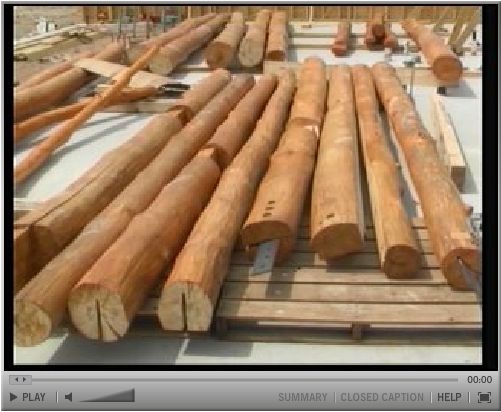
The trees being used are aspens. They are fast-growing and were harvested from a farm dedicated to sustaining its population. A slight sheen and a lack of bark are the only things that show they have been processed for construction. Builders said the trunks have strength similar to steel when they are maintained instead of sawed into boards.

Dal Loiselle, the developer and construction manager for the site, has worked on “green” building sites for 21 years. He said the costs are not all that different from those involved in traditional construction, provided the effort is made from the start. Adding environmentally friendly traits to an existing project can be expensive.

“It entails commitment, basically,” he said. “It’s just a matter of having the desire and doing it.”

Loiselle emphasized that none of the technology being incorporated is new. It’s off the shelf stuff that any builder can use.

The completed structure will be LEED platinum certified and meet the requirements for building biology, Vedic architecture and the Living Building Challenge. Students will have access to the roof and walls to study the concepts they learn in class. Monitors will track every shift in temperature, humidity and environmental change, wired into a website people can check from anywhere in the world.

Thursday’s ceremony was somewhere between a groundbreaking and a dedication, tied into Earth Day at MUM. It’s the 40th Earth Day, noted Fairfield Mayor Ed Malloy. He expressed the hope that the building’s edge-of-the-envelope attempt today will be standard in another 40 years.

Matt Milner can be reached at (641) 683-5359 or via e-mail at mmilner@ottumwacourier.com

KTVO-3: Greenest building in America in Fairfield

April 23, 2010

Video: http://www.heartlandconnection.com/news/video.aspx?id=447437

Maharishi University of Management’s new Sustainable Living Center is a building that will set a new standard for green building in America by being completely off the grid with respect to electricity, heating and cooling, water, and waste.

Greenest building in America in Fairfield

The new sustainable living center will be one of three buildings in the U.S. to meet the Living Building Challenge
By Alex Halfmann
Thursday, April 22, 2010 at 6:12 p.m.

FAIRFIELD, IOWA — One heartland university aims to practice what they preach, and what they preach exemplifies Earth Day.

Maharishi University of Management’s new Sustainable Living Center will be one of the greenest buildings in America when completed this fall.

The University’s sustainable living program will utilize the building, which will help students understand firsthand what they are learning.

“The students will be able to see in the building that they are occupying what we are teaching. This building will be off the grid completely in respect to electricity, heating, cooling, water, and waste disposal,” said Maharishi University’s Director of the sustainable living program David Fisher.

The building is designed to meet the Living Building Challenge, the highest standard for sustainable design and green building in the world.

“After a while, the U.S. Green Building Council realized there was a lot more buildings could do so they came up with the Living Building Challenge which is much more stringent than even the LEED Platnium. In fact, they have now gone to the 2nd version of the Living Building Challenge” Fisher said.

Parts of the project  literally come from the school’s backyard.

“We’re using compacted earth blocks that come from earth just across the street where they were clearing out a parking lot.  We took that soil, compacted it into 26,000 earth blocks, and so that will serve as thermal mass which will help insulate the building,” Fisher said.

While the building might look relatively bare on Earth Day, they expect the roof, complete with solar panels, to be installed by the end of next week. The site will then use only electricity generated on site.

The building will be one of the first three to achieve the Living Building Challenge’s standards. It will be unique because it will be the first to combine that standard with the standards of LEED Platinum certification.