Archive for the ‘Art’ Category

Home is where the heart is – Felicia Hoo

November 29, 2009

Living Guides – Profile

By Willy Wilson | Nov 06, 2009

Home is where the heart is – Felicia Hoo

–––––––––––––––––––––––––––––––––––––––––––––––––––––––––––––––––––––––––––

Fifteen miles west of Kuala Lumpur sits the quintessential upper middle class Malaysian suburb of Kota Kemuning, Shah Alam. There are acres of private club houses, newly-built malls, public schools and Wet World Waterpark.

Dry, quiet and remote, these thoughts came to mind when I first visited the area. But what seems to be monotonous life in Kota Kemuning could very well be its best offering, for many of the residents here prefer a quiet suburban life to a hectic existence in the city. Or at least that is the case of Felicia Hoo.

For Felicia, Kota Kemuning offers an unmatched convenience for her family, her business and herself. The jovial woman is the CEO of Samaria Sdn Bhd by day, a single mother by fate and an artist by choice. She runs a multi-million dollar worth of cutlery business, sends her two boys to school and takes time to paint from her mini studio – all of which are done within Kota Kemuning.

“The tranquility this area offers is supreme,” she says, “the kind of peacefulness you only get outside of Kuala Lumpur.”

Although Kota Kemuning is far from the city centre, Felicia maintains that the area is by no means a secluded one. Thanks to the well linked major expressways such as the North-South Central Link, Federal Highway, Damansara-Puchong expressway and the proposed Kemuning-Federal Highway link.

“It is just the best location for me and my family,” Felicia comments proudly of her area.

Nostalgic and Alluring

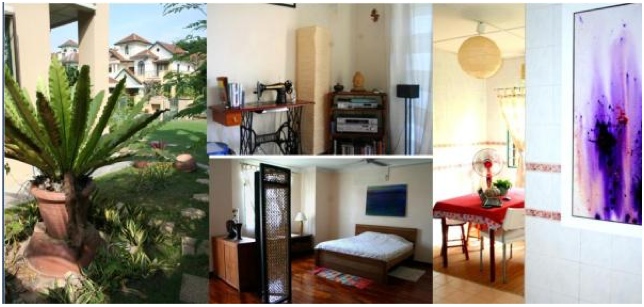
Stepping into Felicia’s 2-storey bungalow feels like a trip down the memory lane. There is an arresting nostalgic appeal that is usually present in your grandparents’ house; the kind of old house charm that instantly makes you feel at ease.

Part of it could be due to a Singer sewing machine and an old stereo that are perched in one corner of the living room, while the other could be because of the old-fashioned arrangement of the furniture, the simple selection of fabric for the curtain and the natural greeneries the house is surrounded by. Whatever it is, it is hard to resist the allure of this house.

Yet, from the outside, it is a mere modern bungalow with an extensive garden, a spacious living room and a lot of canvasses propped against the walls. Such contrast makes this house, well, charming.

The first floor consists of two living rooms, a kitchen and a guest room that is converted into a mediation room. Three bedrooms on the second floor are occupied by Felicia and her two sons.

“People always say that my house has an air of an art gallery,” says Felicia of her cosy house. Which is understandable; there are at least sixty canvassed paintings scattered around the house, all of which are done by the lady herself. The well-ventilated house has two big doors that allow fresh air and sunlight to come into the house.

The central area of the house is a mini studio with high-ceiling concept from where Felicia paints. “I prefer my house to be this way,” says Felicia, “It gives me an inner peace.”

Felicia asserts that she does not feel the need to decorate her house with fancy stuff. What she looks for in a house, according to her, is comfort.

“A house that provides you with a peace of mind is priceless. Your home is worth millions when it houses your heart,” she says. How true!

For the Love of Art
Felicia Hoo is not the typical CEO with a power suit, two assistants and three mobile phones. She is, indeed, more of a jeans-and-funky-hairstyle kind of CEO. As if that is not rare enough, Felicia is also a soon-to-be Transcendental Meditation (TM) instructor, an avid traveller and an occasional host in household product exhibitions. Yes, she does all these while having her cutlery business rolling.

Of her occasional hosting gigs, Felicia comments, “I had been given chances to do a 45-minute food carving demo to visitors during exhibitions like HomeDec.” She does not consider such shows as merely a part of marketing strategy, but also a chance to bond with her customers.

“There are so many things I would like to share with people,” she says, “And it is not just about my business, but also about my passion in meditation, arts and green lifestyle!”

Ever an advocate for green cause, Felicia is set to educate her customers about this issue. She has started this effort by utilising 100 percent non-toxic materials for the production of Samaria products. It is not surprising, then, that her business only gets bigger by the day.

She credits her house for her tremendous success. Which Feng Shui guru did she seek advice from, you may ask!

“I never had any Feng Shui advice from anyone,” she says.

“What we all need is a place where we belong. I can go into a state of total absence from stress and anxiety from work when I paint here,” she says, pointing at one corner in the kitchen, where a cloth-coated wooden table, a few chairs and a fan are placed modestly.

“I sketch faces, emotions and natural beauty here. When I get a solid idea, I spill it onto a canvas and start painting at my mini studio,” says Felicia.

Her abstract arts are quite impressive, especially considering the fact that she has never been trained professionally.

“Better yet, I will have my first solo exhibition in Iowa, United States, next year. The art gallery and I are firming things up now,” she says, “I have my home to thank for this exhibition.”

The moral of the story is: to make your home a comfortable space for your mind, body and soul is to write your own success story both in personal and professional life. Just ask Felicia!

–––––––––––––––––––––––––––––––––––––––––––––––––––––––––––––––––––––––––––

This article was the result of a group assignment in one of HUC Professor Mohan Gurubatham’s classes on entrepreneurship in Kuala Lumpur, Malaysia. One of the student groups contacted The Star to interest them in an interview with Felicia Hoo, a friend of Mohan’s who visited their class. Mohan, who also lives and teaches part time at MUM, says, “She epitomizes following your heart and bliss, a classic rags to riches story of single parent mother, bottom up, and my students volunteered to rebrand her business and shape her strategy. She is a firm believer in doing nothing and accomplishing everything from the source of thought!!! She is going to be a TM teacher.”

After Willy Wilson, the student who wrote this article, thanked Dr. Mohan for the class, Mohan replied that it had been a pleasure for him as well, and that Felicia was going to Thailand to train as a TM teacher very soon. The end of the article mentions that she will have her “first solo exhibition in Iowa, United States, next year. The art gallery and I are firming things up now,” she says.

A good guess would have it in one of Fairfield’s more prominent art galleries. More to come….

UPDATE: Nov 17, 2022

Feli Hoo not only became a TM teacher, she turned her business over to her sister/CEO, retired, married Danish psychiatrist and TM teacher, Henrik Westergaard, and moved there. Read about it in their interview with Mary Swift for TM Home: What happens if you add a daily dose of Transcendental Meditation to the life of a businesswoman from Malaysia and a psychiatrist from Denmark? Here’s how the practice of TM transformed this lovely couple—and how each of us can become our own therapist and find our way home.

Filmmaker Responds To BC Government Arts Cuts

November 28, 2009

Filmmaker Responds To BC Government Arts Funding Cuts

Artless PSA Goes Viral

Kryshan Randel and Cara Yeates Join Forces With Top Art Venues To Create “A World Without Art”

ARTLESS, an independently produced public service announcement about the arts funding cuts, was released online Tuesday as part of a campaign to protest the BC government’s current and planned arts funding cuts. The ad, which imagines a grey artless world, is shot in some of Vancouver’s most iconic artistic venues. This powerful visual statement is rapidly gaining attention.

After its premiere as a part of the Wrecking Ball Cabaret on Monday, this PSA received over 1000 hits its first day on YouTube. ARTLESS is currently featured on the Facebook and Twitter pages of many of BC’s top entertainers, and is spreading fast to theatres, schools and TV stations. It can be seen at artlesspsa.wordpress.com

Kryshan Randel and Cara Yeates were assigned the theme “A World Without Art” by the Wrecking Ball Committee. Immediately, they had the ambitious idea of filming inside some of Vancouver’s most important artistic venues, including the Orpheum, Fifth Avenue Cinemas and Grunt Gallery, emptying them of their art and replacing it with grey. To create further impact, the ad features twelve year old rising star Alex Ferris (RV, The Time Traveller’s Wife) wandering through the stark venues, trying to imagine what art looks like. His journey is accompanied by a haunting song, which was provided by a local elementary school choir.

The team consisting of Randel (Director/Co-writer), Yeates (Co-writer/Producer), Toby Gorman (Director of Photography) and Mathieu Wacowich (Co-Producer), was small but fearless. The shoot was a tremendous challenge; five locations photographed in one ten-hour filming day on Gorman’s one day off from on-set work. “My guerrilla filmmaking background helped us make our day, but barely – it was the hardest thing I’ve ever done”, says Randel.

But the hard work is already paying off. Alan Franey director of the Vancouver International Film Festival has committed to passing this PSA onto the festival’s contact list and screening it at the VanCity Theatre. ARTLESS will be soon featured on Novus Television and KVOS. And the message is being delivered to schools across BC. Every hour Randel and Yeates are updated of more good news in regards to its exposure.

The team of working artists is dedicated to this cause. Randel has a personal investment in the issue. His short drama GLIMPSE recently won the NSI Short Filmmakers Award. GLIMPSE was funded by the Kick Start program, which was recently cancelled due to the funding cuts. Randel’s career is on the rise; his short horror film JACK, made in collaboration with many of BC’s top talents including Zach Lipovsky (ON THE LOT), won four awards including the Grand Jury Prize at this month’s Bloodshots Film Festival. Judge Dan O’Bannon (creator/writer of ALIEN, writer of TOTAL RECALL) praised the film’s entertaining blend of humor and horror. BC’s arts funding is a strong component of Randel’s future as a filmmaker in Vancouver. If it goes, he may be forced to go as well.

Yeates just finished a whirlwind international tour with her one woman plays SOME RECKLESS ABANDON. Her work has been supported by the BC Arts Council in the past and she’s hoping to get funding for her latest project. Cara was just awarded the first ever Joanna Marratta award for artistic achievement and community leadership at the Vancouver Fringe.

At the moment, all of Randel and Yeates’ energies are concentrated on getting the PSA screened everywhere they can. Yeates notes “as artists we are fighting these cuts the only way we know how, through our art”.

To spread the word about ARTLESS please visit: artlesspsa.wordpress.com

How St. Patrick’s stained glass was rescued twice

November 11, 2009

How St. Patrick’s stained glass was rescued twice

By Linda Murphy
Special to The Herald News
Posted Nov 08, 2009 @ 01:56 AM

MadonnaNewport —Divine providence may have led William Vareika to “wake up” from a quick lunchtime Transcendental Meditation and discover the artist that would influence his life. But that was only the beginning of a series of twists of fate that would ultimately lead him to rescuing the most comprehensive collection of the artist’s stained glass windows from destruction at Fall River’s St. Patrick’s convent.

Vareika, raised in Brockton, was about halfway through Boston College, immersed in the idealism of the late 1960s with a clear vision of going on to law school and, as he put it, “changing the world.” But an art history class thwarted his plans.

More than a century earlier, the artist, John La Farge, who was also heading for a career in law, decided at the urging of a friend, New York architect Richard Morris Hunt, to move to Newport, R.I., to study painting with his brother, William Morris Hunt. With plans to become a lawyer abandoned, La Farge married a Newport woman, Mary Margaret Perry, daughter of Commodore Oliver Hazard Perry, and immersed himself in Newport’s robust intellectual artistic community, painting landscapes of the seaside city, portraits and flowers.

Considered to be the father of the American mural movement and the painter of the first Impressionist experiment on American soil, La Farge is regarded today as one of the preeminent 19th century artists for his pioneering stained glass work, including the invention of opaque opalescent glass designs, artistically significant floral painting and early Art Nouveau illustrations.

Vareika, in an attempt to get out of a final exam in his art history class at Boston College, hastily arranged to opt for a last-minute research paper and was given 24 hours to find a topic. Frantically he headed to nearby Trinity Church, where he often spent his lunch in Transcendental Meditation. Upon awakening, he said, the vision of La Farge’s murals and stained glass in the church revealed his research topic. As part of the project, Vareika stopped at the Boston Museum of Fine Arts, spending his last $10 to purchase a print of La Farge’s landscape “Wood Interior.”

He said the project was so well-received that the professor urged him to change his major to art history, but he remained steadfast in his determination to become a lawyer.

Before heading off to law school in 1974, Vareika decided to visit Newport to see the city where La Farge had lived and worked for most of his life. As fate would have it, one of the first people he met was a woman who was trying to save La Farge’s stained glass windows from destruction in an abandoned church.

Preserving the La Farge windows in that church turned into a six-year battle.

“I agreed to help them over the summer,” said Vareika. “I was very naïve back then; I had no idea how long something like that would take.”

Supporting himself as a part-time janitor and art picker, buying and selling art he picked up at yard sales, proved to be lucrative. Like La Farge, Vareika discarded law school plans, married a Newport woman, his wife Alison, and settled into a career in the arts in Newport, eventually opening William Vareika Fine Arts on Bellevue Avenue. Over the years he’s grown to be regarded as an expert and dealer in La Farge’s work, and today he owns the original painting of the $10 “Wood Interior” print he bought back in college as part of his research project.

“I would say I have a passion for his work,” said Vareika. “He’s played a major role in my life.”

An art dealer of three centuries of significant American artists, Vareika also handles the work of Benjamin West, Gilbert Stuart and William Trost Richards.

In the 1890s, La Farge’s broad art career and expertise in stained glass led to the commission of 13 windows for a private chapel in a home on Kay Street. Two wealthy Newport sisters, Mary Gwendolyn Bird Caldwell and Mary Elizabeth Breckenridge Caldwell, who were orphaned at a young age and raised by a guardian, built the chapel in memory of their parents.

In 1931, during the Great Depression, the chapel with La Farge’s images of the Madonna and child, the motherly St. Elizabeth of Hungary and Saint John the Evangelist was slated for demolition but the art and chapel contents were spared through the efforts of Fall River Bishop James Cassidy. He secured the windows and the other chapel furnishings and installed them in the St. Patrick’s Church Sisters of Mercy convent house.

Approximately 70 years later, the Diocese of Fall River had merged several parishes into the church at 1589 S. Main St,, which is known today as the Good Shepherd Parish, and announced plans to demolish the former convent for a parking lot.

Twenty-seven years after saving the first series of La Farge windows, Vareika was called on again to preserve the work of the artist who had played such a prominent role in his art career. This time it was Sister M. Therese Antone, president of Salve Regina University at the time (she’s the chancellor now) and her colleague, Sister Marypatricia Murphy, treasurer of the Sisters of Mercy of America, who contacted the art dealer in 2001 in an effort to save the 13 stained glass windows and original chapel contents from destruction at the convent.

“It seemed like déjà vu. I thought about the windows we saved back in 1974 and began to wonder what would happen to these windows,” he said.

Against all odds, Vareika, the two nuns and a committee of volunteers managed to rescue the windows and chapel contents in 2004 and in the process, their preservation effort expanded to include the construction of the new chapel at Salve Regina, scheduled to open in August 2010.

Michael Semenza, Salve Regina vice president for university relations, said the university, through the efforts of the board of trustees and private donors, raised $350,000 to buy the windows and chapel items from the Fall River diocese.

“This is the case of how art has inspired a construction project,” said Vareika. “Now they’ll be back in Newport at a Catholic institution and chapel where they can be appreciated for their liturgical value as part of a worship environment.”

As part of the project, Vareika has assembled the most extensive show and sale of La Farge’s work to date to raise funds to restore the windows, which are being repaired by the Serpentino Stained and Leaded Glass Studio in Needham.

“This summer I discussed postponing the show with Sister Therese Antone because the economy was so lousy and she told me ‘to have faith,’” he said. “A show like this, with pieces from museums and private collections, can take a year or more to pull together, but in less than six weeks I managed to assemble the entire exhibition.”

The show, which includes several of the stained glass windows, features approximately 150 pieces of La Farge’s oils, watercolors, drawings and block prints as well as illustrations and paintings of stained glass designs.

“I set out to put on a survey of every aspect of his work to show how important his work was so people would come together and support the project,” he said.

One of only two known cartoons (true to size preliminary paintings of stained glass) priced at $225,000 is for sale as part of the show. The only other known La Farge cartoon is in the Worcester Art Museum’s collection.

“When I lecture to school kids I tell them to be open to signals: If I hadn’t come to Newport I would never would have become an art dealer, I wouldn’t have met my wife and these stained glass windows would never have made their way back to a chapel in Newport. It’s fate,” said Vareika.

The show at the 212 Bellevue Ave. gallery runs through Nov. 30. For more information and to view additional La Farge artwork see http://www.vareikafinearts.com or call 401-849-6149.

This stained glass window by John La Farge was once in St. Patrick’s convent in Fall River. — The Herald News

Scattered Skies and Seas: New Paintings and Collages by Benjie Cabangis

November 8, 2009
MANILA BULLETIN
Benjie Cabangis: Allusions to Hot-tempered Nature
By PAM BROOKE A. CASIN
November 8, 2009, 1:38pm

It was the Beatles that did it. The impact of the quartet’s avant-garde music at that time was too palpable for anyone not to notice; the world has never seen anything like it. Theirs was cult-like. In England and elsewhere, the most famous musical men on the planet were always met with frenzied screams and sighs of admiration. In the Philippines, artists started following their footsteps and took impetus from the rich and powerful imagery of their songs. The young Benjie Cabangis was one of them.

The abstract artist says that the band’s White Album influenced him a lot. Released in 1968, the album cover was unlike any other. It was white and minimalist and had been stripped off of adornments and color that their previous albums boasted. Songs from the record were mostly inspired by the group’s sojourn in India to study meditation under the celebrated Maharishi Mahesh Yogi. Naturally, the songs were moving and possess simple guitar riffs and lilting melodies that captivated the hearts of many.

Cabangis’s oeuvre follows suit. (He also meditates first before proceeding to paint and practices transcendental meditation which Yogi founded. The artist attests that meditation helps him to clear his mind and focus on a painting). His current abstractions, collectively known as ‘Scattered Skies and Seas,’ may be a bit unobtrusive aesthetic-wise but the artist’s statement about it is no less than a powerful and ominous reminder to us all of nature’s wrath and provoking complexities.

Click here to read complete article.